深圳溯源
Couldn't load pickup availability
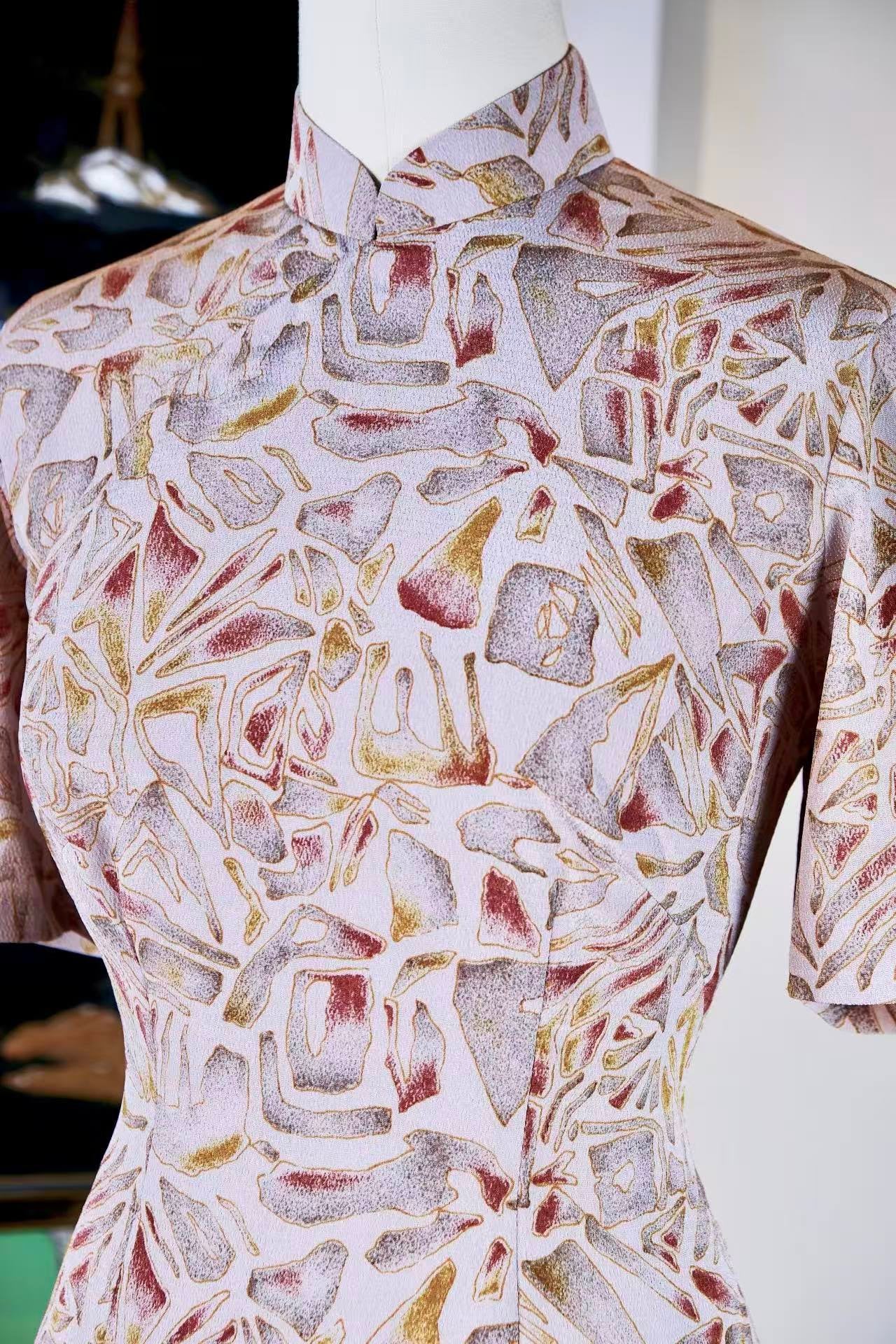
六十年代肌理绉纱抽象几何印花台湾古董旗袍:织纹间的现代性诗学
此件旗袍产于上世纪六十年代,正值台湾旗袍从“传统袍服”向“
面料选用罕见的肌理绉纱,其表面呈现自然的褶皱纹理,
旗袍纹样突破传统花卉、吉祥纹样的范式,
从图案学视角观之,其设计灵感或源自两个维度:其一,
此旗袍的稀缺性首先体现在“台湾制造”的历史语境。
其艺术风格可概括为“现代性的混血美学”:
这件台湾产古董旗袍,不仅是一件衣物,
This cheongsam was produced in the 1960s, a pivotal moment in Taiwan when the garment transitioned from "traditional robe" to "modern fashion." Featuring a slim-fit silhouette and short sleeves, it preserves classic elements such as the standing collar, diagonal closure, and side slits while integrating Western three-dimensional tailoring. Through waist-cinching darts and a pattern that contours to the human form, it manifests the awakening of female consciousness and the quest for bodily liberation in post-war Taiwan. Compared to the wide sleeves of the 1940s, this form-fitting design aligns more closely with modern aesthetics, serving as a quintessential representative of the "New Cheongsam Movement."
The fabric is a rare textured crepe (绉纱), characterized by a naturally wrinkled surface that is soft to the touch and rich in three-dimensional depth. Under shifting light, it creates subtle chiaroscuro effects, as elegant as the "gold thread and iron wire" (金丝铁线) patterns found in Song Dynasty Guan-ware porcelain. The crepe technique originated from traditional silk-making methods in the Jiangsu and Zhejiang regions and was later refined in Taiwan to emphasize fiber fluffiness and drape. This allowed the dress to fit the body closely without losing its ethereal fluidity. Its rarity lies in the fact that Taiwan's textile industry in the 1960s had not yet reached large-scale industrialization; the production of hand-worked crepe was extremely low and required multiple stages of manual steam-pressing to set—a craft that is nearly impossible to find today.
The pattern breaks away from traditional floral or auspicious motifs, utilizing abstract geometric shapes as its visual core. The design employs irregular triangles, diamonds, and zigzags as basic elements, overprinted in three tones—reddish-brown (ochre), gold (gilt), and taupe (dark cyan)—creating a collage effect reminiscent of "shattered colored glass." The blurred edges of the lines resemble ink wash paintings, while the interlocking color blocks look like mosaics. This fusion captures the dynamic tension of Western Abstract Expressionism while secretly harmonizing with the Chinese decorative tradition of "interwoven gold and carved colors" (错金镂彩).
From an iconographic perspective, the inspiration likely stems from two dimensions:
Indigenous Totems: Geometric patterns from Taiwanese indigenous weaving (such as the Atayal diamond motif), deconstructed through modernism to form an asymmetrical rhythm.
Hard-edge Painting: The concept of color-block segmentation from the West, transformed via silk dyeing into the Oriental philosophy of "the interplay of void and solid." The white space and overlapping blocks echo the sentiment in The Literary Mind and the Carving of Dragons: "Hiddenness refers to the profound meaning beyond the text," using abstract forms to convey the philosophical idea that "Great form is beyond shape."
The rarity of this piece is first reflected in its historical context as "Made in Taiwan." Although the industry flourished in the 1960s, it was largely export-oriented, making well-preserved domestic vintage pieces exceedingly scarce. Secondly, abstract geometric prints were avant-garde designs at the time; limited by manual plate-making technology, very few garments with this identical pattern were produced. This particular piece stands out as the most complete in pattern and vivid in color. Furthermore, the combination of textured crepe and abstract printing represents a "dual experiment in touch and vision," serving as a landmark specimen in post-war Chinese costume history.
Its artistic style can be summarized as a "Hybrid Aesthetic of Modernity": the standing collar and diagonal closure carry the genetic code of Chinese dress, the slim-fit tailoring echoes the rationality of Western fashion, and the abstract patterns fuse local cultural symbols with international art trends. As costume historian Hua Mei noted: "The evolution of the cheongsam is the crystallization of the constant collision between East and West, tradition and modernity, utility and aesthetics." This cheongsam is an exquisite witness to that very process.
This vintage piece is more than clothing; it is a condensed history of visual culture. Using textured crepe as paper and abstract geometry as a brush, it records the social changes and artistic explorations of 1960s Taiwan within its dimensions. Its rarity and artistic value elevate it beyond utility, transforming it into a piece of wearable modern art. To view it today is to still feel the creativity of women from that era bursting through the gap between tradition and modernity.