深圳溯源
Couldn't load pickup availability
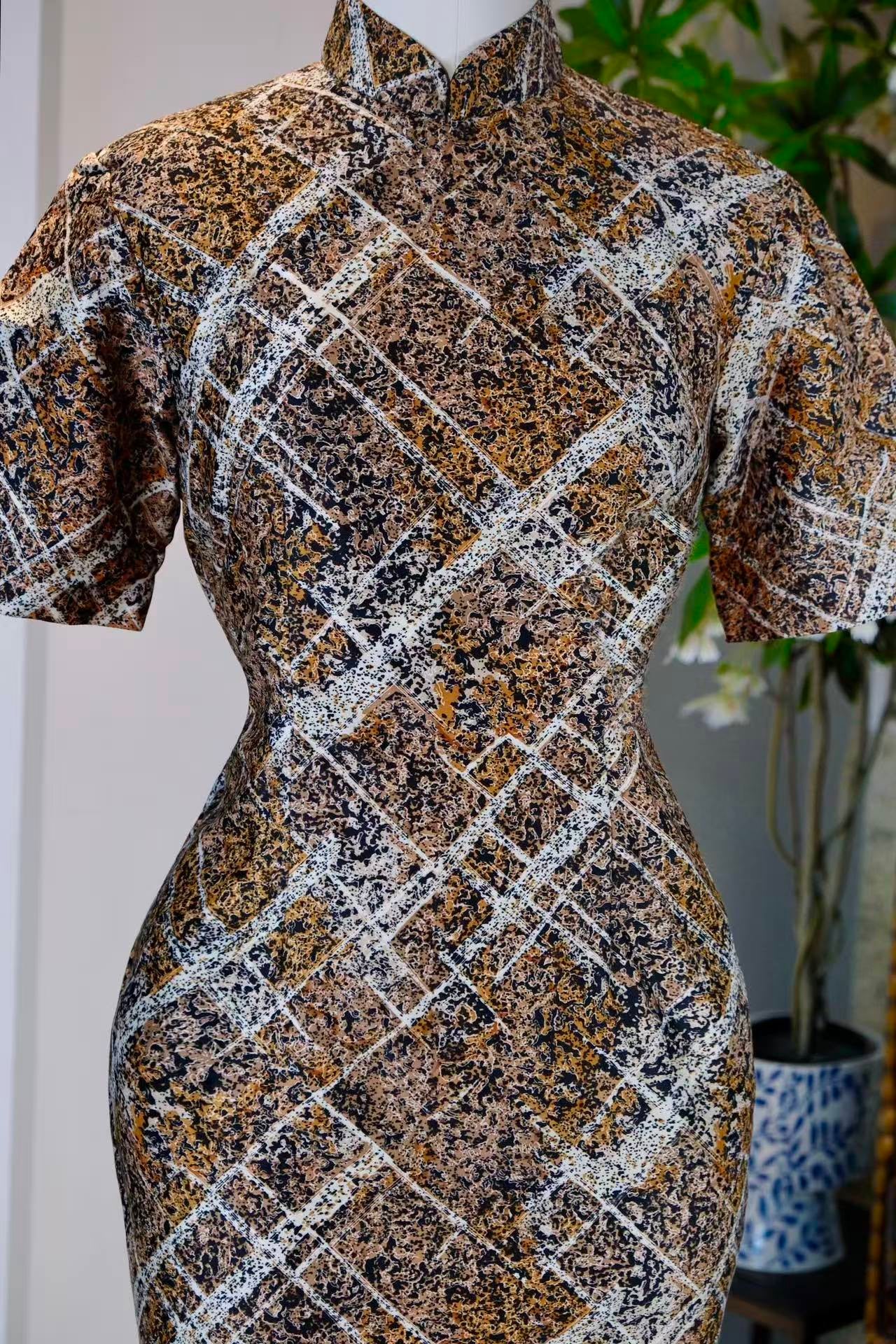
六十年代手作印染斜纹棉旗袍——墨金交织的时光密语
此件旗袍以斜纹棉为帛,施手工印染之技,经纬间凝六十年代风华,
其纹样以菱格为骨,却非刻板的几何复刻。
斜纹棉的肌理与手工印染的晕色相得益彰:棉质经年沉淀,
此袍更可视为六十年代台湾文化身份的物质见证:
藏此一袭,犹揽半部华服史:它既是手工印染技艺的活化石,
"Ink-wash textures meet the resilience of twill, capturing the essence of Taiwan’s mid-century craftsmanship."
This Qipao, crafted from twill cotton and adorned with manual discharge/resist dyeing techniques, encapsulates the elegance of the 1960s and the soul of Taiwanese heritage. The fabric’s texture evokes the seasoned quality of antique parchment; its brownish-yellows resemble autumn sunlight through trees, indigo blues mimic twilight valleys, and off-whites trace the patterns of frost. These are the natural graces of hand-dyeing: the dye permeates deep into the cotton fibers, creating a layered, bleeding effect that mechanical printing can never replicate. Every inch resonates with the warmth of the artisan’s touch and the silent maturation of time.
The pattern uses rhombic grids as its skeleton, yet it is far from a rigid geometric repetition. White lines delineate the intersecting warp and weft of the diamonds, while the dyed spots within resemble ink droplets on Xuan paper. The fusion of brown, black, and beige echoes the "xieyi" (freehand) spontaneity of Xu Wei’s Inky Grapes, while also channeling the misty landscapes of Northern Song painter Mi Fu’s "Mi-dot brushwork" (Mi Dian Cun). The grid lines and ink spots break conventional boundaries, subtly aligning with the I Ching philosophy of "Change leads to flow." This deconstructs traditional regularity into a modernist rhythmic flow—a textile vessel for the 1960s trend of "Modernizing Oriental Aesthetics."
The texture of the twill cotton complements the ethereal bleeding of the hand-dyeing. After decades of preservation, the cotton remains supple and resilient. The diagonal weave of the twill gives the surface a sophisticated matte luster, where the "breathing" of the fibers is visible through the varying depths of color. This quality—described as "texture like aged jade, glow like a gentle rainbow"—is the rare hallmark of antique cotton. During that era, Taiwan’s textile industry inherited the traditions of southern Fujian while integrating the essence of Japanese dyeing arts. Such hand-dyed twill, due to its complex and time-consuming process, is far rarer today than silk Qipaos—a true "feather of a phoenix" (Ji Guang Pian Yu) among mid-century textiles.
This garment serves as a material witness to Taiwan’s cultural identity in the 1960s. At a time when local designers were seeking their roots amidst the waves of Western modernism, they deconstructed traditional motifs like "splashed ink" and "ice cracks" into dyed patterns. By using the common medium of twill cotton to carry an elite aesthetic, they mirrored poet Yu Kwang-chung’s sentiment: "The modern is the reflection of the classical; the West is the echo of the East." To behold this robe today is to find the cultural nostalgia of the island’s intellectuals hidden within the mottled ink, and the survival wisdom of the handicraft industry within the intersecting grids.
To possess this piece is to embrace a microcosm of Chinese sartorial history. It is a living fossil of hand-dyeing techniques, a temporal specimen of twill cotton, and a microscopic slice of the 1960s Taiwanese cultural ecosystem. As fingertips brush against the weathered texture of the cotton, the ink bleeding within the grids seems to whisper: those spots soaked through by time are, in fact, the stubborn seals of Oriental aesthetics left during its modern transformation.