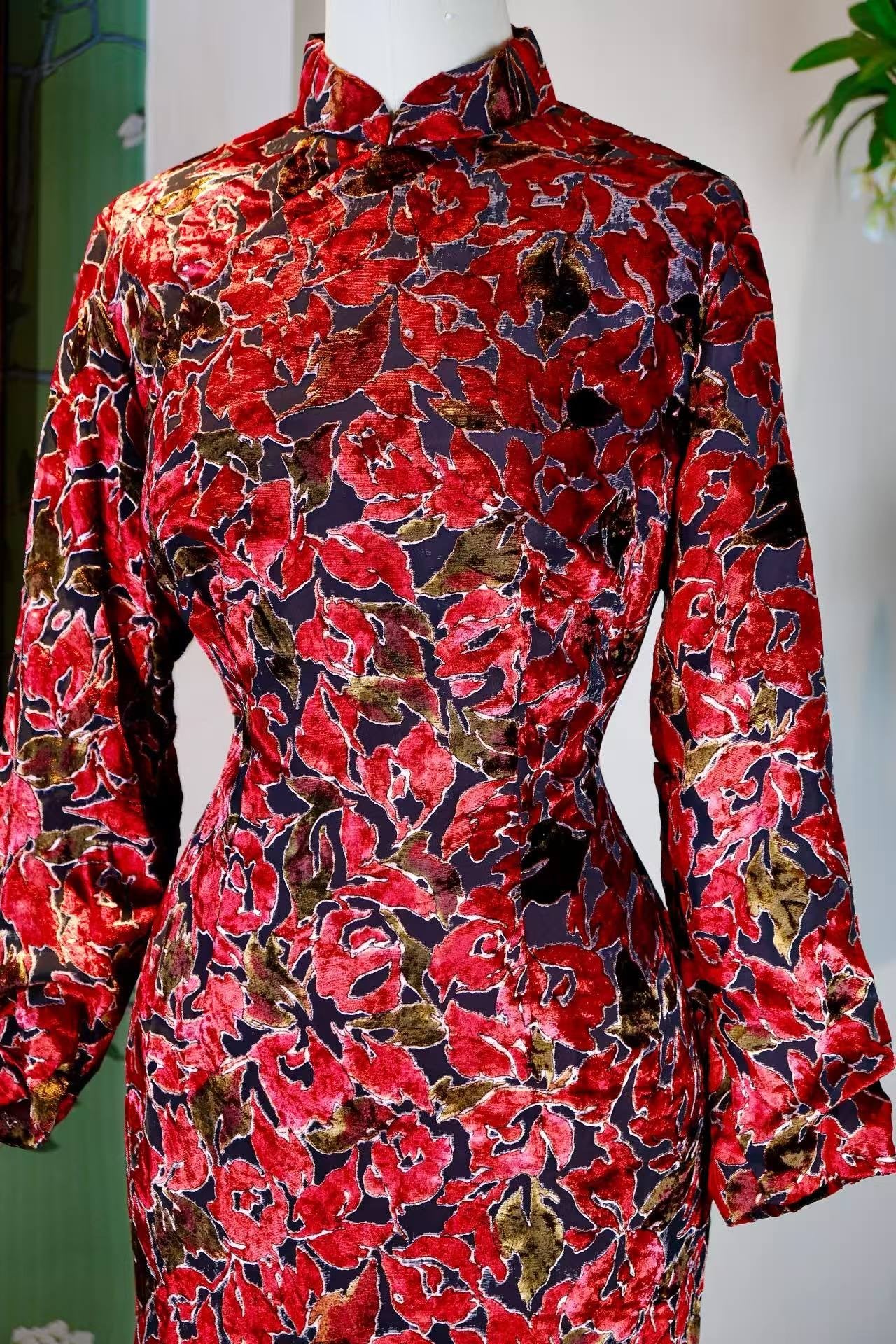
六十年代手绘晕染丝绒旗袍:香江锦绣里的东方主义诗学
“绒光浮暗香,泼彩醉香江。”这件香港制古董旗袍,以丝绒为帛,以晕染为笔,将岭南画派的写意美学与海派旗袍的曼妙身姿熔铸一体,堪称“布面上的泼彩山水”。其艺术价值与稀缺性,可从图案意境、工艺流脉与时代语境三重维度解码。
一、图案:泼彩花卉中的“虚实相生”
旗袍面料采用“泼彩晕染”技法,以酒红、绛紫为主色调,间杂金褐叶脉,构成“繁花不落”的视觉盛宴。设计师以“虚实相生”为美学内核:红色花卉似牡丹却又不具象,紫底如暮云沉坠,金褐叶脉如枯笔皴擦——恰似张大千《泼彩荷花》中“似与不似之间”的写意精神,又暗合岭南画派“折衷中西,融通古今”的艺术主张。花朵的边缘晕染模糊,如墨渍遇水自然晕开,这种“模糊性”打破了传统纹样的规整性,赋予面料流动的生命感,宛如将“落花依草”的诗意瞬间凝固于丝绒肌理之中。
二、工艺:香江匠艺与东方主义的邂逅
上世纪六十年代的香港,作为中西文化交汇的“东方之珠”,其制衣工艺兼具海派传承与南洋风情。此袍采用“手绘晕染丝绒”,以丝绒为底,以化学染料为墨,通过“多次罩染、局部晕色”工艺实现色彩的渐变与交融:丝绒的绒毛肌理使色彩呈现出“雾面光晕”效果,手绘的笔触痕迹若隐若现,每一寸都承载着匠人的呼吸节奏。相较于同期上海旗袍的“精细刺绣”,香港手绘旗袍更显自由奔放,这种“不完美之美”恰是手工艺术对抗工业化的最后倔强。
三、稀缺性:时代褶皱里的文化琥珀
六十年代的香港旗袍,正处于“传统旗袍”向“现代时装”转型的断层期:一方面,手绘晕染工艺因工序繁复(需先绘底稿、再分层罩染、最后固色),在七十年代后逐渐被印花布取代;另一方面,丝绒材质的娇贵(易勾丝、褪色)使得保存完好的古董品如凤毛麟角。此袍历经六十余载,绒面色泽依旧饱满,晕染图案无开裂,堪称“时间琥珀”——它不仅是一件旗袍,更是香港制衣黄金时代的缩影,是东方美学在全球化浪潮中的一次优雅回眸。
尾声:穿在身上的“岭南诗”
穿上它,仿佛听见六十年代香江码头的汽笛,看见霓虹灯下旗袍女子的回眸。那绒面上的泼彩花卉,是传统文人画的“墨戏”,也是现代都市的“霓虹”;是东方的,也是世界的。正如宗白华所言:“中国美学是‘虚实相生’的,于有限中见无限。”这件旗袍,正是将这份“无限”穿在了身上——它不属于任何时代,却又属于所有热爱美的时代。
1960s Hand-painted Ombré Velvet Qipao: Orientalist Poetics in Hong Kong Splendor
"Soft luster carries a hidden fragrance; splashed colors intoxicate old Hong Kong."
This Hong Kong-crafted antique Qipao uses velvet as its canvas and ombré painting as its brush, melting the freehand aesthetics of the Lingnan School into the graceful silhouette of the Shanghai-style Qipao. It is a "landscape of splashed colors on fabric," decodable through three dimensions: pattern imagery, craft lineage, and historical context.
I. Pattern: The "Symbiosis of Void and Substance" in Splashed Florals
The fabric employs a "splashed-color ombré" technique, dominated by wine red and crimson purple, interspersed with golden-brown leaf veins to create a visual feast of "everlasting blossoms." The core philosophy is the "Symbiosis of Void and Substance" (Xu Shi Xiang Sheng): the red flowers resemble peonies but remain non-representational; the purple base sinks like twilight clouds, and the golden-brown veins mimic the "dry brush" strokes of traditional calligraphy. It echoes Zhang Daqian's "Splashed Lotus"—the spirit of being "between likeness and unlikeness"—while aligning with the Lingnan School's mandate to "reconcile East and West." The blurred edges of the flowers break traditional regularity, endowing the fabric with a fluid vitality.
II. Craft: The Encounter of Hong Kong Artistry and Orientalism
In the 1960s, Hong Kong—the "Pearl of the Orient"—blended Shanghainese heritage with Southeast Asian flair. This piece features hand-painted ombré velvet, using chemical dyes as ink. Through multiple layers of shading and localized color-bleeding, a seamless transition is achieved. The velvet pile creates a "matte halo" effect, where the faint traces of the hand-painted brushwork carry the artisan's rhythmic breathing. Compared to the precise embroidery of contemporary Shanghai Qipaos, Hong Kong’s hand-painted versions are more liberated and bold—a "beauty of imperfection" that stands as a final defiance against industrialization.
III. Scarcity: Cultural Amber in the Folds of Time
Hong Kong Qipaos of the 1960s existed in a transitional rift between tradition and modern fashion. The hand-painting process—requiring sketching, layered shading, and color fixing—was gradually replaced by printed fabrics in the 1970s. Furthermore, the delicate nature of velvet makes pristine antique specimens as rare as phoenix feathers. Having survived sixty years with its pile intact and colors vibrant, this robe is a "Cultural Amber"—a microcosm of Hong Kong’s golden age of tailoring and an elegant backward glance of Oriental aesthetics amidst the tide of globalization.
Epilogue: A Wearable "Lingnan Poem" To wear it is to hear the steamboat whistles of 1960s Hong Kong and see the silhouette of a woman under neon lights. The splashed blossoms on the velvet are both the "ink-play" of traditional literati and the "neon" of a modern metropolis. As philosopher Zong Baihua said: "Chinese aesthetics finds the infinite within the finite." This Qipao drapes that very "infinitude" upon the body—it belongs to no single era, yet speaks to all who love beauty.