深圳溯源
Couldn't load pickup availability
衣服尺寸:
胸围/腰围/臀围:96/88/100 厘米
衣长:117 厘米
细节描述:
一、图案解码:当几何理性邂逅蕾丝浪漫
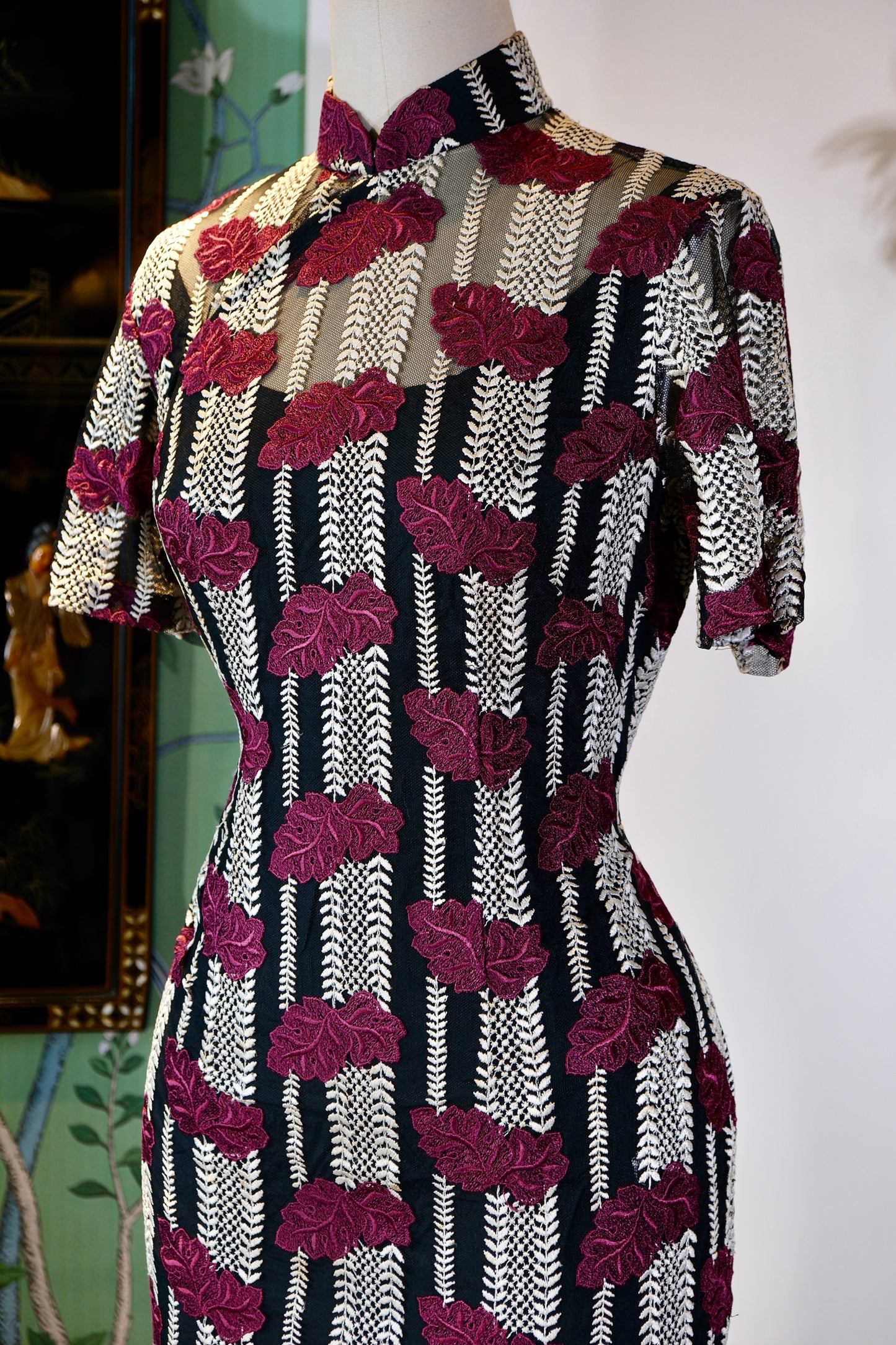
这件诞生于上世纪六十年代的香港旗袍,以机绣蕾丝为骨,织就了一幅“理性与感性共生”的视觉诗篇。裙身主体采用黑白几何条纹为底,细密的针脚勾勒出类似麦穗或蕨类叶片的重复纹样,既暗合中国传统“缠枝纹”的绵延意象,又融入西方装饰艺术运动(Art Deco)的几何秩序感——这种“中西合璧”的设计语言,正是六十年代香港作为东西方文化交汇港口的缩影。
而最摄人心魄的,是覆盖于几何底纹之上的酒红色立体蕾丝花卉。这些花卉以机绣工艺呈现,花瓣层叠如绽放的牡丹或芍药,边缘缀以细腻的镂空蕾丝,既保留了传统刺绣的精致,又因机械生产的精准而呈现出独特的“工业诗意”。更巧妙的是,领口与胸前的“挖胸”设计,以蕾丝的半透明质感打破传统旗袍的保守,既呼应了六十年代全球女性解放思潮,又以东方含蓄的方式诠释性感,恰如张爱玲所言:“旗袍是严谨的,但严谨里藏着放肆。”
二、时光故事:维多利亚港畔的“摩登旧梦”
六十年代的香港,正经历着从转口港到制造业中心的蜕变。这件旗袍的诞生,恰逢“香港制造”的黄金年代——彼时,本地纺织业引进先进缝纫设备,机绣工艺取代部分手工,既降低了成本,又让精致服饰走入中产女性衣橱。它或许曾属于一位在写字楼里敲击打字机的“职业女性”,或是参加赛马会的名媛,又或是穿梭于中环与铜锣湾的时尚弄潮儿。裙摆的每一道褶皱里,都藏着那个年代香港女性的独立与优雅:她们穿着它参加商务宴请,在维多利亚港的晚风里摇曳生姿;也穿着它出席家庭聚会,于推杯换盏间展现东方女性的温婉与自信。
三、艺术价值:稀缺性背后的文化密码
从艺术风格看,这件旗袍是“新中式”美学的早期范本。它打破了传统旗袍的单一纹样,将西方几何美学与中国传统花卉刺绣并置,形成“冲突中的和谐”——这种设计思路,比当代“国潮”早了半个世纪。而机绣蕾丝的运用,更体现了六十年代香港工艺的“过渡性”:既保留了手工的温度,又拥抱了工业化的效率,是研究“传统工艺现代化”的活态标本。
其稀缺性,则源于三重维度:
- 工艺稀缺:六十年代香港机绣蕾丝旗袍现存极少,彼时此类服饰多为出口或高端定制,留存至今者多为博物馆级藏品。
- 时代稀缺:挖胸设计是六十年代旗袍的“叛逆”特征,既不同于五十年代的保守,也异于七十年代的夸张,是特定时代的审美孤本。
- 文化稀缺:它见证了香港从殖民地到国际都市的身份转型,是“东方好莱坞”黄金年代的服饰注脚,承载着不可复制的城市记忆。
四、结语:穿在身上的历史叙事
这件旗袍,是时光的容器,也是文化的信使。它用几何条纹书写理性,用蕾丝花卉吟唱浪漫,用挖胸设计宣告觉醒,更用每一针每一线,缝合了六十年代香港的繁华与沧桑。正如本雅明在《机械复制时代的艺术作品》中所言:“真正的艺术品,总在复制中保留着独一无二的‘光晕’。”这件港产古董旗袍,正是带着这种“光晕”,从历史深处走来,等待新的主人,续写它的东方传奇。
Measurements / Size Guide:
Bust / Waist / Hips: 96/88/100 cm
Total Length: 117 cm
Detailed Description:
I. Decoding the Pattern: Where Geometric Rationality Meets Lace Romance
Born in 1960s Hong Kong, this Qipao uses machine-embroidered lace as its skeleton to weave a visual poem of "the symbiosis of reason and sensibility." The main body of the skirt features a black-and-white geometric striped base, with fine stitching outlining repetitive motifs resembling wheat ears or fern leaves. This design subtly echoes the continuous imagery of traditional Chinese "scrolling vine patterns" while integrating the geometric order of the Western Art Deco movement—a hybrid design language that serves as a microcosm of 1960s Hong Kong as a cross-cultural gateway.
The most soul-stirring element is the layered, burgundy-red 3D lace blossoms overlaid upon the geometric ground. Rendered through machine embroidery, the petals bloom like peonies or herbaceous peonies, fringed with delicate openwork lace. They preserve the exquisite nature of traditional embroidery while exhibiting a unique "industrial poetics" through mechanical precision. More ingenious is the "keyhole" (Wa-Xiong) cutout at the neckline and chest; the semi-transparent texture of the lace breaks the conservatism of traditional Qipaos. This echoes the global wave of women's liberation in the 1960s while interpreting sensuality through Eastern restraint, much like Eileen Chang’s observation: "The Qipao is austere, yet within that austerity lies wantonness."
II. Tales of Time: A "Modern Old Dream" by Victoria Harbour
Hong Kong in the 1960s was undergoing a metamorphosis from an entrepôt to a manufacturing hub. The birth of this Qipao coincided with the "Golden Age of Made in Hong Kong"—a time when the local textile industry introduced advanced sewing equipment, and machine embroidery replaced some manual labor. This lowered costs and allowed exquisite garments to enter the wardrobes of middle-class women. It might have belonged to a "career woman" typing away in a Central office, a socialite at the races, or a fashion trendsetter strolling through Causeway Bay. Every fold in the skirt hides the independence and grace of Hong Kong women of that era: they wore it to business banquets, swaying gracefully in the evening breeze of Victoria Harbour, and to family gatherings, radiating Eastern warmth and confidence amidst toasts.
III. Artistic Value: The Cultural Code Behind Scarcity
Artistically, this Qipao is an early prototype of "Neo-Chinese" aesthetics. It shatters the monolithic patterns of traditional Qipaos by juxtaposing Western geometric aesthetics with traditional Chinese floral embroidery, creating a "harmony within conflict"—a design philosophy that predated contemporary "Guochao" (China Chic) by half a century. The use of machine-embroidered lace reflects the "transitional" nature of 1960s Hong Kong craftsmanship: preserving the warmth of the hand while embracing industrial efficiency. It is a living specimen for studying the "modernization of traditional crafts."
Its scarcity stems from three dimensions:
Craft Scarcity: Very few 1960s Hong Kong machine-embroidered lace Qipaos survive today; at the time, such garments were mostly for export or high-end custom orders, with survivors often being museum-quality pieces.
Epochal Scarcity: The "keyhole" cutout is a rebellious feature of 1960s Qipaos, distinct from 1950s conservatism and 1970s exaggeration—a unique aesthetic relic of its time.
Cultural Scarcity: It witnessed Hong Kong’s identity transformation from a colony to an international metropolis, serving as a sartorial footnote to the golden age of the "Hollywood of the East" and carrying irreplaceable urban memories.
IV. Conclusion: A Historical Narrative Worn on the Body
This Qipao is a vessel of time and a messenger of culture. It writes rationality with geometric stripes, sings of romance with lace blossoms, and declares awakening through its cutout design. With every needle and thread, it stitches together the prosperity and vicissitudes of 1960s Hong Kong. As Walter Benjamin noted in The Work of Art in the Age of Mechanical Reproduction: "The genuine artwork always retains a unique 'aura' despite reproduction." This Hong Kong-made antique Qipao carries exactly such an "aura," emerging from the depths of history to await a new owner to continue its Eastern legend.