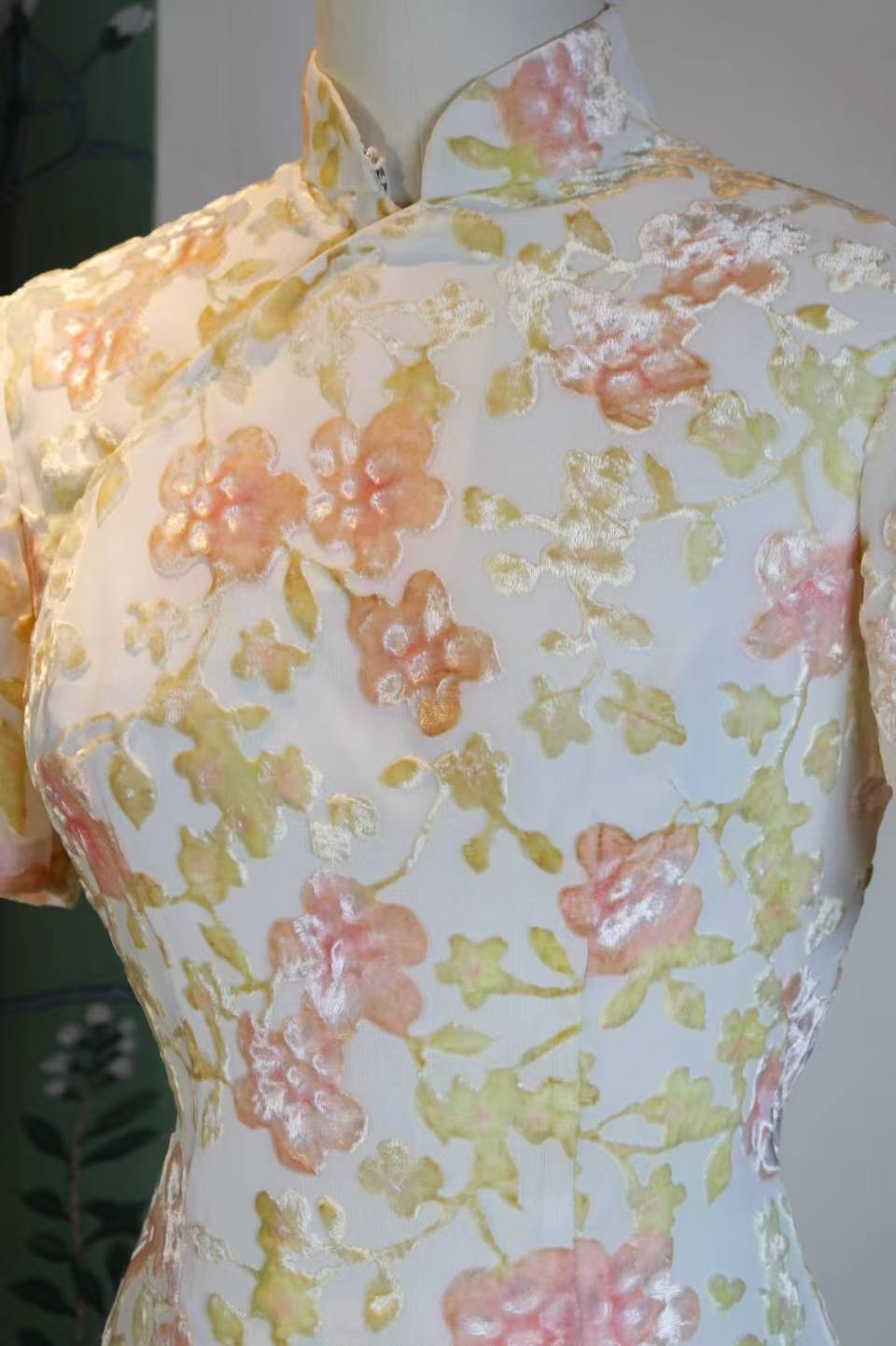
六十年代烧花丝绒手绘晕染台湾产古董旗袍
这件产自上世纪六十年代的台湾古董旗袍,其面料工艺堪称“时光雕琢的浮雕诗篇”。工匠用丝与棉混纺为底,织就立体花卉绒面,再以精密化学腐蚀工艺“烧花”,仅留花纹处绒毛,使衣身呈现“浮雕”般的视觉与触感——绒面生凉,肌理如岁月刻痕。更绝妙者,匠人以矿物颜料手绘晕染,技法承自宋代“没骨”画法,不勾轮廓,直以色彩浓淡干湿写物象,令花朵从鹅黄渐至绯红,如晨曦中初绽的海棠,娇嫩欲滴,似将时光凝于一瞬。
其图案采用“折枝花卉”纹样,摒弃传统满地铺陈,受西方现代主义美学影响,以“疏可走马”之留白,暗合中国画“气韵生动”之旨。花朵形态介于写实与写意之间,既有牡丹之雍容,又带桃花之俏丽;枝叶穿插灵动自然,如《诗经·小雅》所咏“常棣之华,鄂不韡韡”,在疏密间传递出生命的韵律。这种“西料中韵”的布局,恰是六十年代台湾服饰业在传统与现代间寻找平衡的缩影,如月映千江,各得其妙。
它非仅衣物,更是凝固的历史诗篇。当目光掠过晕染笔触与烧花肌理,仿佛见六十年代台湾女子着华服而立,于风云变幻中以从容姿态演绎东方优雅。如张爱玲所言“衣服是一种语言,随身带着的是袖珍戏剧”,这件旗袍便是那场“袖珍戏剧”的主角,在时光长河中,以静默之姿诉说着传统与现代的优雅碰撞,如月照花林,皆成幻影,却永恒动人。
此旗袍集烧花丝绒之工艺、手绘晕染之笔意、折枝花卉之风韵于一体,是六十年代台湾服饰艺术的巅峰之作。其稀缺性与艺术性,使其成为传世珍品——岁月留香,不止于衣,更在那凝固的时光与不朽的匠心之中。
1960s Taiwanese Antique Qipao: Burn-out Velvet with Hand-Painted Gradient
This 1960s antique Qipao from Taiwan features a fabric craft that can be described as a "sculpted poem in relief." Artisans utilized a silk-cotton blend as the base to weave a three-dimensional floral pile, then applied a precise chemical etching process known as "burn-out" (Devoré). By removing the pile except on the patterns, the garment achieves a visual and tactile "relief" effect—the velvet remains cool to the touch, with textures resembling the etchings of time itself. Most exquisitely, the artisan applied hand-painted gradients using mineral pigments, a technique inherited from the "Boneless" (Mogu) style of the Song Dynasty. Without outlines, the colors—ranging from primrose yellow to crimson—define the form through varying shades and moisture, resembling begonia blossoms freshly blooming in the morning mist, as if time itself were frozen in a singular moment.
I. Iconography: The Rhythm of Sparse Branches
The motifs employ "broken-branch floral" (Zhezhi) patterns, moving away from traditional dense layouts. Influenced by Western Modernist aesthetics, the design utilizes "vast white space" (Liubai) to align with the Chinese principle of "Vivid Resonance" (Qi Yun Sheng Dong). The floral forms sit between realism and abstraction, possessing the opulence of a peony yet the charm of a peach blossom; the branches interlace with a natural vitality reminiscent of the line from The Classic of Poetry: "The flowers of the cherry-tree, are they not gorgeous?" This layout of "Western Material with Oriental Charm" is a microcosm of the 1960s Taiwanese garment industry seeking a balance between tradition and modernity.
II. Historical Narrative: A Miniature Drama
This is more than a garment; it is a solidified historical poem. As one's gaze follows the painted strokes and etched textures, one can almost see a 1960s Taiwanese woman standing elegantly amidst a changing world. As Eileen Chang remarked: "Clothing is a language, a miniature drama one carries around." This Qipao is the protagonist of that miniature drama, silently narrating the graceful collision of tradition and modernity through the long river of time—like moonlight shining upon a flowering forest: a fleeting vision, yet eternally moving.
Conclusion: A Masterpiece of Craft and Soul
Combining the technical prowess of burn-out velvet, the poetic brushwork of hand-painted gradients, and the charm of broken-branch florals, this piece represents the pinnacle of 1960s Taiwanese sartorial art. Its scarcity and artistry make it a timeless treasure—the fragrance of the years lingers not just in the fabric, but in the frozen time and immortal ingenuity of the artisan.