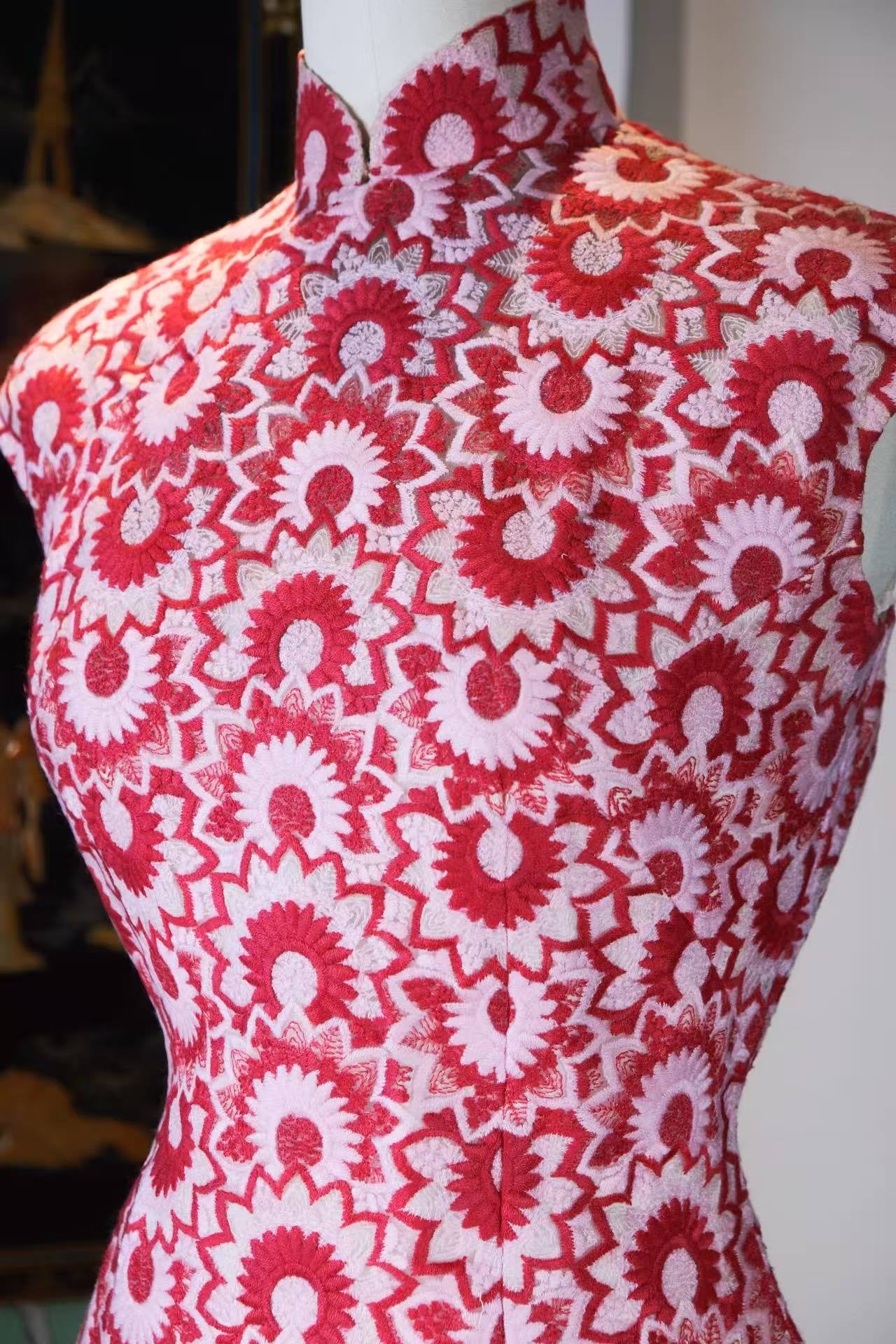
1960s Hong Kong Art Deco Machine-Embroidered Lace Qipao: A Poetics of Time and Lace
The Intersection of Form and Freedom As a frontier of East-West synthesis, Hong Kong’s qipao design in the 1960s preserved traditional elements—standing collars, sleeveless silhouettes, and form-fitting cuts—while embracing the geometric aesthetics of Art Deco. The crisp arc of the collar and the natural tapering of the waist not only inherit the elegance of the Republic era but also echo the re-examination of the female form during the 1960s liberation movement. The use of machine embroidery marks the collision between industrial production and traditional craftsmanship, ensuring that this garment retains a unique artistic texture even in the age of mass production.
The Geometry of Lace: Order and Rhythm The fabric features intricate geometric floral patterns created through machine-embroidered lace. The interlacing of red and white creates a powerful visual rhythm. The motifs are dominated by repetitive, radial blossoms with serrated edges and circular centers, following a strict symmetrical layout. This aligns with the ancient principle from the Rites of Zhou: "Using patterns as rhythm," abstracting natural forms into a beauty of order.
A Modernist Reconstruction of Tradition This geometric floral language is highly consistent with the core tenets of Art Deco—inspired by tribal arts and industrial mechanical aesthetics, emphasizing the dialectical relationship between straight lines and curves. The openwork lace technique subtly evokes the Chinese "Ice-Crackle" (Bingliewen) motif, reconstructing the Oriental philosophy of "Negative Space" (Liubai) through modern methods.
Conclusion: A Cultural Dialogue in Silk and Thread The rarity of this piece lies in its "dual crossover" historical value. It stands as a witness to the rise of Hong Kong’s garment industry. In the 1960s, Hong Kong qipaos conquered global markets through a model of "rapid iteration and Sino-Western fusion." The introduction of machine-embroidered lace was, in fact, a localized adaptation of French Chantilly lace techniques. To a collector, this garment is more than a physical relic; it is a transcript of a cross-cultural conversation that bridged East and West.