深圳溯源
Couldn't load pickup availability
衣服尺寸:
胸围/腰围/臀围:100/90/110 厘米
衣长:118 厘米
细节描述:
一、图案解构:暗夜里的“锦上添花”
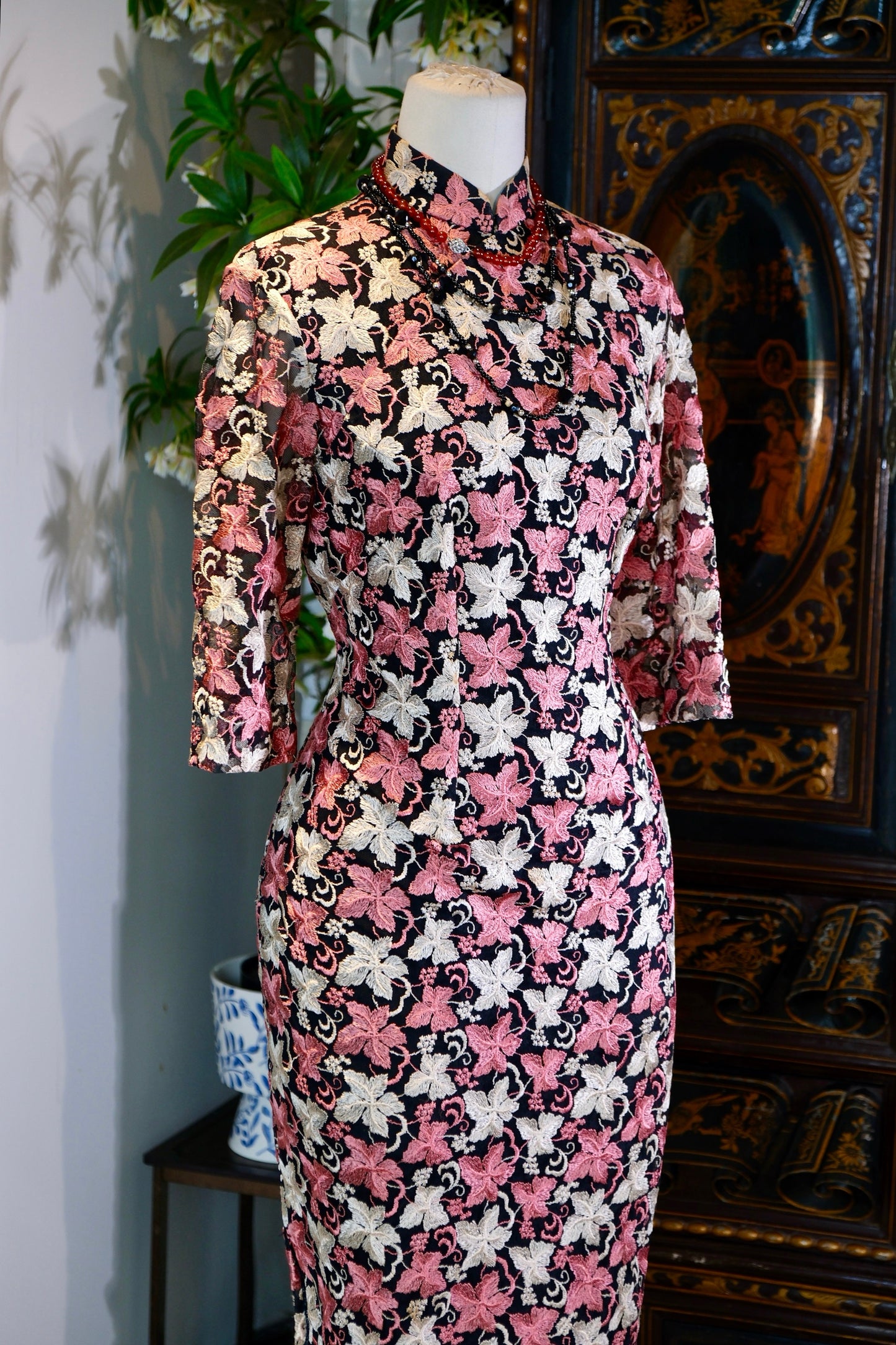
这件旗袍最摄人心魄之处,在于其纹样在黑色底色上的极致绽放。
- 底色与基调:以沉稳深邃的黑色蕾丝网底为基,如同静谧的夜空。这种黑色并非死寂,而是充满了包容性,它压住了所有浮躁,为上面的色彩提供了绝佳的舞台。在色彩心理学中,黑色代表着神秘、高贵与永恒,是那个年代成熟女性展现风韵的首选。
- 花卉主体:图案并非具象的写实花卉,而是经过高度艺术提炼的抽象花型。
- 形态:花朵呈五瓣或多瓣放射状,花瓣边缘带有锯齿状的刺绣肌理,显得锋利而立体。花型饱满,仿佛正在盛放。
- 色彩:运用了极为细腻的渐变刺绣工艺。从奶白色的清雅,过渡到柔粉色的娇嫩,再到深玫红色的浓郁。这种色彩在黑色底布上跳跃,宛如暗夜中盛开的繁花,既有“万绿丛中一点红”的视觉冲击力,又不失温婉。
- 藤蔓连结:所有的花朵被卷曲缠绕的藤蔓线条串联,这种构图方式源自中国传统纹样中的“缠枝纹”(又称万寿藤)。它生生不息、连绵不断的视觉效果,寓意着“生生不息,万代绵长”的美好祝愿。
二、古董衣的故事:海峡彼岸的工业美学
这件旗袍,不仅仅是一件衣服,它是上世纪六十年代台湾纺织工业崛起与中西文化交融的见证者。
- 时代背景:六十年代的台湾,正处于轻工业腾飞的初期。纺织业作为当时的经济支柱,开始引入先进的机器刺绣技术。这件旗袍正是这一技术变革的产物。它不同于三四十年代上海旗袍的纯手工刺绣,它展现的是一种“工业时代的精致”与“批量生产中的独特性”。
- 工艺解析:所谓的“机绣蕾丝”,在当时是一项极具现代感的工艺。
- 机绣的魅力:机器刺绣相比手工刺绣,线条更加均匀、针脚更加细密,且能呈现出立体感极强的浮雕效果。请注意看那花瓣的边缘,针脚细密如鱼鳞,这种高密度的刺绣在当年的机器上完成,需要极高的技术水准。
- 蕾丝底布:底布采用的是当时流行的化学纤维蕾丝,这种材质挺括、耐磨,且自带一种半透明的朦胧美感,是六十年代“摩登”的代名词。
- 穿着者的想象:我们可以想象,在1965年的台北某场晚宴上,或者是一场中秋赏月会上,一位穿着这件旗袍的女子,或许是一位归国华侨,或许是一位大学教授的家眷。她穿着这件衣服,优雅地穿梭在觥筹交错之间。这件衣服既有传统的东方韵味,又有当时西方流行的立体剪裁,完美地勾勒出了她曼妙的身姿。
三、引经据典:艺术与稀缺性的双重奏
- 美学风格:
- “墨分五色”:中国水墨画讲究“墨分五色”,而这件旗袍则是在黑色的底布上,用彩色的丝线绣出了繁花似锦。这种强烈的黑白对比与彩色点缀,极具现代艺术的构成感,同时也暗合了中国传统绘画中“计白当黑”的留白美学。
- “繁花似锦”:古人云“繁花似锦觅安宁”,这件旗袍上的繁花,象征着那个年代人们对于美好生活的向往与追求。在那个动荡的年代,这样一件衣服,是女性心中对和平与安宁的寄托。
- 稀缺性:
- 时代的绝响:随着七十年代成衣工业的进一步发展和八十年代快时尚的兴起,这种精工细作的机绣蕾丝旗袍逐渐退出了历史舞台。如今,想要找到一件保存完好、针脚整齐、色彩依然鲜艳的六十年代台湾产旗袍,实属不易。
- 工艺的不可复制:当年的机绣机器大多已被淘汰,这种特定的针法和蕾丝底布的质感,是现代机器难以完全复刻的。每一针每一线,都记录着那个时代的工业记忆。
结语:
这件旗袍,是历史的切片,是艺术的载体。它静静地立在那里,仿佛在诉说着那个年代的繁华与落寞,优雅与坚韧。拥有它,不仅仅是拥有了一件衣服,更是拥有了一段可以被触摸的历史。
Measurements / Size Guide:
Bust / Waist / Hips: 100/90/110 cm
Total Length: 118 cm
Detailed Description:
The most soul-stirring aspect of this cheongsam (qipao) is the exquisite blooming of its patterns against a profound black backdrop.
Base Color and Tone: Using a steady, deep black lace mesh as its foundation, it resembles a tranquil night sky. This black is not lifeless; it is full of inclusivity, suppressing all restlessness to provide a perfect stage for the colors above. In color psychology, black represents mystery, nobility, and eternity—the premier choice for mature women of that era to showcase their grace.
Floral Subjects: The motifs are not literal, realistic depictions but highly refined abstract floral forms.
Form: Flowers radiate in five or more petals, with serrated embroidered textures along the edges that appear sharp and three-dimensional. The blossoms are full, as if captured at the peak of their bloom.
Color: Utilizing an exceptionally delicate gradient embroidery technique. It transitions from the elegance of milk white to the tenderness of soft pink, and finally to the richness of deep fuchsia. These colors leap off the black fabric like blossoms in the night—possessing the visual impact of "red amidst a sea of black" without losing gentleness.
Vine Connections: All blossoms are linked by curling, winding vine lines. This composition stems from the "Intertwining Vine" (Chanzhi Wen) of traditional Chinese patterns. Its visual effect of endless vitality symbolizes the auspicious wish for "continuous life and eternal prosperity."
This cheongsam is more than a garment; it is a witness to the rise of Taiwan’s textile industry and the fusion of Eastern and Western cultures in the 1960s.
Historical Context: In the 1960s, Taiwan was in the early stages of a light-industrial boom. Textiles, as the economic pillar, began introducing advanced machine embroidery. This qipao is a product of that technological revolution. Unlike the purely handmade embroidery of 1930s Shanghai, it showcases a "precision of the industrial age" and "uniqueness within mass production."
Craftsmanship Analysis: The so-called "Machine-Embroidered Lace" was a highly modern craft at the time.
The Charm of Machine Embroidery: Compared to handwork, machine embroidery offers more uniform lines and denser stitches, capable of creating a strong relief effect. Note the petal edges—the stitches are as fine and dense as fish scales. Achieving such high-density embroidery on the machines of that era required peak technical proficiency.
Lace Base: The fabric utilizes chemical fiber lace, which was popular at the time for being crisp and durable, possessing a semi-transparent, hazy beauty—the very definition of "modern" in the 1960s.
The Wearer's Silhouette: One can imagine a lady at a 1965 Taipei gala or a Mid-Autumn moon-watching party. Perhaps she was a returned overseas Chinese or the wife of a university professor. Moving gracefully through the crowd, her garment combined traditional Eastern charm with the Western-influenced three-dimensional tailoring of the day, perfectly contouring her elegant silhouette.
Aesthetic Style:
"Five Shades of Ink": Traditional Chinese ink painting emphasizes "ink divided into five colors." This qipao uses colored silk threads to "paint" flourishing blossoms on a black "ink" base. This stark contrast between black and color possesses a modern sense of composition, while aligning with the "counting white as black" (Ji Bai Dang Hei) philosophy of traditional aesthetics.
"Flourishing Blossoms": Ancient poets spoke of finding peace amidst flourishing flowers. The blossoms on this qipao symbolize the era's longing for a beautiful life. In a time of social transition, such a garment was a woman’s vessel for peace and tranquility.
Scarcity:
The Swan Song of an Era: As the ready-to-wear industry advanced in the 70s and "fast fashion" rose in the 80s, these meticulously crafted machine-embroidered lace qipaos gradually exited the historical stage. Finding a 1960s Taiwanese specimen with such intact stitches and vibrant colors is now remarkably difficult.
Irreproducible Craft: Most of the embroidery machines from that period have been decommissioned. The specific stitching logic and the texture of that vintage lace are nearly impossible for modern machines to replicate perfectly. Every thread records the industrial memory of its time.
This cheongsam is a slice of history and a carrier of art. Standing silently, it speaks of the era’s prosperity and loneliness, its elegance and resilience. To own it is not just to possess a dress, but to hold a piece of touchable history.