深圳溯源
Couldn't load pickup availability
衣服尺寸:
胸围/腰围/臀围:106/96/112 厘米
衣长:116 厘米
细节描述:
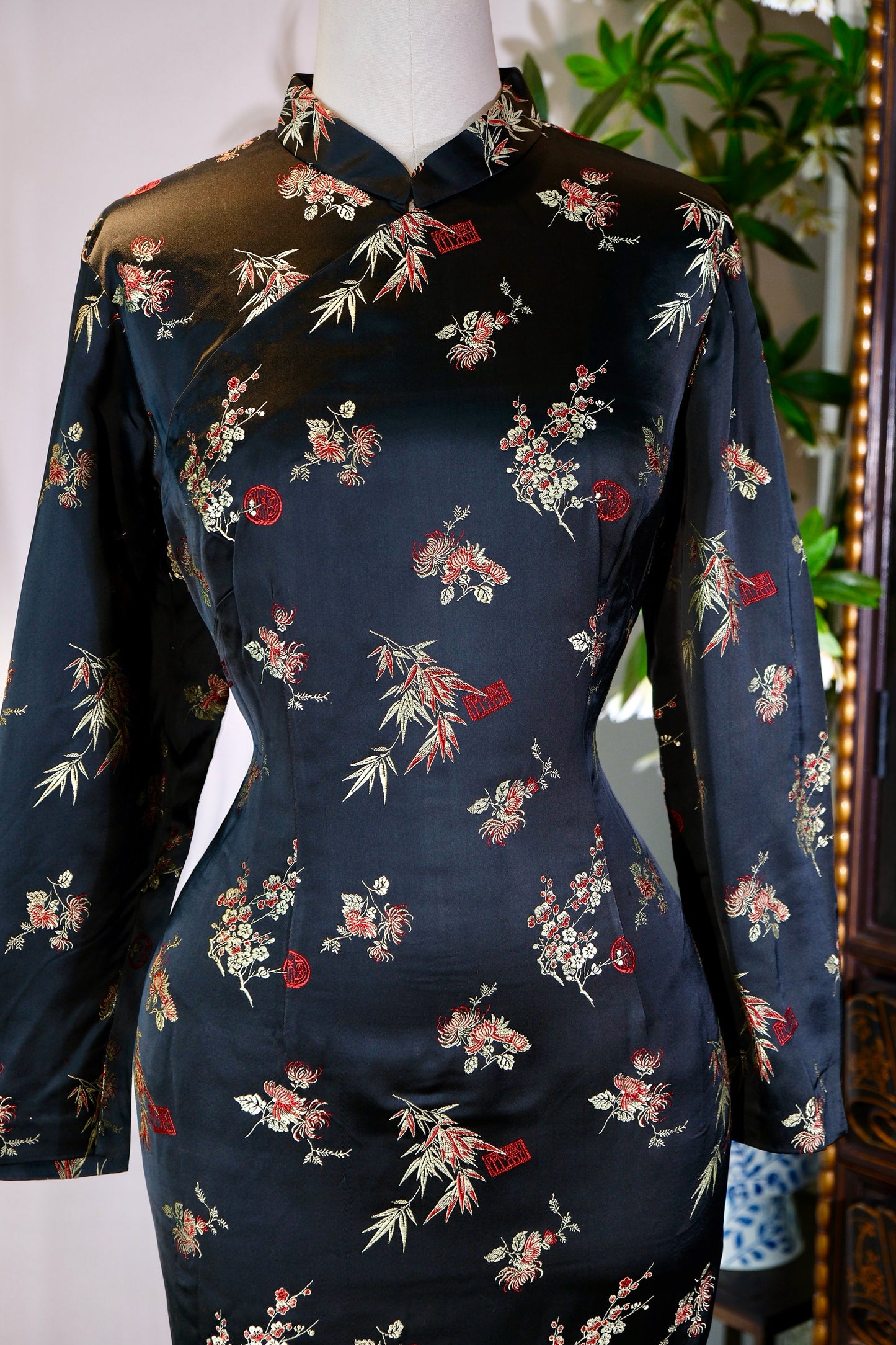
一、图案:岁寒三友与四君子的织锦对话
此袍以墨色织锦缎为底,缎面泛幽微光泽,如夜露凝于宣纸。其上提花纹样以“梅、竹、菊”为核心,间缀红色篆印,构成“岁寒三友”与“四君子”的意象交响:
- 梅:枝干虬曲如铁,花朵或含苞如朱砂点染,或绽放似玉雪裁成,红白相间,暗合“疏影横斜水清浅,暗香浮动月黄昏”(林逋《山园小梅》)的清绝。
- 竹:叶片以金线与墨绿丝线交织,竹叶如剑,疏密有致,似有“咬定青山不放松”(郑燮《竹石》)的风骨,与梅枝交错,形成“梅竹双清”的文人画境。
- 菊:花瓣层叠如金盏,或簇或散,暗合“宁可枝头抱香死,何曾吹落北风中”(郑思肖《寒菊》)的孤傲,与梅、竹共同构建“三友”之外的“四君子”补白。
- 篆印:红色篆印如“福”“寿”“吉祥”等,以朱砂色织入,既破墨底之沉,又添金石之趣,似文人画上的钤印,赋予织物以“书画同源”的雅意。
二、故事:香江织锦里的时光密码
此袍产自上世纪六十年代的香港,彼时大陆动荡,而香江成为传统工艺的“避风港”。织锦缎工艺源自明清江宁织造局,至民国时由苏州、杭州传入香港,结合本地丝织技术,形成“港工织锦”的独特风格——既保留江南的细腻,又融入南洋的明艳。
旗袍的剪裁为典型的“海派改良款”:立领微斜,襟线自右肩斜下至腰际,开衩及膝,腰身收束如“S”型,既承袭民国旗袍的曲线美,又适应香港湿热气候的透气需求。据考,六十年代香港中产女性常于茶楼、舞厅穿着此类旗袍,既是身份象征,亦是对传统文化的坚守。
三、艺术与稀缺:织机上的文人风骨
从艺术风格看,此袍堪称“织物上的文人画”。其图案布局借鉴“折枝花鸟”构图,梅枝斜出、竹影婆娑、菊丛错落,打破传统对称式纹样的呆板,暗合“计白当黑”的国画美学。织锦缎的“提花”工艺更需“千丝万缕”的匠心——每朵花需经数十根经纬线交织,竹叶的渐变色彩需换梭数十次,非熟练织工不能为之。
稀缺性则源于三重维度:
- 工艺濒危:现代机器印花取代手工提花,能织此等复杂纹样的老织机已不足百台,港产织锦缎旗袍存世量不足千件。
- 时代孤本:六十年代香港旗袍多为民国遗风的“最后辉煌”,此后成衣工业化浪潮席卷,手工定制旗袍渐成绝响。
- 文化符号:梅竹菊的组合,在文革时期被视为“封建残余”,而香港作为“文化飞地”,得以保存这一文人审美,使其成为特殊历史时期的“活化石”。
四、结语:衣以载道,锦以传心
此袍非衣,乃一卷织就的《岁寒图》。墨底如宣纸,梅竹菊如笔墨,篆印如题跋,穿着者行走间,便是“人在画中行”的古典意境。它承载着六十年代香港的文化记忆,也凝结着中国文人“比德于物”的精神追求——梅之傲、竹之坚、菊之洁,皆在丝缕间流转,成为可触摸的“东方美学标本”。
今观此袍,当知“衣冠载道”非虚言。每一道提花,都是时光的刻痕;每一抹色彩,都是文化的基因。它不仅是古董衣,更是一段“织在丝里的中国史”。
Measurements / Size Guide:
Bust / Waist / Hips: 106/96/112 cm
Total Length: 116 cm
Detailed Description:
This cheongsam (qipao) features an ink-black brocade base with a subtle luster, resembling night dew condensed on Xuan paper. The jacquard motifs focus on plum blossoms, bamboo, and chrysanthemums, interspersed with red seal imprints, creating a symphonic imagery of traditional Chinese botanical symbolism:
Plum Blossoms: The branches are as gnarled and powerful as iron. The blossoms appear either as budding cinnabar dots or full blooms like carved jade and snow. The contrast of red and white perfectly captures the ethereal beauty of "sparse shadows slanting across clear, shallow water; a dim fragrance floating in the moonlight at dusk."
Bamboo: The leaves are woven with interlaced gold and dark green silk threads. Sharp as swords and harmoniously spaced, they embody the integrity of "clinging firmly to the green mountain." Intertwining with the plum branches, they create a scholarly "Double Purity of Plum and Bamboo" painting style.
Chrysanthemums: The petals are layered like golden cups, clustered or scattered. They echo the noble isolation of "preferring to die with fragrance on the branch rather than be blown off into the north wind," serving as a "Gentlemanly" completion to the Three Friends of Winter.
Seal Imprints: Red seal marks such as "Blessing" (Fu), "Longevity" (Shou), and "Auspiciousness" (Jixiang) are woven in cinnabar hues. These break the somberness of the ink base and add the charm of epigraphy, endowing the textile with the elegant "unity of calligraphy and painting."
This garment was produced in 1960s Hong Kong, a time when the "Fragrant River" served as a "safe harbor" for traditional crafts during mainland turbulence. The brocade technique originated from the Imperial Weaving Bureau of the Ming and Qing Dynasties and was brought to Hong Kong via Suzhou and Hangzhou during the Republican era. Combined with local silk-weaving technology, it formed a unique "Hong Kong Brocade" style—preserving Jiangnan’s delicacy while incorporating the vibrancy of the South Seas.
The tailoring is a classic "Modified Shanghainese Style": a slightly slanted standing collar, a diagonal bodice line from the right shoulder to the waist, knee-length side slits, and an "S-shaped" silhouette. It inherits the curvilinear beauty of Republican-era qipaos while meeting the breathable needs of Hong Kong’s humid climate. In the 1960s, middle-class Hong Kong women wore such cheongsams to teahouses and ballrooms as symbols of status and cultural persistence.
Artistically, this robe is a "literati painting on fabric." Its layout draws from "broken branch" bird-and-flower compositions, with plum branches slanting out and bamboo shadows swaying, breaking the stiffness of traditional symmetrical patterns. The "jacquard" process requires immense ingenuity: each flower is woven from dozens of interlacing warp and weft threads, and the gradient colors of the bamboo leaves require shifting the shuttle dozens of times—a task impossible for anyone but a master weaver.
The scarcity arises from three dimensions:
Endangered Craft: Modern machine printing has replaced manual jacquard. Fewer than 100 old looms capable of weaving such complex patterns remain, and surviving 1960s Hong Kong brocade cheongsams number fewer than a thousand.
Temporal Uniqueness: 1960s Hong Kong cheongsams represent the "Final Glory" of the Republican style before the wave of garment industrialization rendered bespoke hand-tailoring nearly extinct.
Cultural Symbol: The combination of plum, bamboo, and chrysanthemum was once viewed as "feudal residue" elsewhere. Hong Kong, as a "cultural enclave," preserved this scholarly aesthetic, making this garment a "living fossil" of a specific historical period.
This is not merely a garment, but a woven scroll of the Winter Scene. The ink base is the paper, the plum, bamboo, and chrysanthemum are the ink, and the seals are the inscriptions. As the wearer moves, it creates the classical mood of "a person walking within a painting." It carries the cultural memory of 1960s Hong Kong and the spiritual pursuit of Chinese literati—the pride of the plum, the strength of the bamboo, and the purity of the chrysanthemum. It is a tangible "Specimen of Eastern Aesthetics."
Observing this robe, one realizes that "clothing as a vessel for the Dao" is no exaggeration. Every jacquard weave is a mark of time; every splash of color is a cultural gene. It is a piece of "Chinese history woven into silk."