深圳溯源
Couldn't load pickup availability
衣服尺寸:
胸围/腰围/臀围:100/90/108 厘米
衣长:104 厘米
细节描述:
一、衣上纹章:墨流染与金粟的共舞
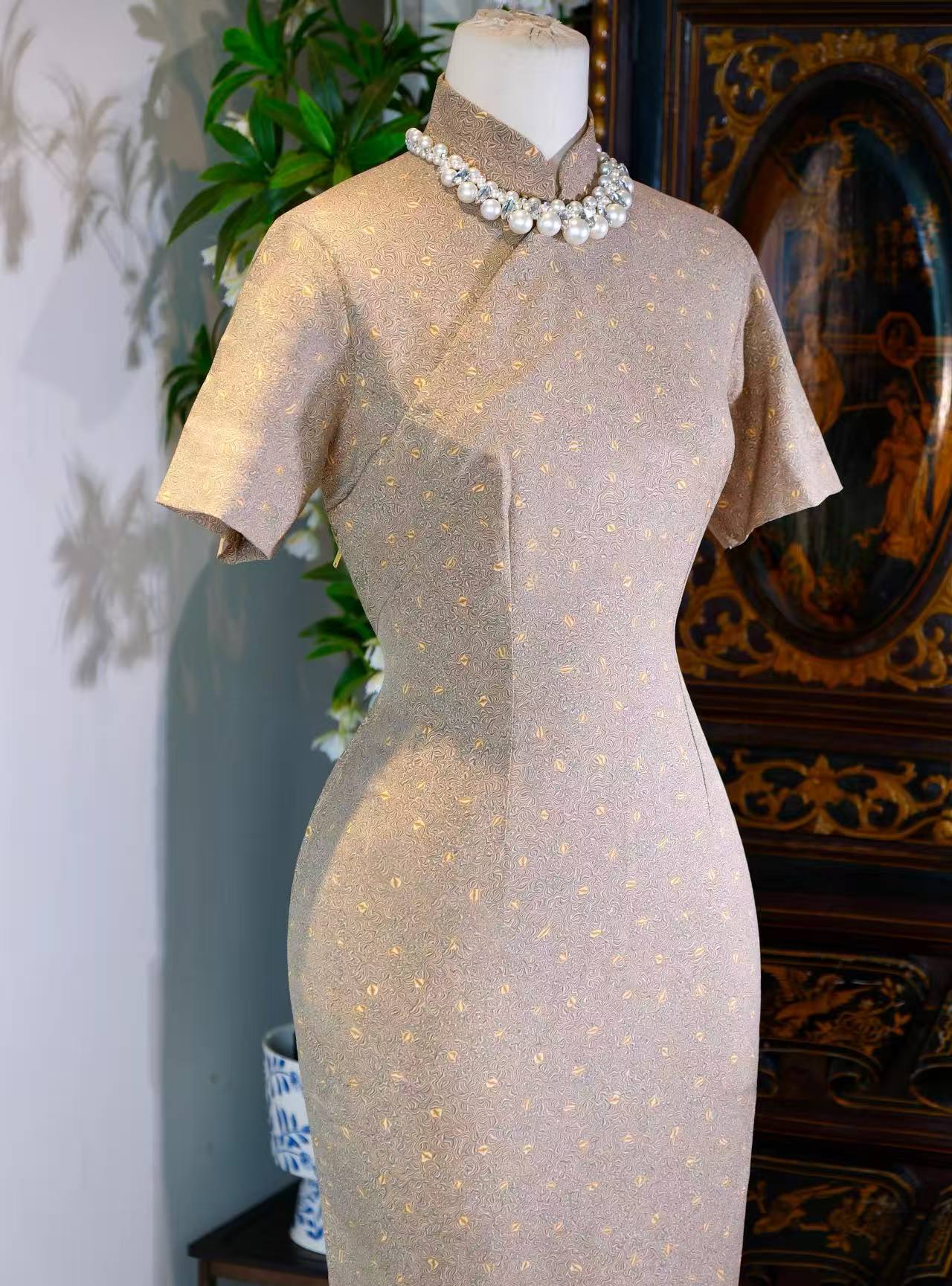
这件旗袍的图案,是传统工艺与文人审美的极致凝练。底布采用日本特有的墨流染工艺,以水墨晕染的流动感为基,似宣纸上未干的墨痕,又似江南烟雨中的朦胧水波,暗合宋代米芾“墨戏”之雅趣。其上密布的金粟纹(又称“雨丝纹”),以极细的米色丝线织就,如粟米散落,又似星子坠入墨池,在光影流转间若隐若现,既有《天工开物》所载“织金”的华贵,又含文人画“计白当黑”的留白意境。
墨流染的灰褐底色沉静如古玉,金粟纹的暖金光泽则如岁月沉淀的金箔,二者交织出“低调的奢华”——不似明清织金那般张扬,却暗合六十年代台湾社会从传统向现代转型的含蓄审美:既保留着对古典工艺的敬畏,又悄然融入现代设计的简约线条。
二、古董衣的故事:六零年台湾的“衣以载道”
这件旗袍诞生于1960年代的台湾,彼时正值战后经济复苏与文化重构期。台湾纺织业在日据时期积累的技术基础上,结合大陆迁台工匠的传统技艺,形成了独特的“台式旗袍”风格:既承袭海派旗袍的修身剪裁(如图中贴合身形的省道设计),又融入本土对舒适与实用性的追求(短袖、中长款便于日常活动)。
墨流染工艺的运用,更暗含时代隐喻。六十年代台湾知识分子阶层兴起“文化寻根”思潮,传统水墨艺术成为精神寄托,而将水墨意象转化为织物纹样,正是“衣以载道”的体现——穿着者不仅是展示服饰,更是在宣示对中华美学的坚守。据台湾纺织史学者考证,此类墨流染面料因工艺复杂(需手工晕染、多次套色)、产量极低,多用于定制旗袍,仅流通于政商名流或文化世家,堪称“行走的艺术品”。
三、艺术风格与稀缺性:时间淬炼的孤品
从艺术风格看,这件旗袍是“新古典主义”的典范:
- 形制:立领、右衽、短袖、收腰、中长摆,既保留旗袍的经典符号,又通过简洁的线条弱化传统旗袍的繁复装饰,符合六十年代国际时尚界“少即是多”的极简趋势;
- 纹样:墨流染的抽象水墨与金粟纹的几何秩序形成对比,暗合中国传统美学“和而不同”的哲学,与同时期西方抽象表现主义艺术形成跨时空对话;
- 工艺:面料的墨流染需手工完成,每匹布纹样皆独一无二,加之金粟纹的提花织造,对纺织技艺要求极高,如今此类工艺已濒临失传。
其稀缺性更体现在“时代标本”价值:六十年代台湾产旗袍存世量极少,而墨流染面料因染料配方与工艺失传,几乎成为绝响。这件旗袍不仅是一件衣物,更是研究战后台湾纺织史、服饰美学与社会文化的“活化石”——正如《考工记》所言:“天有时,地有气,材有美,工有巧,合此四者,然后可以为良。”它凝聚了特定时代的“天时、地气、材美、工巧”,是不可复制的历史馈赠。
四、结语:穿在身上的文化史诗
这件墨流染金粟纹旗袍,是六十年代台湾的时尚注脚,更是东方美学的物质载体。当指尖抚过那如水墨般流动的纹路,仿佛能触摸到那个年代的温度:知识分子在书房挥毫泼墨,纺织工匠在车间精心织造,名媛淑女在社交场合优雅转身……它以衣为媒,讲述着一段关于传承与创新、传统与现代的东方故事,而这样的故事,如今已成绝响,唯有这件古董衣,仍在时光中静静诉说。
Measurements / Size Guide:
Bust / Waist / Hips: 100/90/108 cm
Total Length: 104 cm
Detailed Description:
The pattern of this cheongsam (qipao) is a supreme distillation of traditional craft and literati aesthetics. The base fabric employs the unique Suminagashi (ink-wash marbling) technique, creating a sense of fluid motion akin to wet ink traces on Xuan paper or misty ripples in a Jiangnan rain—subtly echoing the "Ink Play" (Moxi) elegance of Song Dynasty master Mi Fu. Atop this base lies a dense field of "Golden Grain" motifs (also known as "Rain-thread motifs"), woven with exquisite beige silk threads. These patterns appear like scattered grains of millet or stars fallen into an ink pool, flickering amidst the shifting light and shadow. It possesses the opulence of the "woven gold" described in Tiangong Kaiwu, while retaining the "intentional void" (Ji Bai Dang Hei) found in literati paintings.
The taupe hue of the Suminagashi is as serene as ancient jade, while the warm glow of the Golden Grains resembles the gold leaf of weathered history. Together, they weave a "low-key luxury"—not as ostentatious as the woven gold of the Ming and Qing dynasties, but perfectly aligned with the understated aesthetics of 1960s Taiwan during its transition from tradition to modernity: a reverence for classical craft quietly merged with the minimalist lines of modern design.
This qipao was born in 1960s Taiwan, a period of post-war economic recovery and cultural reconstruction. Building upon the technical foundations laid during the Japanese colonial period and the traditional skills of master tailors from mainland China, a unique "Taiwanese Qipao" style emerged: inheriting the slim tailoring of the Shanghai style (seen in the dart designs that contour the body) while integrating local pursuits for comfort and practicality (short sleeves and mid-length cuts for daily movement).
The use of Suminagashi carries a profound metaphorical meaning. During the 1960s, a "Cultural Root-Seeking" movement rose among Taiwan’s intellectual class, where traditional ink art became a spiritual anchor. Translating ink-wash imagery into textile patterns was an embodiment of "Clothing as a Carrier of the Way" (Yi Yi Zai Dao)—the wearer was not merely displaying fashion but declaring a commitment to Chinese aesthetics. According to textile historians, such Suminagashi fabrics were extremely low-yield due to their complex, multi-layered hand-dyeing processes. They were mostly reserved for bespoke qipaos for the political and business elite or cultural families, truly earning the title of "walking works of art."
Artistically, this qipao is a paragon of "Neoclassicism":
Form: Featuring a standing collar, right-side closure, short sleeves, a cinched waist, and a mid-length hem, it retains classic qipao symbols while weakening redundant decorations through clean lines—aligning with the "Less is More" minimalist trend of the 1960s international fashion world.
Motif: The contrast between the abstract Suminagashi ink wash and the geometric order of the Golden Grains reflects the Chinese philosophy of "Harmony in Diversity," forming a cross-temporal dialogue with Western Abstract Expressionism of the same era.
Craft: The Suminagashi process must be completed by hand, making every yard of fabric unique. Coupled with the jacquard weaving of the Golden Grains, it demands the highest level of textile skill—crafts that are now on the brink of extinction.
Its scarcity is further emphasized by its value as an "era specimen." Very few 1960s Taiwanese qipaos survive today, and since the dye formulas and techniques for Suminagashi have largely been lost, this piece is nearly a swan song. It is a "living fossil" for researching post-war Taiwanese textile history and social culture. As Kao Gong Ji states: "Heaven has its seasons, Earth its vital energy, materials their beauty, and craftsmanship its ingenuity. When these four are combined, a fine work is born." This qipao condenses the unique "season, energy, beauty, and ingenuity" of its time.
This Suminagashi and Golden Grain qipao is a fashionable footnote of 1960s Taiwan and a material vessel for Eastern aesthetics. As your fingertips glide over the ink-like fluid lines, you can almost touch the warmth of that era: the intellectual painting in his study, the artisan weaving in the workshop, and the socialite turning gracefully at a gathering. It uses clothing as a medium to tell an Eastern story of heritage, innovation, and the dialogue between tradition and modernity—a story that has now become a rare echo, whispered silently by this vintage garment through the halls of time.