深圳溯源
Couldn't load pickup availability
“衣,德之共也;裳,德之贰也。”《左传》的古老训诫,
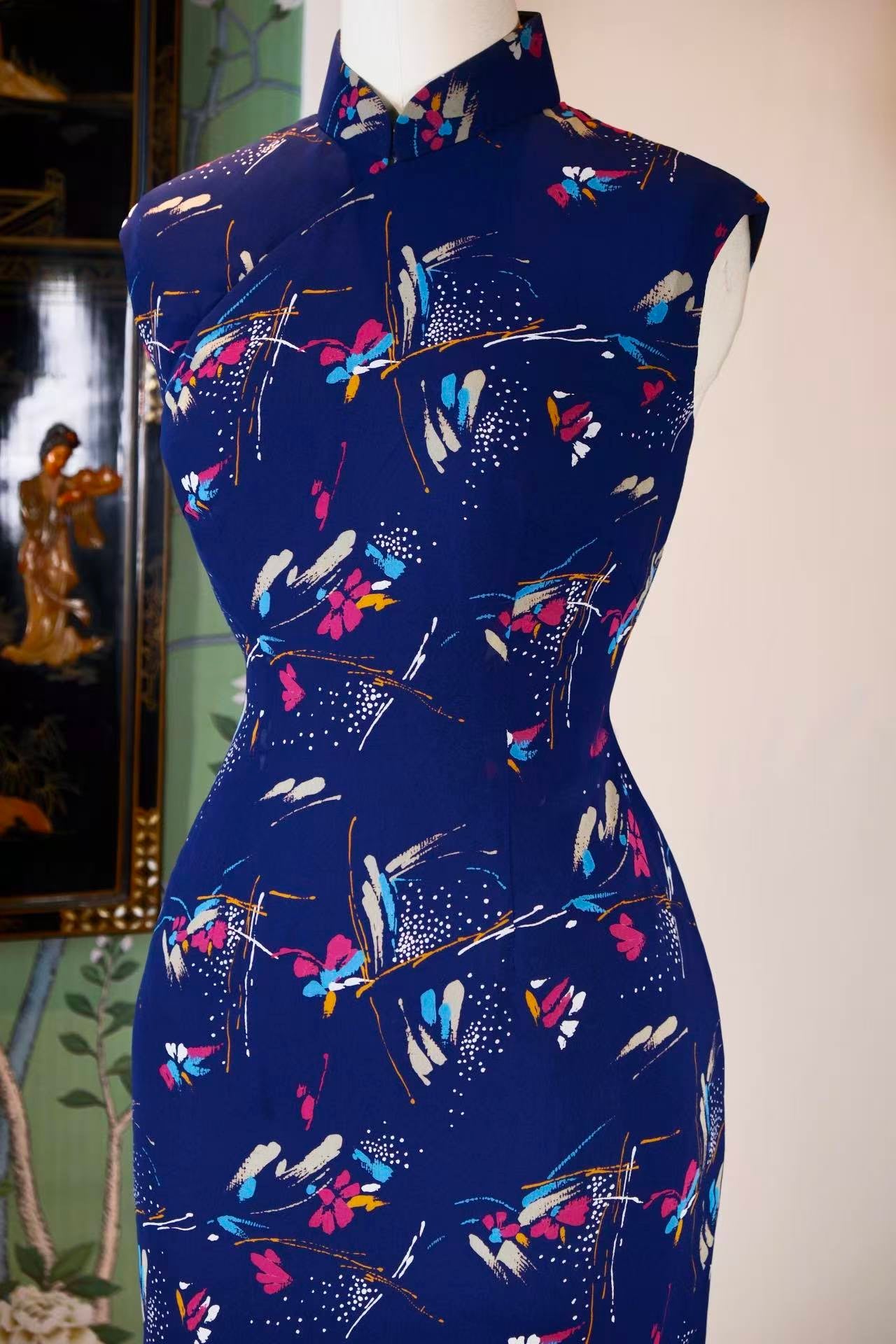
深邃如香江夜潮的墨蓝底色,是旗袍的留白 canvas。其上抽象印花以“似与不似之间”的东方美学为魂,
六十年代的香港,正处在中西文化激荡的十字路口。
存世六十余载,这件旗袍的面料仍保持着丝滑的光泽,印花未褪色,
“衣带渐宽终不悔,为伊消得人憔悴。”柳永的词,原是写相思,
A Poem of Oriental Modernism "Clothing is the manifestation of virtue." This ancient precept from the Zuo Zhuan finds a modern echo in this early 1960s Hong Kong antique qipao. Here, ink-blue depths and abstract prints engage in a breathtaking dance. More than a garment, it is a frozen frame of Oriental Modernist poetry, containing the mid-century stylistic codes of the Hong Kong peninsula.
The "Wild Cursive" of Fabric The deep ink-blue, reminiscent of the midnight tides of Victoria Harbour, serves as the qipao’s blank canvas. The abstract prints draw soul from the Oriental aesthetic of "likeness within unlikeness," yet they break free from the shackles of traditional botanical motifs. Splashes of fuchsia, azure, and primrose yellow sweep across the fabric like a swan skimming water; fine gold lines, sharp as seal-carving blades, outline a flowing rhythm. This composition of points, lines, and planes evokes the grand freehand style (Da Xieyi) of Wu Changshuo’s late works—finding order within chaos and ancient elegance within vibrancy. This is a modern reconstruction of traditional patterns: it inherits the unrestrained spirit of Ming and Qing literati painting while aligning with the improvisation and tension of Western Abstract Expressionism. It is, quite literally, "Wild Cursive calligraphy on a field of silk."
A Microcosm of the "East-West" Crossroads Hong Kong in the 1960s stood at the crossroads of cultural turbulence. This qipao’s abstract print is a perfect microcosm of that zeitgeist. Discarding the heavy embroidery of traditional styles, it utilized lighter, more contemporary printing techniques to wear "urban modernity" on the body. Imagine a woman in Central during that era: her hem brushing against tram tracks, the ink-blue reflecting the harbour lights, the abstract patterns shifting under neon signs. She was simultaneously the classical Eastern beauty and the mysterious "Modern Girl" of Western imagination. This is the rarest quality of Hong Kong antique qipaos—they represent the first wave in Chinese fashion history to actively embrace modernity without losing their Oriental core.
The Craftsmanship of the "Golden Decade" Having survived over sixty years, the fabric retains its silky luster, the prints remain vivid, and the tailoring stays true—a miracle for a pre-synthetic era. More importantly, it carries the genetic code of Hong Kong’s "Golden Decade" of garment making: the crispness of the high collar, the curve of the side slits, and the density of the piping all manifest the artisan's pursuit of the "perfect fit." This is not a mass-produced replica; it is a nameless artisan’s improvisation on beauty, a silent witness to Hong Kong's golden age as the "Hollywood of the East."
A New Modernity in Old Times "My belt grows loose, yet I do not regret it; for her, I pine away." Liu Yong’s famous lines on longing serve as the best footnote for the timeless beauty of this piece. It once belonged to a woman of peerless grace; now, it travels through time, condensing the moonlight, sea breeze, and neon of 1960s Hong Kong onto this ink-blue cloth. To collect it is to preserve a flowing history of Oriental modernity—a "New Modernity" found within old times. This is its irreplaceable and singular value.