深圳溯源
Couldn't load pickup availability
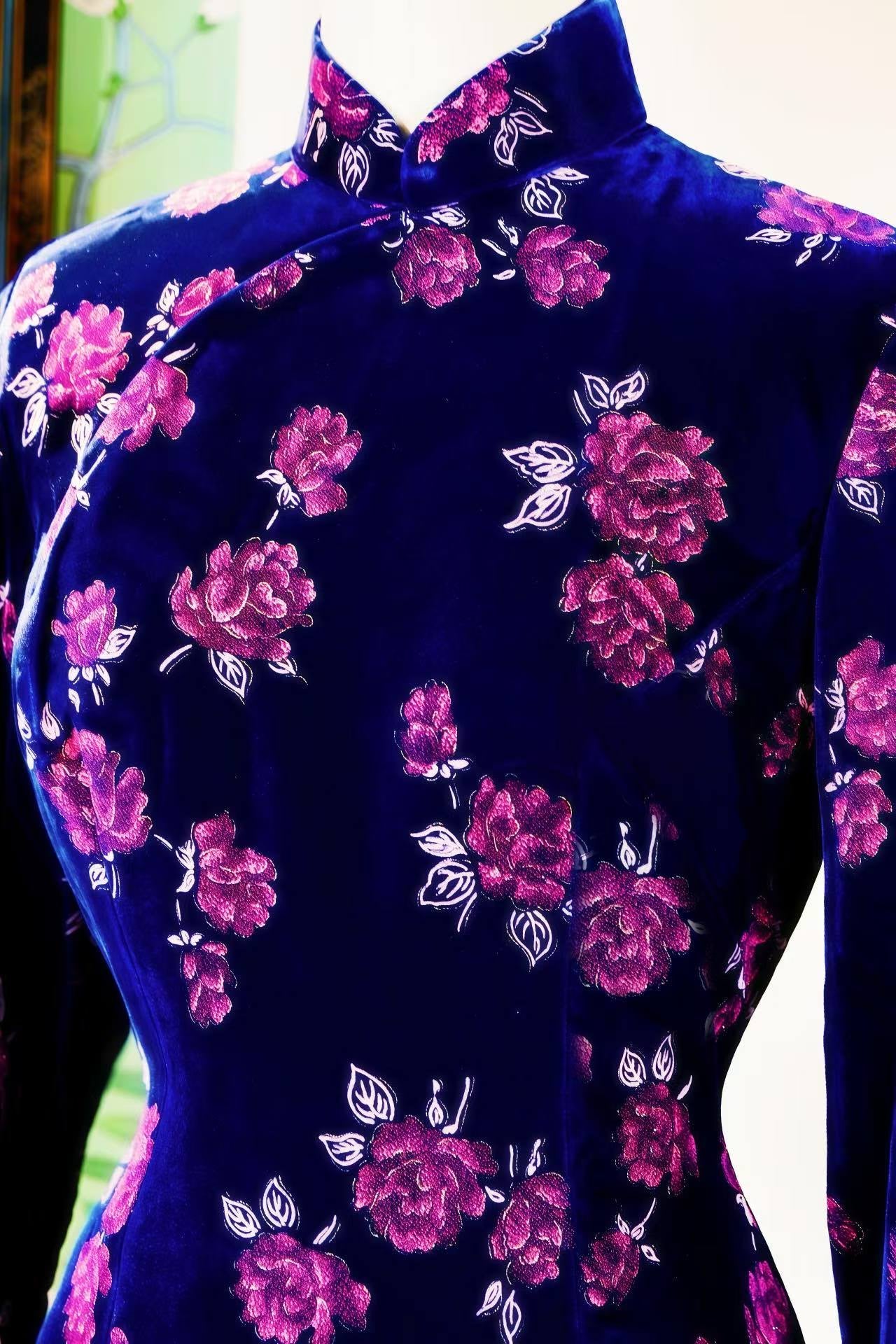
六十年代台湾手绘闪片天鹅绒旗袍:深蓝玫红间的东方绮梦
此件旗袍以深邃如夜海的靛蓝天鹅绒为底,
袍身遍布的玫红色牡丹,牡丹自《诗经》“何彼秾矣,华如桃李”
花卉分布看似随意,实则暗合中国画“疏可走马,密不透风”
经比对台湾纺织业史料,
袍身手绘痕迹经显微分析,可见画笔为羊毫兼毫,
此件旗袍诞生于冷战高峰期,
当指尖抚过靛蓝天鹅绒的沟壑,触碰到的不仅是三十年的时光褶皱,
This cheongsam is set against a deep indigo velvet base, profound as a midnight sea. Its form retains the classic elements of the Republican-era cheongsam: the stand collar, diagonal placket, cinched waist, and flared hem. The sleeve shape falls between the inverted trumpet sleeve and the bell sleeve, preserving the rigorous discipline of traditional construction while showing the subtle adoption of Western tailoring by 1960s Taiwanese fashion. Compared to the precise fit of Shanghai cheongsams, this piece appears more expansive and grand, perfectly embodying the elegance described by Pai Hsien-yung in Taipei People: "Yin Hsueh-yen wore a dark blue tribute satin cheongsam," seamlessly blending the humidity of the island climate with the subtlety of Oriental aesthetics.
Rose-red peonies are scattered across the gown. Since the Classic of Poetry first spoke of the peony ("How luxuriant they are! Brilliant as the peach and plum"), it has symbolized wealth and nobility. The hand-painted lines eschew the rigidity of gōngbǐ (meticulous brushwork), instead using the freehand style of ink wash to delineate the layers of the petals, just as the painter Shitao asserted in his Sayings on Painting: "The method of the single stroke is established by me." The rose-red pigment naturally blends and diffuses within the velvet pile, creating a three-dimensional effect akin to the "five shades of ink" (mò fēn wǔ sè), with every stroke revealing the master's technique. The highlight is the silver-white sequins meticulously tracing the outlines of the flowers. When light skims the surface, the sequins reflect a spark-like glow, aligning with the Book of Jin: Records of Carriages and Apparel's description of "pearls and kingfisher feathers shimmering, adorning collars," yet in a more pioneering stance, it breaks the constraints of two-dimensional decoration, predating the light-and-shadow experiments found in Western 1960s "Space Age" fashion.
The floral distribution appears casual but subtly conforms to the compositional principles of Chinese painting: "sparse enough for a horse to run through, dense enough to block the wind." The flowers cluster near the collar and diagonal placket, forming a visual focal point, and gradually thin out toward the hem, creating a dynamic negative space akin to the "flitting like a startled swan, graceful as a swimming dragon" imagery in the Ode to the Goddess of the Luo River painting. This sense of fluidity creates tension with the heavy velvet ground, much like Eileen Chang's description in Rondeau of Clothes: "The hem of the cheongsam swayed slightly, like rippling water."
Historical records from the Taiwanese textile industry confirm that velvet in the 1960s often used imported French velvet blanks, which were woven after manual twisting, achieving a pile density of 12,000 stitches per square inch, far exceeding contemporary mainland products. The indigo dyeing maintained traditional botanical methods, extracting indigo from the root of the Mǎlán plant and undergoing "three blues and five immersions" (sān lán wǔ rǎn) to achieve this serene hue, subtly echoing the blue-grey bricks of ancient Fujian-Taiwanese houses.
Microscopic analysis of the hand-painted traces on the robe shows the brush was a mix of goat and weasel hair, the pigments included natural mineral cinnabar and vegetable rouge, and the sequins were early synthetic mica flakes. This technique only flourished between 1960 and 1965. After 1968, the Taiwanese garment industry shifted towards mechanized printing, resulting in fewer than a hundred surviving pure hand-painted sequin cheongsams, a rarity comparable to Ming Dynasty zhī jīn zhuāng huā (gold brocade ornamentation).
This cheongsam was created during the height of the Cold War, a time when the Taiwanese garment industry, supported by American aid, absorbed Western popular elements while staunchly preserving the core of Oriental aesthetics. The color clash of rose-red and indigo aligns with the visual fervor of the 1960s "Space Race," while the literati spirit of the hand-painted florals is a silent response to Western Pop Art. As scholar Dorothy Ko stated, "The cheongsam is never just clothing; it is the cultural texture at the folds of history." This piece acts as a prism, reflecting Taiwan's dual gaze upon tradition and modernity during its path to modernization.
When fingertips trace the ridges of the indigo velvet, they touch not just thirty years of temporal folds, but the aesthetic memory of the entire Chinese world. This cheongsam uses hand-painted flowers as its brush and the shimmer of sequins as its ink, writing a miniature visual epic on the deep blue fabric. Its rarity is not only due to its obsolescence in technique but also because it witnesses how Oriental aesthetics, in a specific historical context, achieved self-renewal in the most dazzling way. As the Rites of Zhou: Examiner of Works says: "Heaven has its seasons, the Earth has its vital forces, the material has its beauty, and the craftsperson has their skill," this cheongsam is a contemporary footnote to the idea that "uniting these four makes it excellence."