深圳溯源
Couldn't load pickup availability
衣服尺寸:
胸围/腰围/臀围:114/106/116 厘米
衣长:114 厘米
细节描述:
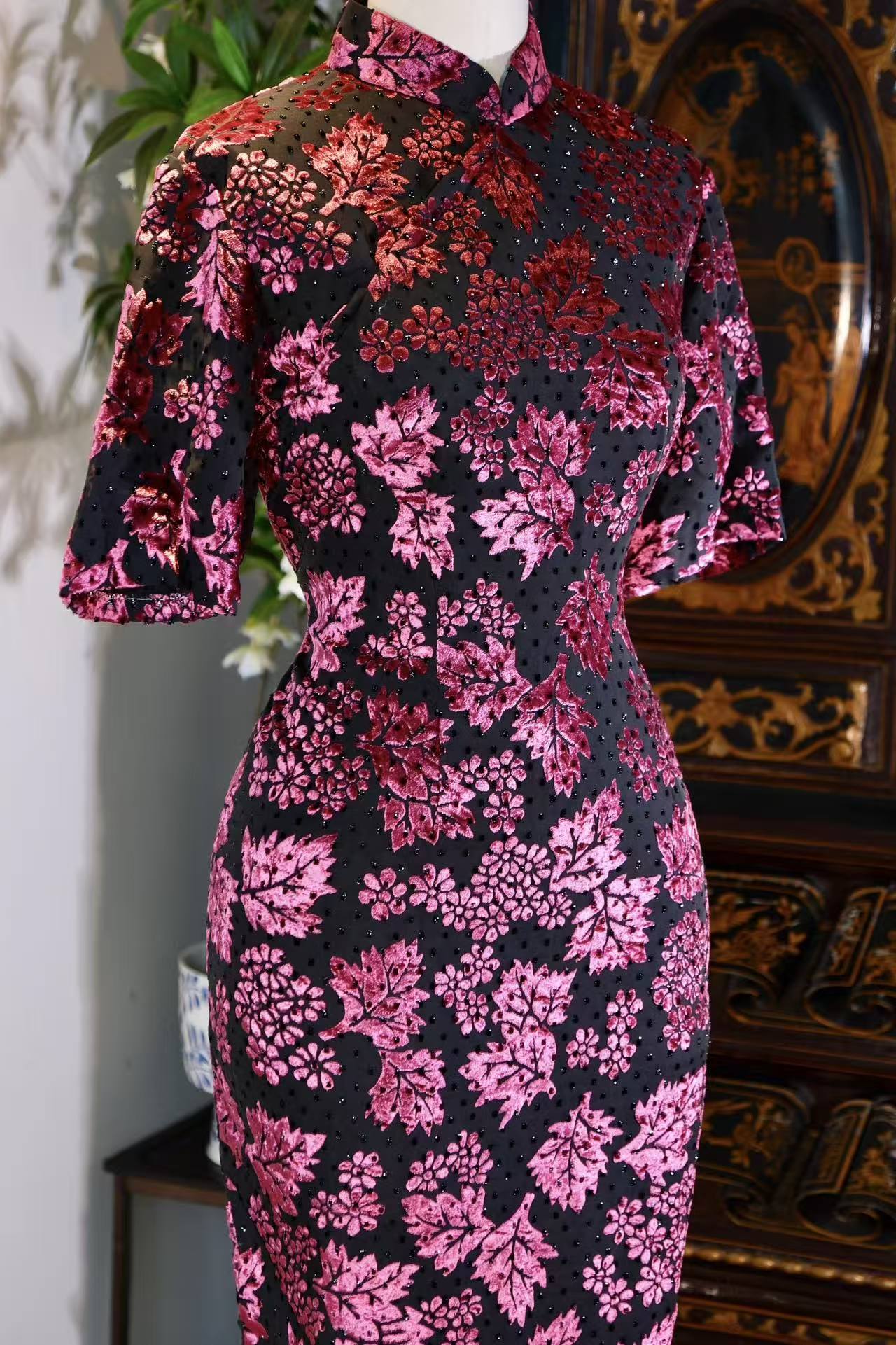
当指尖触碰到这袭旗袍的瞬间,仿佛能听见半个世纪前的时光在丝绒经纬间低语。这是一件诞生于上世纪六十年代台湾的烧花丝绒织金旗袍,它以暗夜为底,以繁花为墨,将传统工艺与时代审美熔铸成一件流动的艺术品,在岁月的长河中沉淀出不可复制的稀缺之美。
一、图案:暗夜繁花,灼灼其华
旗袍的底色是浓得化不开的玄黑,如同深夜的天鹅绒幕布,而粉紫与绛红的烧花图案便在这幕布上恣意绽放。烧花工艺以化学药剂蚀刻丝绒表层,使花纹呈现出浮雕般的立体感——叶片边缘带着手工剪裁的毛边质感,花瓣则如凝固的火焰,在光线下流转着丝绒特有的哑光与织金线的微芒。
图案主体为缠枝莲与秋菊的变体,莲叶舒展如掌,脉络清晰可见;菊花则层层叠叠,既有“采菊东篱下”的隐逸,又暗含“金英翠萼带春寒”的富贵。粉紫的渐变从花蕊向外晕染,似朝霞初升时的云翳,绛红则如晚霞沉淀的朱砂,两种色彩在黑底上碰撞出“万绿丛中一点红”的视觉张力,却因烧花工艺的柔和过渡而显得和谐典雅。更妙的是,织金线以隐纹方式穿梭于花叶之间,远看如星子点缀夜空,近观则见金线勾勒出花瓣的轮廓,恰似《天工开物》所言:“金缕绣罗襦,银丝穿宝髻”,将低调的奢华藏于细节之中。
二、故事:渡海遗珍,时代剪影
这件旗袍的故事,要从六十年代的台湾说起。彼时大陆旗袍工艺随移民渡海而来,与台湾本土的丝绒织造技术相遇,催生出独特的“台式旗袍”风格——既保留了海派旗袍的修身剪裁,又融入了海岛气候所需的透气面料。烧花丝绒本是欧洲传入的工艺,经台湾工匠改良后,以本土桑蚕丝为底,创造出更适合亚热带气候的轻薄丝绒,而这件旗袍正是这一技术融合的典型代表。
三、艺术风格:中西合璧,雅俗共赏
从艺术风格看,这件旗袍完美诠释了“中学为体,西学为用”的设计理念。立领、斜襟是典型的中式元素,立领高度恰到好处,既显脖颈修长,又符合传统“藏而不露”的审美;而修身剪裁则借鉴了西方立体裁剪技术,腰部的收省与臀部的放摆,精准贴合女性曲线,展现出“吴带当风”般的流动美感。
烧花工艺的浮雕感与织金线的金属质感,又为传统旗袍注入了现代艺术的抽象性。叶片与花朵的排列看似随意,实则暗合“疏可走马,密不透风”的构图法则,既有文人画的写意,又有装饰艺术的秩序感。这种“雅”与“俗”的平衡,恰如宗白华在《美学散步》中所说:“中国美学中的‘错彩镂金’与‘初发芙蓉’,本是一体两面。”这件旗袍正是将繁复的工艺与自然的意象融为一体,达到了“虽由人作,宛自天开”的境界。
四、稀缺性:工艺绝响,孤品难寻
如今,这样的烧花丝绒织金旗袍已近乎绝迹。烧花工艺因化学药剂的使用对工匠健康有害,早已被更环保的数码印花取代;而手工织金线更因成本高昂,在现代旗袍中难觅踪影。更难得的是,这件旗袍保存完好,丝绒未褪色,织金线未氧化——这得益于台湾潮湿气候下特有的防蛀处理工艺,如今已无人掌握。
在古董旗袍收藏界,六十年代台湾产旗袍本就稀缺,而烧花丝绒织金款更是凤毛麟角。它不仅是一件衣服,更是一部穿在身上的历史,一段凝固的时光。当我们在博物馆的玻璃柜中凝视它时,看到的不仅是粉紫与绛红的繁花,更是一个时代的风华,一种工艺的绝唱,一份跨越半个世纪的优雅邀约。
这袭旗袍,值得被珍藏,更值得被讲述——因为它不仅是过去的美,更是未来的诗。
Measurements / Size Guide:
Bust / Waist / Hips: 114/106/116 cm
Total Length: 114 cm
Detailed Description:
The moment my fingertips brush against this cheongsam (qipao), I can almost hear the whispers of half a century ago drifting through the warp and weft of the velvet. This is a 1960s Taiwanese-made Devoré velvet and gold-woven cheongsam—a piece that uses the darkness of night as its canvas and flourishing blooms as its ink. It melts traditional craftsmanship with the aesthetics of its era into a fluid work of art, distilling a rare, unrepeatable beauty from the river of time.
The base color of the cheongsam is a black so deep it feels inseparable—much like a midnight velvet curtain—upon which the Devoré patterns of dusty purple and crimson bloom with wild abandon. The Devoré (burn-out) technique uses chemical etchants to dissolve the velvet surface, giving the patterns a relief-like three-dimensionality. The edges of the leaves possess a hand-cut, raw texture, while the petals resemble solidified flames, shifting between the matte finish unique to velvet and the subtle shimmer of gold-woven threads under the light.
The motifs are variations of intertwining lotus and autumn chrysanthemums. The lotus leaves stretch out like palms with clearly visible veins, while the chrysanthemums are layered in clusters, embodying both the seclusion of "plucking chrysanthemums by the eastern fence" and the nobility of "golden petals and emerald calyxes braving the spring chill." The gradient of dusty purple bleeds outward from the pistils like clouds at sunrise, while the crimson settles like the cinnabar of a sunset. These two colors collide on the black base with the visual tension of "a single red amidst a sea of green," yet appear harmonious and elegant due to the soft transitions of the Devoré process. More exquisitely, gold-woven threads traverse the flowers and leaves as hidden patterns—from afar, they resemble stars dotting the night sky; up close, they outline the petals, hiding a low-key luxury within the details.
The story of this cheongsam begins in 1960s Taiwan. During this period, mainland qipao craftsmanship migrated across the sea with the people, meeting local Taiwanese velvet-weaving technology. This encounter gave birth to the unique "Taiwanese Cheongsam" style—retaining the slim-fit tailoring of the Shanghainese school while incorporating breathable fabrics suited for the island’s climate. Devoré velvet, originally a technique introduced from Europe, was refined by Taiwanese artisans using local mulberry silk to create a lighter velvet better suited for the subtropics. This cheongsam is a quintessential representative of that technical fusion.
Artistically, this cheongsam perfectly interprets the design philosophy of "Chinese essence with Western application." The standing collar and diagonal bodice are classic Chinese elements, with a collar height that accentuates a slender neck while adhering to the traditional aesthetic of "concealing rather than revealing." Meanwhile, the slim-fit silhouette draws from Western 3D tailoring, with precise waist darts and hip shaping that contour the feminine curve, exhibiting a fluid beauty reminiscent of "flowing ribbons in the wind."
The relief-like texture of the Devoré and the metallic feel of the gold threads inject a sense of modern abstract art into the traditional garment. The arrangement of leaves and blossoms appears casual but adheres to the compositional law of "sparse enough to let a horse run through, yet dense enough to block the wind," possessing both the freehand style of literati painting and the structural order of Art Deco. This balance between "high art" and "secular beauty" mirrors the words of aesthetician Zong Baihua: "The ornate and the natural are but two sides of the same coin in Chinese aesthetics."
Today, such Devoré velvet and gold-woven cheongsams are nearly extinct. The Devoré process has long been replaced by more eco-friendly digital printing due to the health hazards posed by the chemicals used; manual gold-weaving has also vanished from modern qipaos due to prohibitive costs. More remarkably, this cheongsam is impeccably preserved—the velvet has not faded, and the gold threads have not oxidized—thanks to a specific moth-proofing technique unique to Taiwan’s humid climate, a craft now lost to time.
In the world of antique qipao collection, 1960s Taiwanese pieces are already rare, but Devoré velvet and gold-woven models are truly "phoenix feathers and unicorn horns." It is not just a garment; it is a piece of history worn on the body, a moment in time solidified. When we gaze at it through a museum’s glass, we see not just the purple and crimson blooms, but the splendor of an era, the swan song of a craft, and an elegant invitation spanning half a century.