深圳溯源
Couldn't load pickup availability
衣服尺寸:
胸围/腰围/臀围:98/90/110 厘米
衣长:108 厘米
细节描述:
在时光的褶皱里,总有一些织物承载着超越衣饰本身的重量。这件上世纪六十年代产自台湾的粉紫色印花旗袍,便如一枚凝固的时光胶囊,将那个年代的审美意趣、工艺匠心与女性风韵,悄然封存于经纬之间。
一、图案:粉紫花影里的自然诗学
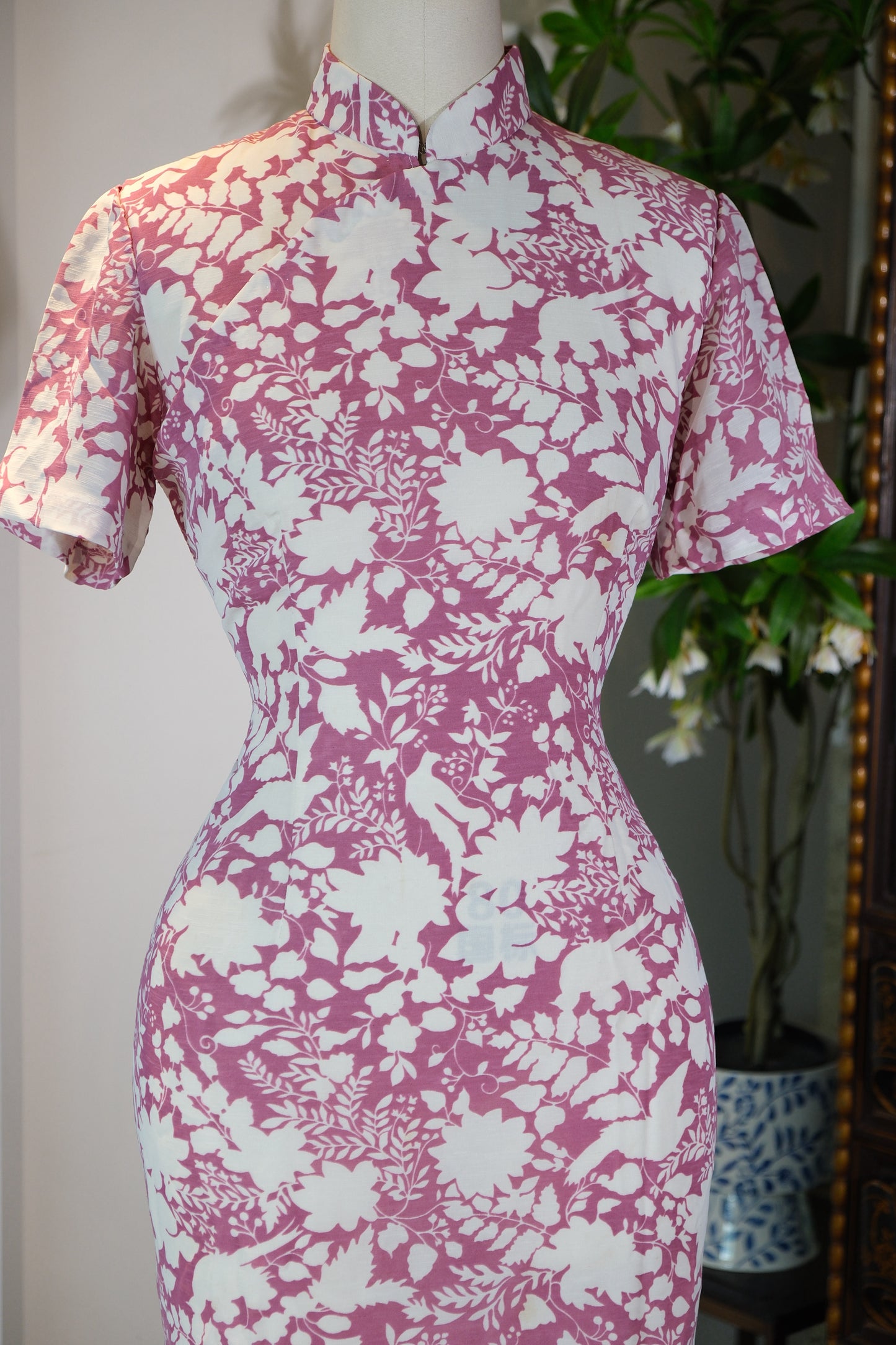
旗袍的底色是温柔的粉紫,如暮春时节的晚霞,晕染出朦胧的诗意。其上以白色为墨,绘就一幅繁而不乱的花鸟图景:牡丹与缠枝莲舒展盛放,花瓣层叠如云,枝叶蜿蜒似水,其间点缀着灵动的飞鸟,或栖于花枝,或振翅欲飞,仿佛下一秒便会啼破布面的静谧。这种“花间有鸟,鸟戏花间”的构图,深谙中国传统花鸟画“气韵生动”之妙,却又摒弃了宫廷织绣的繁复堆砌,以现代印花工艺的简洁笔触,勾勒出自然生灵的蓬勃生机。
粉紫与白色的色彩碰撞,既非传统旗袍的浓艳富贵,亦非素色旗袍的清冷孤绝,而是六十年代台湾社会转型期的审美隐喻——既有对传统“雅正”色彩的继承,又融入了现代女性对“清新”与“柔美”的追求。正如《考工记》所言:“天有时,地有气,材有美,工有巧”,这件旗袍的图案,恰是“天时”(时代审美)、“地气”(台湾地域文化)、“材美”(印花面料的细腻质感)与“工巧”(图案设计的疏密有致)的完美融合。
二、故事:海岛时光里的旗袍记忆
上世纪六十年代的台湾,正处于传统与现代的交汇点。旗袍作为女性日常着装的重要选择,既保留着民国时期海派旗袍的修身剪裁,又因应海岛气候与生活节奏,逐渐向“轻便化”“生活化”转变。这件旗袍的短袖设计、及膝长度,正是这一趋势的生动注脚——它褪去了长旗袍的庄重束缚,却保留了立领、斜襟等经典元素,让女性在行走间既能展露身姿的曲线美,又不失东方女性的含蓄韵致。
据考,六十年代台湾的纺织印染业正值发展期,本土印花面料开始大量应用于旗袍制作。这件旗袍的面料虽非苏杭丝绸的华贵,却以棉质或混纺的亲民质感,成为当时中产阶级女性的日常选择。或许它曾属于一位台北女教师,在教室与家之间穿梭;或许它曾陪伴一位台南商贾的妻子,出席过家庭聚会与节庆宴席。岁月在它的边缘留下些许泛黄的痕迹,却也让每一道褶皱都浸染了生活的温度——那是属于海岛女性的、带着烟火气的优雅。
三、艺术风格:传统纹样的现代转译
从艺术风格而言,这件旗袍的图案设计堪称“传统纹样现代转译”的典范。其花卉造型虽借鉴了明清织锦中的“缠枝莲”“宝相花”等经典纹样,却摒弃了传统纹样的对称规整,转而采用更为自由的“散点式”构图,让花叶与飞鸟在布面上自然生长,形成“满而不塞,疏而不空”的视觉效果。这种设计既呼应了六十年代国际流行的“自然主义”风潮,又暗合中国传统美学中“师法自然”的哲学思想。
更值得注意的是,图案中的飞鸟形象并非具象的工笔描绘,而是以简练的轮廓线条勾勒,颇有汉代画像砖“以形写神”的韵味。这种“写意”与“写实”的平衡,让旗袍在视觉上既具装饰性,又不失灵动性,恰如张爱玲所言:“旗袍是女性的第二层皮肤”,它不仅包裹身体,更承载着女性对美的想象与表达。
四、稀缺性:时光淘洗后的文化遗珍
在古董旗袍的收藏领域,六十年代台湾产旗袍因其“过渡性”与“地域性”,具有独特的稀缺价值。相较于民国时期海派旗袍的声名显赫,或当代新中式旗袍的创新迭代,六十年代台湾旗袍处于“承上启下”的位置——它既延续了民国旗袍的剪裁精髓,又为后来台湾本土服饰风格的形成奠定了基础。而本土印花面料的应用,更使其成为研究台湾纺织史与服饰史的重要实物资料。
此外,这件旗袍保存至今,品相完好,图案清晰,色彩未褪,实属难得。在时光的淘洗中,许多同时期的旗袍或因面料老化、或因款式过时而湮没无闻,而这件粉紫花影旗袍,却以它独特的艺术风格与历史价值,成为“时光的幸存者”。它不仅是衣橱中的古董,更是一段被织物铭记的历史,一种被针脚缝制的文化。
结语
当指尖抚过这件旗袍的布面,仿佛能触碰到六十年代台湾的微风——带着花香,带着海的气息,带着那个年代女性对生活的热爱与对美的执着。它不是一件冰冷的展品,而是一个有温度的故事,一首用色彩与线条写就的诗,一段关于时光、地域与女性的静默叙事。
在快时尚泛滥的今天,这样的古董旗袍更显珍贵。它提醒我们:真正的美,从不是转瞬即逝的潮流,而是经得起时光打磨的经典;真正的服饰,从不是简单的蔽体之物,而是承载文化、记忆与情感的精神容器。这件粉紫花影旗袍,便是这样一件容器——它装着过去,也映照着当下;它属于历史,也属于每一个懂得欣赏它的人。
备注:微瑕特价
Measurements / Size Guide:
Bust / Waist / Hips: 98/90/110 cm
Total Length: 108 cm
Detailed Description:
Within the folds of time, certain fabrics carry a weight that transcends mere clothing. This pink and purple printed Qipao, produced in Taiwan during the 1960s, acts as a frozen time capsule, quietly sealing the aesthetic tastes, craftsmanship, and feminine grace of that era within its warp and weft.
I. Patterns: Natural Poetics in Pink and Purple Floral Shadows The base color of the Qipao is a gentle pinkish-purple, like the twilight clouds of late spring, imbuing the piece with a hazy poetics. Upon this backdrop, white ink creates a bustling yet orderly scene of flowers and birds: peonies and lotus vines bloom in full splendor, their petals layered like clouds and branches meandering like water. Nimble birds are interspersed among them—some perched on branches, others poised for flight—as if they might break the stillness of the fabric with a chirp at any moment. This composition of "birds among flowers" masters the "vivid resonance" (Qi Yun Sheng Dong) of traditional Chinese bird-and-flower painting, yet discards the heavy accumulation of palace embroidery in favor of the concise strokes of modern printing, outlining the vigorous vitality of natural creatures.
The color collision between pink-purple and white is neither the intense opulence of traditional Qipaos nor the cold isolation of solid-colored ones. Instead, it is an aesthetic metaphor for Taiwan's social transition in the 1960s—inheriting traditional "refined and correct" colors while integrating the modern woman’s pursuit of "freshness" and "softness." As Kao Gong Ji (The Artificers' Record) states: "Heaven has its seasons, Earth has its Qi, materials have their beauty, and craftsmen have their skill." The pattern of this Qipao is the perfect fusion of the era's aesthetics, regional culture, the delicate texture of the fabric, and the rhythmic design.
II. The Story: Qipao Memories of Island Time Taiwan in the 1960s stood at the intersection of tradition and modernity. As a staple of daily wear, the Qipao retained the slim-fit tailoring of the Republic-era Haipai style while gradually shifting toward being "lightweight" and "lifestyle-oriented" in response to the island climate and pace of life. The short sleeves and knee-length cut of this piece are vivid footnotes to this trend—shedding the solemn constraints of long Qipaos while preserving classic elements like the standing collar and diagonal closure, allowing women to reveal their curves while walking without losing Oriental reserve.
Records show that Taiwan’s textile printing and dyeing industry was in a development phase during the 1960s, and local printed fabrics began to be widely used. While the fabric of this Qipao may lack the luxury of Suzhou or Hangzhou silk, its accessible cotton or blended texture made it a daily choice for middle-class women of the time. Perhaps it belonged to a Taipei schoolteacher or the wife of a Tainan merchant. Time has left faint yellowing on its edges, yet it has also imbued every fold with the warmth of life—an elegance belonging to island women, tinged with the scent of everyday reality.
III. Artistic Style: Modern Translation of Traditional Motifs In terms of artistic style, the pattern design is a model of "modern translation of traditional motifs." While the floral forms borrow from classic patterns like "lotus vines" found in Ming and Qing brocades, they discard symmetrical regularity in favor of a more spontaneous "scattered" composition. This allows flowers, leaves, and birds to grow naturally across the fabric, creating a visual effect that is "full but not congested, sparse but not empty." This design echoes the international "Naturalism" trend of the 1960s while aligning with the Chinese philosophy of "learning from nature."
Notably, the bird imagery is not a concrete fine-brush depiction but is outlined with concise lines, reminiscent of the "using form to depict spirit" charm of Han Dynasty pictorial bricks. This balance between "freehand" and "realism" makes the Qipao both decorative and dynamic. As Eileen Chang said, "The Qipao is a woman’s second skin"; it does not just wrap the body, but carries her imagination and expression of beauty.
IV. Rarity: A Cultural Treasure Refined by Time In the field of antique Qipao collection, 1960s Taiwanese Qipaos possess unique rarity due to their "transitional" and "regional" nature. Compared to the fame of Republic-era Haipai Qipaos or the innovation of contemporary New Chinese Style, these pieces occupy a "link between past and future"—extending the tailoring essence of the Republic while laying the foundation for Taiwan’s local sartorial style. The use of local printed fabrics makes it vital physical evidence for studying Taiwan's textile and costume history.
Furthermore, this Qipao has survived in excellent condition with clear patterns and unfaded colors. Amidst the sifting of time, many contemporary pieces were lost to fabric aging or outdated styles, yet this "Pink & Purple Floral Shadows" Qipao stands as a "survivor of time." It is not just an antique in a wardrobe, but history recorded by fabric and culture sewn by stitches.
Conclusion When fingertips brush against the fabric, one can almost feel the breeze of 1960s Taiwan—carrying the scent of flowers, the sea, and the era's devotion to beauty. It is not a cold exhibit but a warm story, a poem written with color and line. In today's world of fast fashion, such an antique Qipao is even more precious. It reminds us that true beauty is not a fleeting trend but a classic that withstands the polishing of time. This Qipao belongs to history, and to everyone who knows how to appreciate it.
PS:‘AS IS’ condition - Special Offer