深圳溯源
Couldn't load pickup availability
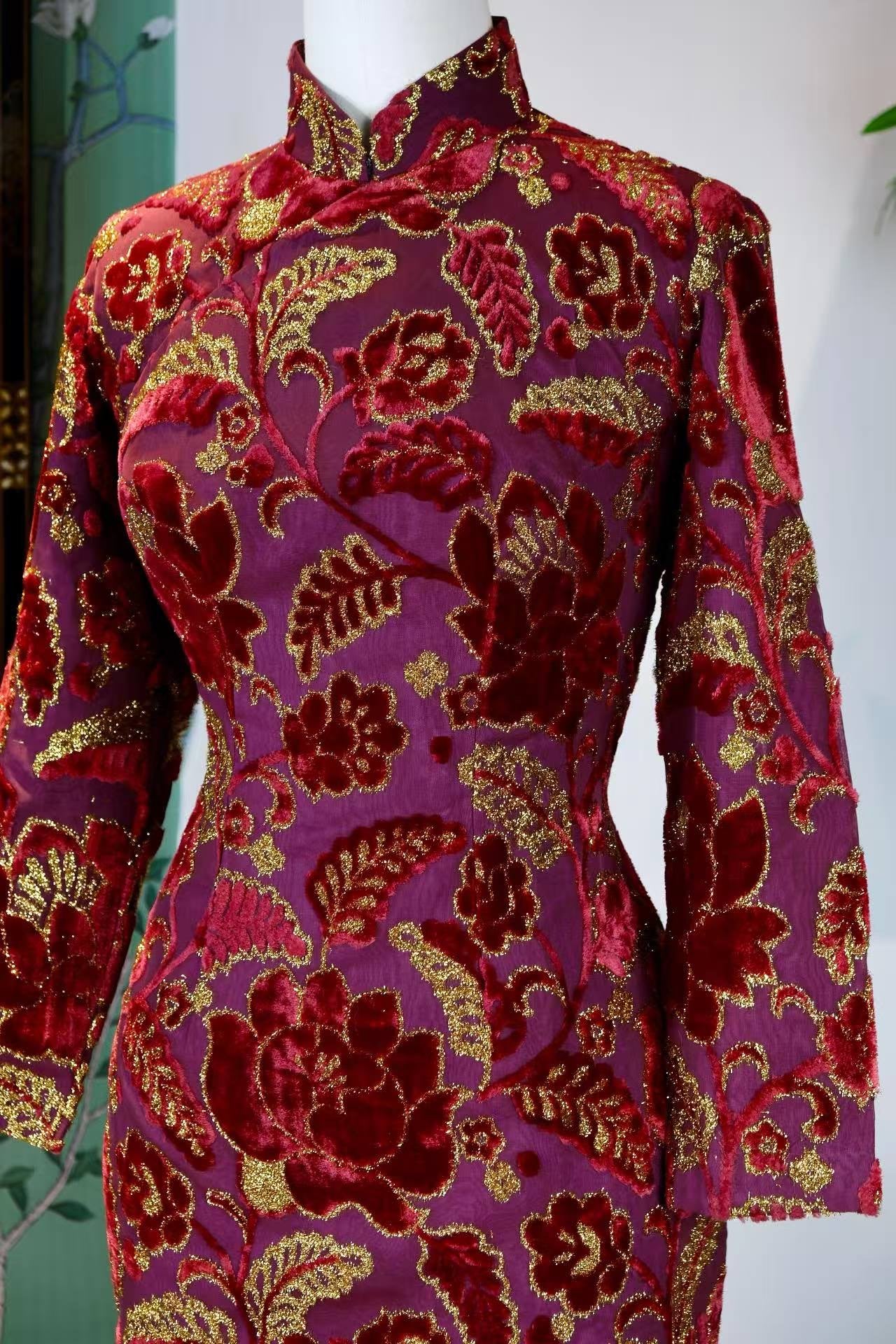
紫金绒影·六十风华——意产织金烧花丝绒古董旗袍
一、面料溯源:丝路跨洋,织中瑰宝
此袍面料源自上世纪六十年代意大利工坊,以“烧花丝绒”(
二、纹样解语:花间诗画,金线述雅
1. 牡丹:国色天香的永恒寓言
袍身遍布的缠枝牡丹,取“花开富贵”之意。《诗经·卫风》“
2. 金线:鎏金岁月的璀璨诗行
缠枝藤蔓以金线勾勒,如唐代杜牧《郡斋独酌》“金络画外地,
3. 构图:虚实相生的东方哲思
纹样布局遵循“密不透风,疏可走马”:牡丹簇拥处,
三、工艺绝响:意匠跨洋,港工点睛
意大利织金烧花技术,以化学腐蚀“烧”去绒面,留下金线骨架,
四、稀缺价值:时光窖藏,孤品无双
上世纪六十年代,意大利织金烧花丝绒多为欧洲贵族定制,
五、结语:穿在身上的诗史
着此袍者,如走入张爱玲《更衣记》的民国光影,
The fabric of this robe originated in Italian ateliers of the 1960s, featuring burn-out velvet (Devoré) as its soul and gold threads as its bone. At that time, the Italian textile industry was renowned for innovative techniques, interweaving mulberry silk with metallic fibers and using chemical etching to "burn" away parts of the pile. This created a texture where semi-transparent mesh and thick velvet coexist—echoing the record in Tiangong Kaiwu: "As for Japanese satin, China imitated it, using gold threads alongside," adding a layer of magnificence. Master tailors in Hong Kong then applied their craft, allowing European weaving technology to harmonize with Oriental tailoring, resulting in a fashion relic of "Chinese essence with Western utility."
1. The Peony: An Eternal Allegory of "National Beauty" The intertwining peonies scattered across the robe signify "wealth and prosperity." While the Classic of Poetry mentions "You threw me a papaya, and I returned a precious jade," here the velvet is the jade, and the gold thread is its brilliance. Single-petaled peonies (reminiscent of Ladies Wearing Flowers) interweave with double-petaled varieties, echoing Guo Xi’s philosophy in The Lofty Message of Forests and Streams: "Mountains take water as their blood and vegetation as their hair," endowing a 2D pattern with the layered depth of a landscape.
2. Gold Threads: Radiant Verses of Gilded Years The intertwining vines are outlined in gold, reminiscent of Du Mu's Tang Dynasty verse: "Gold bridles paint the outskirts; the sword reflects a glassy light," transforming metallic luster into fluid poetry. The gradient of gold thread at the leaf edges (from bold to delicate) aligns with the aesthetic of "gold-inlaid jewelry" found in the Ming Dynasty record Tian Shui Bing Shan Lu. Every reflection is a gilded brushstroke of time.
3. Composition: The Oriental Philosophy of Void and Solid The layout follows the principle: "Dense enough to block the wind, sparse enough for a horse to gallop." Where peonies cluster, the mesh burnt from the velvet resembles fragrant mist; where vines stretch, the gold-outlined branches act like startled swans. This is the Tao of "treating white space as black," resonating with Su Shi’s critique: "To judge a painting by formal likeness is a view fit for a child." It transcends representation to reach the realm of artistic conception.
The Italian gold-burn-out technique "devours" (from the French devoré) the pile to leave a skeletal gold frame, creating an illusion of "flowers hidden in gauze." As Kao Gong Ji suggests: "The seasons of Heaven, the energy of Earth, the beauty of materials, and the skill of the artisan." The meeting of transnational fabric and the bespoke skill of Hong Kong tailors created the 1960s elegance that is "proper yet unrestricted."
In the 1960s, Italian gold-jacquard velvet was mostly customized for European nobility. Upon flowing into Hong Kong and being tailored into Qipaos, it became a "fashion fossil" of East-West collision. Surviving pieces are few; this robe is a paragon among them. The purple velvet is like twilight, the gold thread like flowing fire. Within the intertwining peonies lies a half-century of modern codes—every inch represents the triple scarcity of imported fabric + Hong Kong tailoring + era-defining aesthetics.
Wearing this robe is like stepping into the Republican-era light and shadow of Eileen Chang’s Chronicle of Changing Clothes, or encountering the clanging of 1960s Hong Kong trams. Amidst the purple and gold shadows, the peonies breathe Oriental charm while the gold threads flow with Western skill. Every stitch tells an epic of "weaving dreams across oceans and conveying emotions through Hong Kong craft." This is not merely clothing; it is the amber of time, a vessel of culture. To wear it is to embrace a modern soul from half a century ago.