Purple Palace Enigma: The Urban Poetics of 1960s Hong Kong Abstract Qipao
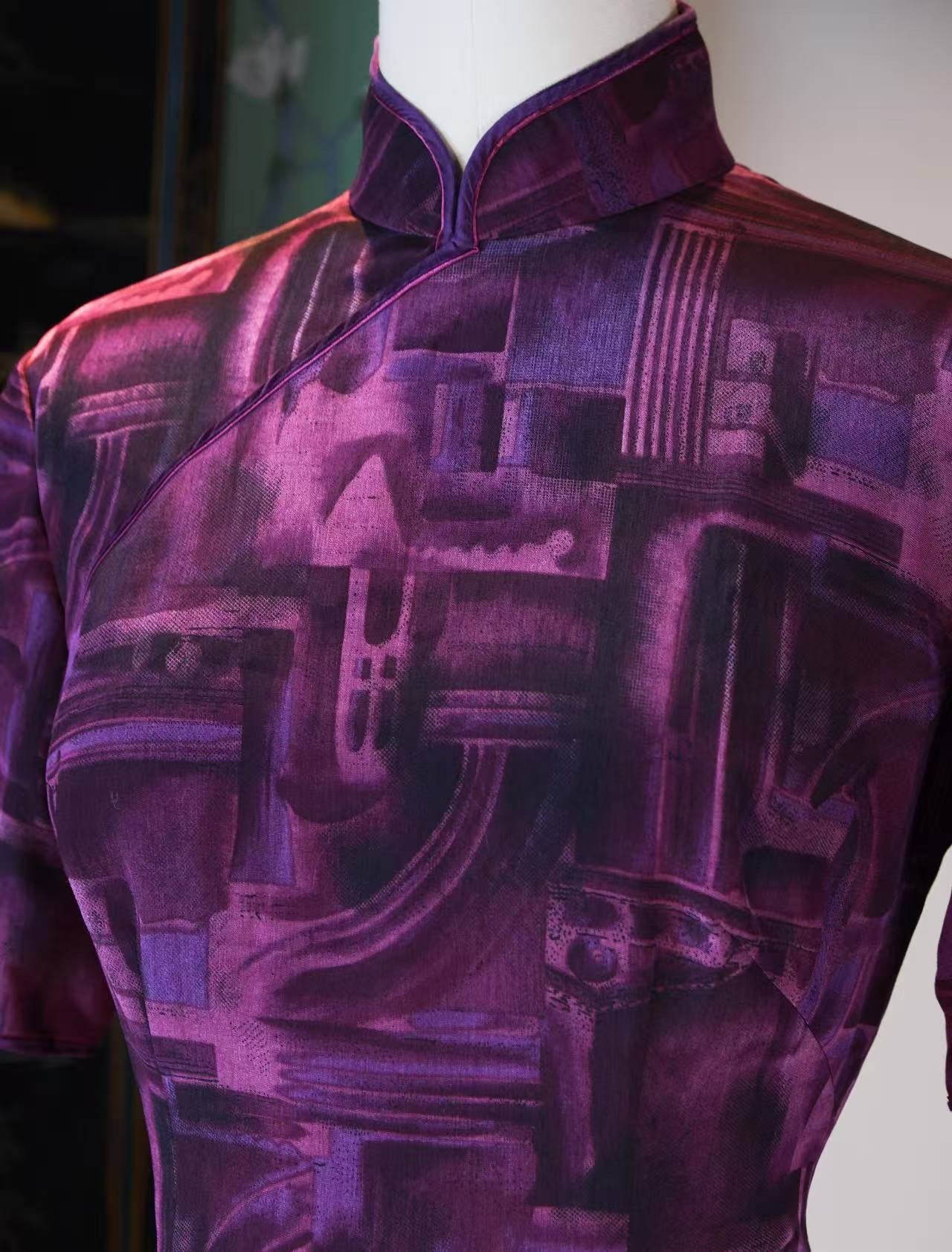
The Loom of Urban Imagery With a standing collar and a silhouette that flows into rhyme, the texture of Gambiered Gauze (Xiangyunsha) captures the misty hues of Victoria Harbour. This Hong Kong atelier antique qipao uses deep purple as its silk canvas, weaving the brushstrokes of 20th-century Abstract Expressionism into its Oriental bone and blood. The patterns are not representational landscapes but codes of urban imagery: interlaced geometric blocks evoke Ezra Pound’s imagery in The Cantos—"the dappled sunlight on / a gray city building"; the interplay of fluid curves and rigid lines resembles a trans-temporal dialogue between Franz Kline’s industrial steel frames and the Lingnan Qilou (shophouse) architecture.
The Post-Modern Deconstruction of Silk The fabric utilizes the "Iridescent Cloud Brocade" unique to 1960s Hong Kong, employing screen-printing techniques to condense the texture of oil paintings onto silk. Every fold reflects a postmodern deconstruction of traditional motifs. Its rarity is hidden in the details: the standing collar aligns with the "elbow-length" sleeve regulations of the Book of Rites, while the Chinese fret patterns (Huiwen) faintly appearing amidst the abstract motifs mark a pioneering attempt by Hong Kong designers to "paint the Chinese soul with Western methods." This echoes Bian Zhilin’s sentiment on T.S. Eliot: "Opening a new linguistic frontier between tradition and modernity."
Conclusion: A Visual Poem of Cultural Resonance As the qipao’s curves envelop the Eastern form, the varying shades of purple resonate with the ringing of tram bells on 1960s Hong Kong streets and the vibrations of oil pigments on canvas. This unique piece, merging Sino-Western aesthetics and freezing the zeitgeist of an era, stands as an irreplaceable visual poem within the tapestry of material cultural heritage.