深圳溯源
Couldn't load pickup availability
衣服尺寸:
胸围/腰围/臀围:92/80/100 厘米
衣长:110 厘米
细节描述:
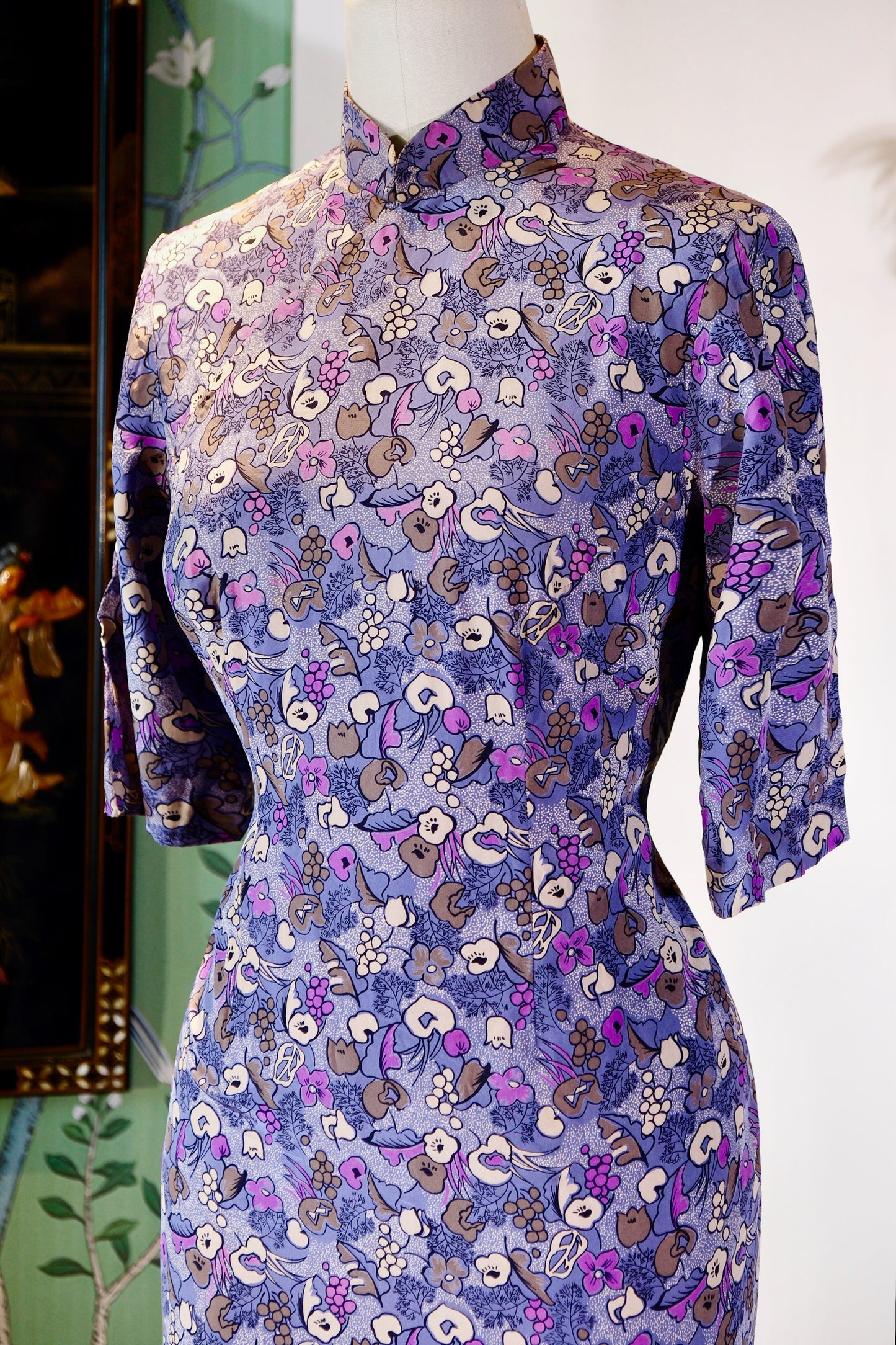
当目光触及这件上世纪六十年代台湾产的古董旗袍时,仿佛推开了一扇通往旧时光的门扉。它以淡紫色为底色,如暮春时节的烟霞,又似江南雨后的远山,朦胧中透着温润的诗意。衣身布满的抽象印花,是那个时代独有的艺术密码——没有具象的花鸟虫鱼,却以灵动的曲线、跳跃的色块,勾勒出自然万物的神韵:棕褐色的叶片如风中轻颤,米白色的花瓣似含露初绽,淡紫与深紫的晕染间,仿佛有蝶影翩跹、蜂蝶流连。这种“似花非花”的抽象表达,既暗合中国传统绘画“写意”的美学精髓,又融入了六十年代国际流行的波普艺术与抽象表现主义思潮,是东方意蕴与西方现代性的奇妙碰撞。
在服装史的脉络中,这件旗袍是台湾战后服饰文化的珍贵切片。六十年代的台湾,正处于传统与现代的转型期,旗袍作为女性日常着装的经典形制,既保留了立领、收腰、开衩的传统结构,又在面料与图案上大胆革新。台湾本土纺织业在战后迅速崛起,引进的先进印染技术让这种色彩层次丰富、图案细腻的抽象印花成为可能。彼时的设计师们,不再满足于传统的缠枝莲、云纹等吉祥纹样,转而尝试以抽象语言解构自然,赋予旗袍更具现代感的视觉张力。这件旗袍的剪裁尤为精妙:七分袖的长度恰到好处地露出手腕的纤细,腰线的收束如书法中的“顿笔”,将东方女性的曲线美凝练成一道优雅的弧线,而裙摆的开衩则在行走间若隐若现地流露风情,恰如《诗经》所言“巧笑倩兮,美目盼兮”,含蓄中藏着灵动。
从稀缺性而言,这件旗袍堪称“孤品级”藏品。六十年代的台湾旗袍,因历经半个世纪的风雨,保存完好的实物已极为罕见。其面料采用当时台湾本土生产的高支棉混纺,触感细腻且挺括,印花工艺采用活性染料,色彩历经数十年仍鲜亮如初,这种工艺的复杂性在当时的台湾纺织业中亦属上乘。更难得的是,其抽象印花图案具有鲜明的时代烙印——既不同于五十年代受海派影响的写实花卉,也不同于七十年代后受西方嬉皮文化影响的迷幻风格,而是精准捕捉了六十年代中期“东方抽象主义”的艺术风潮。彼时台湾艺坛正兴起“五月画会”“东方画会”等现代艺术运动,艺术家们试图以抽象形式重构传统水墨精神,这种思潮悄然渗透至服饰设计领域,使得这件旗袍成为艺术与日常生活的跨界见证。
站在当代回望,这件旗袍早已超越衣物的实用功能,成为承载历史记忆与艺术价值的文化符号。它让我们想起张爱玲笔下“束身旗袍,流苏披肩”的旧上海风情,却又多了几分海岛的清新与时代的前卫;它让我们触摸到六十年代台湾女性的生活图景——她们或许穿着这件旗袍走过台北的西门町,在咖啡馆的玻璃窗前留下倩影,或在传统茶室与现代舞厅间切换身份,成为那个时代“新旧交融”的生动注脚。正如艺术史家巫鸿所言:“物质文化的价值,在于它能将抽象的历史转化为可触摸的质感。”这件紫韵流转的古董旗袍,正是这样一件能让我们与过去对话的“时光容器”,其稀缺性不仅在于存世量的稀少,更在于它凝固了一个时代独有的艺术精神与生活美学。
Measurements / Size Guide:
Bust / Waist / Hips: 92/80/100 cm
Total Length: 110 cm
Detailed Description:
Touching this antique Qipao from 1960s Taiwan feels like pushing open a door to the past. Set against a pale purple base—resembling the misty clouds of late spring or distant mountains after a Jiangnan rain—it exudes a warm, moist poetry within its haziness. The all-over abstract print serves as a unique artistic code of that era. Void of concrete images like birds or flowers, it uses fluid curves and leaping color blocks to outline the spirit of nature: brownish leaves tremble in the wind, cream-white petals seem to bud with dew, and between the gradients of light and deep purple, silhouettes of butterflies seem to dance. This "flower-yet-not-a-flower" abstract expression aligns with the "Xieyi" (freehand) essence of traditional Chinese painting while integrating the global trends of Pop Art and Abstract Expressionism prevalent in the 1960s—a wondrous collision between Oriental resonance and Western modernity.
Within the lineage of costume history, this Qipao is a precious fragment of post-war Taiwanese sartorial culture. Taiwan in the 1960s was in a transitional phase between tradition and modernity. As a classic form of daily wear for women, the Qipao retained traditional structures like the mandarin collar, cinched waist, and side slits, while boldly innovating in fabric and pattern. The rapid post-war rise of Taiwan's local textile industry and the introduction of advanced printing and dyeing technologies made such rich, layered, and delicate abstract prints possible. Designers of the time, no longer satisfied with traditional motifs like scrolling lotuses or cloud patterns, turned to abstract language to deconstruct nature, imbuing the Qipao with a more modern visual tension. The tailoring is particularly exquisite: the three-quarter sleeves perfectly reveal the slenderness of the wrists; the cinched waist acts like a "pausing stroke" (Dunbi) in calligraphy, condensing the curves of the Eastern woman into an elegant arc; and the side slits offer glimpses of charm during movement—much like the line from The Classic of Poetry: "Her artful smile dimpling, her beautiful eyes beaming," a vivid grace hidden within reserve.
In terms of scarcity, this Qipao is a "one-of-a-kind" collectible. Having weathered half a century, well-preserved specimens of 1960s Taiwanese Qipaos are extremely rare. The fabric utilizes a high-count cotton blend produced locally in Taiwan at the time, offering a delicate yet crisp touch. The printing process employed reactive dyes, allowing colors to remain as vibrant as new after decades—a level of complexity that represented the pinnacle of the Taiwanese textile industry then. More notably, the abstract print bears a distinct epochal mark: unlike the realistic florals influenced by the Haipai style in the 1950s, or the psychedelic styles influenced by Western hippie culture after the 1970s, it precisely captures the "Oriental Abstractionism" trend of the mid-1960s. At that time, modern art movements like the "Fifth Moon Group" and the "Ton-Fan Art Group" were rising in Taiwan's art circles, with artists attempting to reconstruct the spirit of traditional ink wash through abstract forms. This trend quietly permeated the field of fashion design, making this Qipao a cross-disciplinary witness to art and daily life.
Looking back from a contemporary perspective, this Qipao has long transcended its practical function to become a cultural symbol carrying historical memory and artistic value. It reminds us of the Old Shanghai elegance described by Eileen Chang—"a tight-fitting Qipao with a fringed shawl"—yet adds a touch of island freshness and avant-garde spirit. It allows us to touch the living landscape of 1960s Taiwanese women: they might have walked through Ximending in Taipei wearing this Qipao, left a silhouette in front of a café window, or switched identities between traditional teahouses and modern dance halls, becoming a vivid footnote to the era's "fusion of old and new." As art historian Wu Hung noted: "The value of material culture lies in its ability to transform abstract history into a touchable texture." This antique Qipao, with its flowing purple rhyme, is such a "vessel of time" that allows us to converse with the past. Its scarcity lies not only in its limited survival but in its solidification of the unique artistic spirit and lifestyle aesthetics of an era.