深圳溯源
Couldn't load pickup availability
衣服尺寸:
胸围/腰围/臀围:90/68/94 厘米
衣长:93 厘米
细节描述:
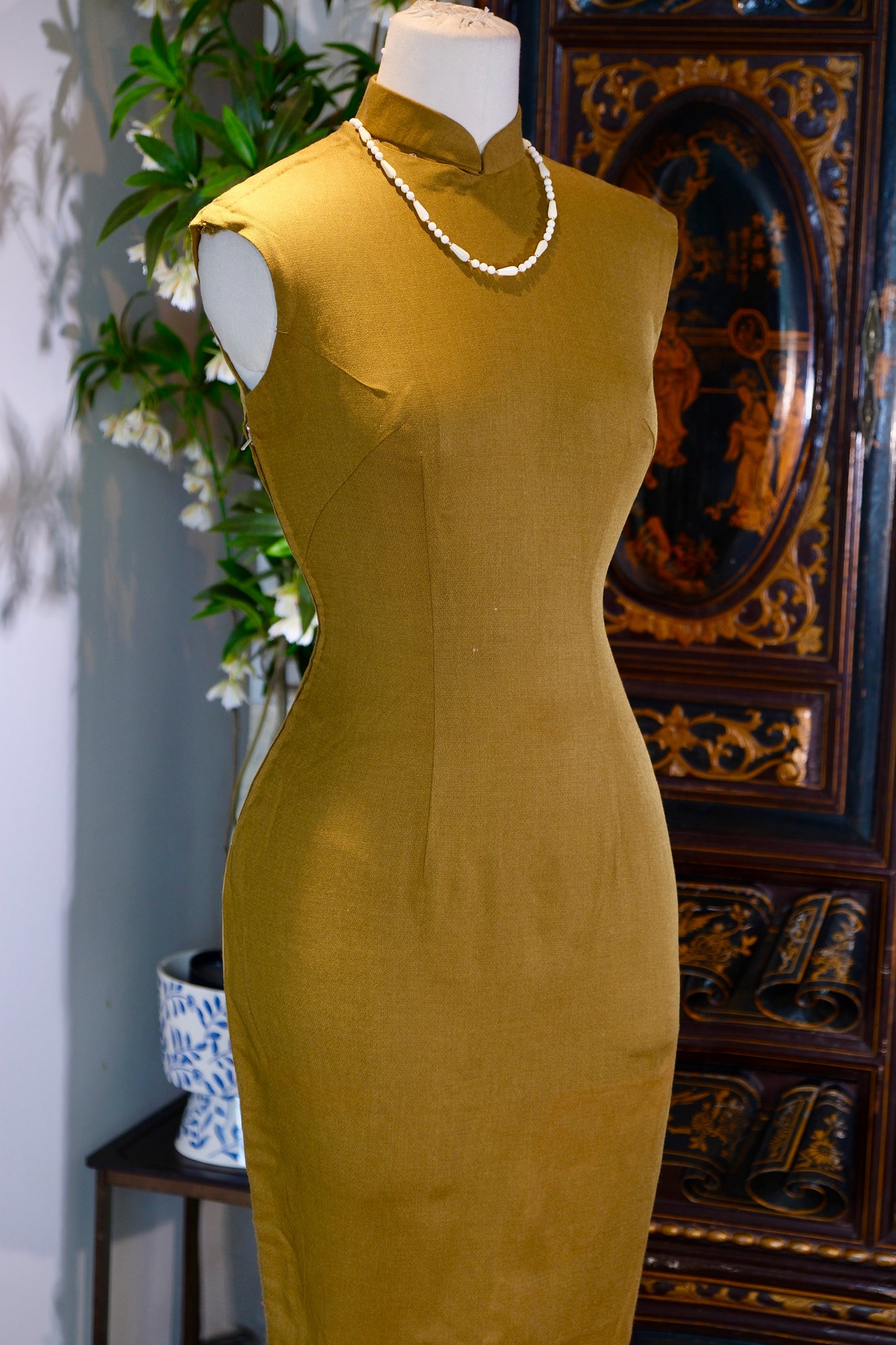
当目光触及这袭芥黄色的无袖旗袍时,仿佛触碰到时光的肌理——它并非寻常织物,而是上世纪六十年代香港裁缝铺里,英国西装料与东方剪裁哲学碰撞出的璀璨结晶。
一、无纹之纹:素色里的经纬史诗
此袍最耐人寻味处,恰在其“无图案”的纯粹。通体采用英国精纺羊毛混纺面料,经纬间暗藏细密的斜纹肌理,如古籍书页的暗纹,需以指尖轻抚方能感知。这种“无纹之纹”的设计,恰合《道德经》“大音希声,大象无形”的哲思——摒弃繁复印花,以面料本身的挺括质感与垂坠光泽为笔,勾勒出东方女性的含蓄风骨。芥黄色调取自《考工记》“土黄为中央正色”,既非明黄之张扬,亦非土褐之沉郁,恰似秋日银杏叶的暖调,衬得肌肤如凝脂,在六十年代的香港街头,定是摩登与传统交织的视觉焦点。
二、时空褶皱:从伦敦到香江的裁缝密码
上世纪六十年代,香港作为东西方贸易枢纽,英国西装料经由远洋货轮抵达维多利亚港,在湾仔或中环的裁缝铺里完成华丽转身。彼时香港旗袍正值“黄金时代”,裁缝们深谙西方立体剪裁之精髓:胸省与腰省的精准定位,使旗袍如第二层肌肤般贴合曲线;无袖设计突破传统,露出肩臂线条,暗合六十年代全球女性解放的浪潮。而英国面料的挺括特性,让旗袍在行走时裙摆微扬,既有西装的利落,又不失旗袍的婉约——这种“中西合璧”的工艺,正如张爱玲在《更衣记》中所言:“旗袍原来是满族人的制服,现在却成了中国妇女的标准服装,而且是最能代表中国女性美的服装。”
三、稀缺性:消逝的黄金时代
此类英料港产旗袍的稀缺性,源于三个不可复制的时代切片:
- 面料绝响:六十年代英国精纺羊毛混纺面料,因环保政策与产业转型,早已停产。其独特的“记忆性”——穿着后能自动恢复挺括——是现代面料难以企及的工艺高度。
- 手工温度:彼时香港裁缝铺多为家族传承,一针一线皆是手工缝制,从量体到成衣需耗时半月。如今机器量产的旗袍,再难复刻这种“以衣载道”的匠心。
- 文化符号:六十年代香港旗袍是“东方好莱坞”的黄金注脚,林黛、乐蒂等影星常着此类旗袍出席活动,使其成为时代美学的活化石。
四、艺术风格:极简主义的前卫先驱
这袭旗袍的艺术风格,可视为东方极简主义与西方现代主义的对话。其立领高度经过精确计算,既保持传统旗袍的端庄,又避免束缚颈部;侧缝的开衩高度恰到好处,行走时若隐若现的小腿线条,暗合《诗经》“巧笑倩兮,美目盼兮”的含蓄美学。无袖设计的大胆突破,更使其成为六十年代“未来主义”时尚的东方诠释——正如法国设计师库雷热同年推出的迷你裙,都在探索身体与服装的新型关系。
当这袭旗袍在衣架上静立,它不仅是衣物,更是一部流动的时装史。它见证过六十年代香港中环的霓虹闪烁,聆听过裁缝铺里的粤语俚语,承载过东方女性对美的执着追求。如今,它带着时光的包浆与稀缺的基因,等待着新的主人,续写属于它的下一个时空篇章。
Measurements / Size Guide:
Bust / Waist / Hips: 90/68/94 cm
Total Length: 93 cm
Detailed Description:
When one's gaze falls upon this mustard-yellow sleeveless cheongsam (qipao), it feels like touching the very texture of time. This is no ordinary textile; it is the brilliant crystallization of British suiting fabric colliding with Oriental tailoring philosophy in a 1960s Hong Kong workshop.
The most intriguing aspect of this garment lies in its "patternless" purity. The entire body is crafted from British worsted wool blend fabric, with a fine twill texture hidden between the warp and weft—like the subtle watermarks on the pages of an ancient book, perceivable only through a gentle touch. This design of "pattern within patternlessness" aligns with the Taoist philosophy of "great music has the faintest notes; the great image has no form." By discarding complex prints and using the fabric's own crisp texture and pendulous luster as its brush, it outlines the reserved integrity of the Eastern woman. The mustard-yellow hue, derived from the "central orthodox color of earth yellow" mentioned in The Artificers' Record, is neither as flamboyant as bright yellow nor as somber as earthy brown. It resembles the warm tone of autumn ginkgo leaves, making the skin appear as fair as congealed fat—a visual focus of intertwined modernity and tradition on the streets of 1960s Hong Kong.
In the 1960s, Hong Kong served as the hub for East-West trade. British suiting fabrics arrived at Victoria Harbour via ocean-going freighters, undergoing a magnificent transformation in the tailor shops of Wan Chai or Central. During this "Golden Age" of the Hong Kong qipao, tailors mastered the essence of Western 3D tailoring: the precise positioning of chest and waist darts allowed the qipao to fit like a second skin. The sleeveless design broke tradition, exposing the lines of the shoulders and arms, echoing the global wave of female liberation in the sixties. The crisp nature of British fabric allowed the hem to lift slightly while walking, possessing the sharpness of a suit without losing the gentleness of a qipao. This "East-meets-West" craftsmanship is as Eileen Chang noted in A Chronicle of Changing Clothes: the qipao became the most representative garment of Chinese feminine beauty.
The scarcity of such British-fabric, Hong Kong-made cheongsams stems from three unrepeatable historical slices:
Fabric Swan Song: 1960s British worsted wool blend fabrics have long been discontinued due to environmental policies and industrial shifts. Its unique "memory"—automatically recovering its crisp shape after wearing—is a height of craftsmanship modern fabrics can hardly reach.
Handmade Warmth: At that time, Hong Kong tailor shops were mostly family legacies. Every stitch was hand-sewn, taking half a month from measurement to completion. Modern mass-produced qipaos can no longer replicate this ingenuity of "clothing as a vessel of Tao."
Cultural Symbol: The 1960s Hong Kong qipao was the golden footnote of the "Hollywood of the East." Movie stars like Lin Dai and Betty Loh Ti frequently wore such garments, making them living fossils of an era's aesthetics.
The artistic style of this cheongsam can be seen as a dialogue between Eastern Minimalism and Western Modernism. The height of the standing collar is precisely calculated to maintain traditional dignity without constricting the neck; the height of the side slits is just right, with the calf lines appearing faintly during movement, aligning with the reserved aesthetics of "charming smiles and beautiful eyes" in the Classic of Poetry. The bold breakthrough of the sleeveless design makes it an Oriental interpretation of "Futurist" fashion—much like the mini-skirts launched by French designer André Courrèges in the same era, both exploring new relationships between the body and clothing.
When this cheongsam stands silently on its hanger, it is not merely a garment but a fluid history of fashion. It witnessed the shimmering neon of 1960s Central, listened to the Cantonese slang in the tailor shops, and carried the Eastern woman's persistent pursuit of beauty. Today, with the patina of time and its rare genetic makeup, it awaits a new owner to continue its next chapter in spacetime.