六十年代台湾斜纹印花古董旗袍:蓝金织就的东方寓言
当目光触碰靛蓝底色上鎏金般的植物纹样,恍若《楚辞》“兰芷变而不芳兮,荃蕙化而为茅”的咏叹浮现——这件六十年代台湾产古董旗袍,以斜纹绸为纸、金粉为墨,将中国传统植物纹样的嬗变写入经纬交织的肌理,成为见证两岸服饰文脉相承的稀缺物证。
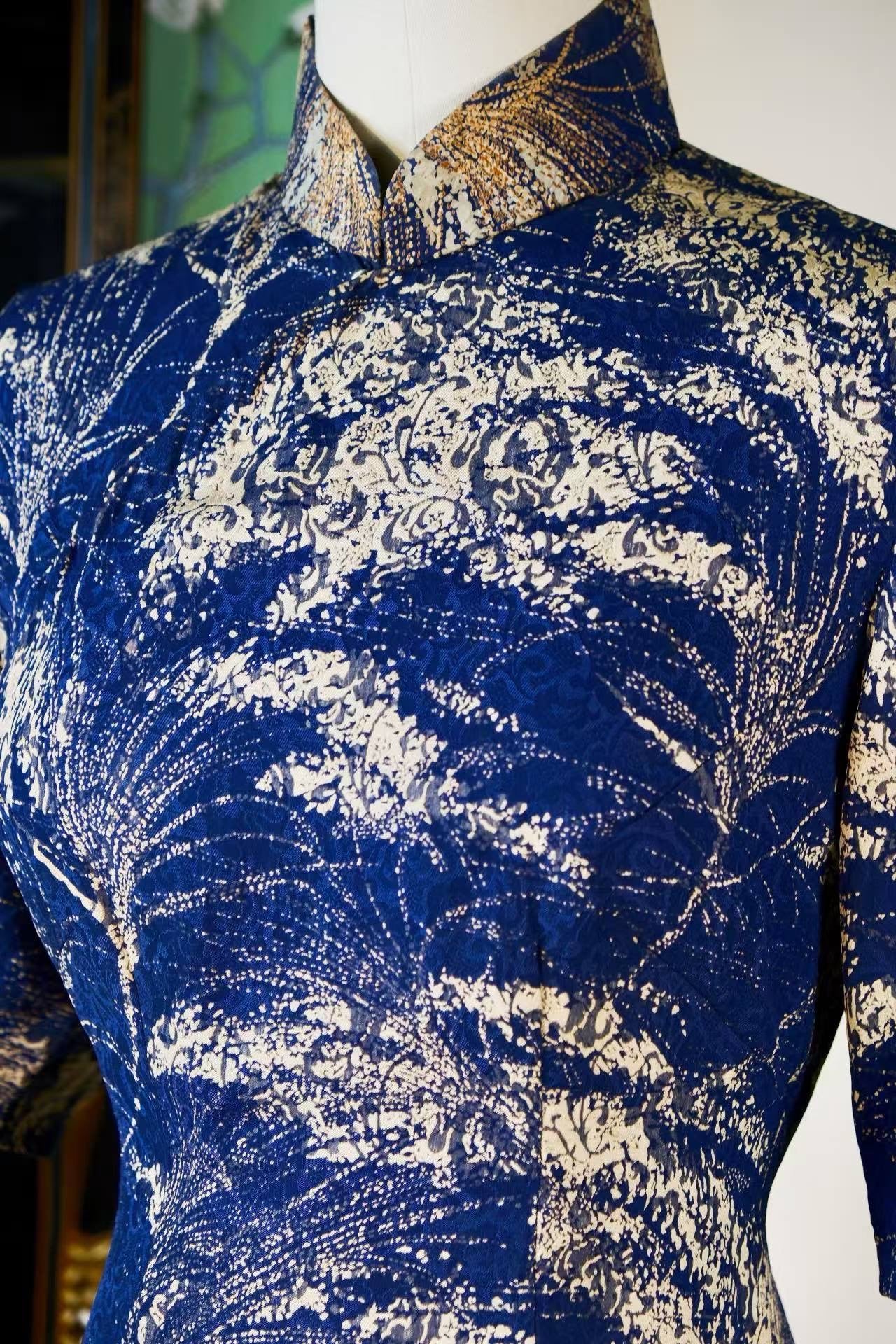
旗袍通体以深邃靛蓝为底,其上铺陈米白与浅金双色印花,构成层叠舒展的植物图景。细观纹样,既有棕榈叶般舒展的羽状脉络,又杂糅卷草纹的婉转缠绕,部分区块更可见类“华虫”(《周礼》郑玄注:“华虫,五色之虫,画之于衣”)的抽象羽翼形态,似将《尔雅·释草》“莔,菟奚”之菟丝藤蔓的缠绵,与《洛神赋》“践椒涂之郁烈,步蘅薄而流芳”的芳草意象熔铸一体。
面料选用紧致斜纹面料,其经纬交织形成的斜向纹路,为印花提供了独特的肌理基底——深蓝底色似青瓷“秘色”,米金纹样若错金工艺的流光,恰如《释名·释采帛》所载“绀,含也,青而含赤色”,在光影间流转出“青金石与黄金相映”的华贵质感。
当指尖抚过斜纹绸的细腻肌理,目光掠过每一处婉转的藤蔓与羽翼,我们触摸的不仅是六十年代的工艺温度,更是一段关于文化传承与创新的诗史。
它以蓝为纸、以金为墨,在时光的长河中沉淀为稀缺的艺术孤本——正如《文心雕龙》所言“文变染乎世情,兴废系乎时序”,这件旗袍的每一道纹路,都镌刻着那个年代独有的文化密码,静待懂它的人,读懂其间的东方寓言。
🌿 An Oriental Fable in Blue and Gold: A 1960s Taiwan Vintage Twill Cheongsam
When one’s gaze meets the gilded botanical motifs upon the indigo base, it evokes the sighs of the Songs of Chu: "The orchids and angelica have lost their fragrance; the fragrant reeds have turned to weeds." This 1960s vintage cheongsam from Taiwan uses silk twill as paper and gold powder as ink, inscribing the evolution of traditional Chinese botanical patterns into its interwoven texture—a rare material testament to the shared sartorial lineage across the Strait.
The garment features a profound indigo base, upon which cream-white and pale-gold dual-tone prints unfold in layered botanical vistas. A close inspection reveals pinnate veins spreading like palm leaves, interlaced with the graceful curves of scrolling vines. Certain sections even manifest abstract wing-like forms reminiscent of "Hua Chong" (as annotated by Zheng Xuan in the Rites of Zhou: "Hua Chong, the five-colored insect, painted upon robes"). It fuses the lingering entanglement of dodder vines from Er Ya with the fragrant herb imagery of The Ode to the Goddess of the Luo River: "Treading the pungent fragrance of pepper-strewn paths; walking through groves of aromatic herbs."
The choice of a tightly woven twill fabric provides a unique textural foundation; its diagonal grain adds depth to the print. The deep blue base mirrors the "secret color" of celadon (Mi Se), while the beige-gold patterns shimmer like gold-inlay craftsmanship (Cuo Jin). This echoes the description in Shi Ming: "Gan (dark purple-blue) contains red within the blue," creating a luxurious texture akin to the resonance between lapis lazuli and gold under shifting light.
As fingertips brush over the delicate grain of the silk twill and eyes trace every winding vine and wing, one touches more than the technical warmth of the 1960s—it is a poetic history of cultural inheritance and innovation.
Using blue as paper and gold as ink, it has settled through the river of time into a rare artistic singular. As stated in The Literary Mind and the Carving of Dragons: "Literary transformations are dyed by the spirit of the age; their rise and fall are tied to the order of time." Every line on this cheongsam carves a cultural code unique to its era, waiting for those who understand to read the Oriental fable within.