深圳溯源
Couldn't load pickup availability
衣服尺寸:
胸围/腰围/臀围:82/68/88 厘米
衣长:108 厘米
细节描述:
一、纹样解码:染织间的繁花叙事
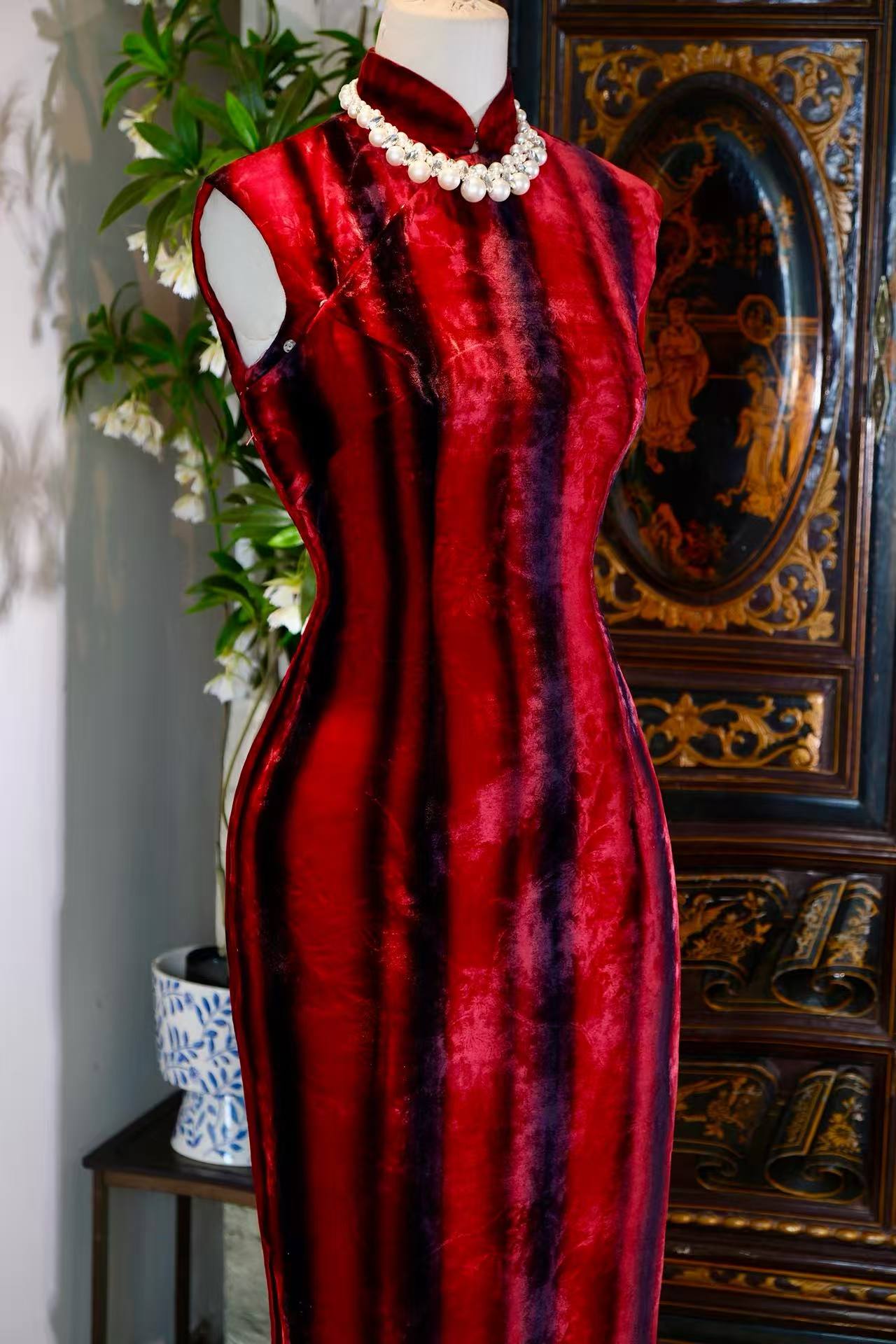
这件诞生于1960年代台湾的无袖立领旗袍,以正红金丝绒为底,暗藏双重工艺玄机。纵向的暗紫色条纹并非机器印花,而是匠人以手工印染逐层晕染而成,似暮色中垂落的葡萄藤,又若古画里的工笔重彩——染料渗透绒面的深浅变化,让每一条纹路都带着手工的温度与不可复制的随机性。
而压花暗纹则以缠枝莲为骨,花瓣边缘缀以细碎卷草,在光线流转间若隐若现。缠枝花卉的纹样,自唐代便寓意“生生不息”,至明清成为宫廷织物的经典母题。台湾匠人将这一传统纹样压印于金丝绒上,既保留绒面的华贵光泽,又通过浮雕质感赋予面料立体的视觉层次,暗合《考工记》“天有时,地有气,材有美,工有巧”的造物哲学。
二、时代切片:海岛上的旗袍余韵
1949年后,大批江浙沪裁缝随迁台湾,将海派旗袍的精致与海岛风情融合。这件旗袍的收腰剪裁、无袖设计,正是1960年代台湾上流社会女性着装的缩影——彼时台湾经济腾飞,名媛们偏爱用金丝绒、织锦缎等奢华面料,在宴会、婚宴等场合彰显身份。
手工印染的竖条纹与压花缠枝纹的结合,在1960年代的台湾旗袍中尤为罕见。据《台湾服饰志》记载,当时能掌握手工印染金丝绒技术的作坊不足十家,多由“荣昌祥”“龙凤号”等老字号定制。这件旗袍的暗纹模具,极可能来自上海迁台的纺织厂,其工艺在1970年代后因化纤面料普及而逐渐失传。
三、艺术风格:东方美学的现代转译
从艺术史视角看,这件旗袍是“新古典主义”在服饰领域的实践。手工印染的竖条纹拉长身形,暗合宋代“瘦金体”的修长审美;压花缠枝纹的朦胧感,则呼应了文人画“计白当黑”的留白意境。不同于1950年代旗袍的繁复刺绣,1960年代台湾设计师更倾向于用面料本身的质感说话——正如张爱玲在《更衣记》中所言:“细节往往是和美畅快,引人入胜的。”
其稀缺性更在于保存状态:金丝绒易褪色、压花易磨损,而这件旗袍历经半世纪,绒面依旧饱满,暗纹清晰可辨,堪称“时光的琥珀”。
四、结语:一件旗袍,一部微缩史
它曾是某位台湾名媛的婚宴礼服,或是某位外交官夫人的晚宴战袍,如今静静陈列,却依旧能听见1960年代台北夜总会里的爵士乐,看见霓虹灯下摇曳的裙摆。正如贡布里希在《艺术的故事》中所说:“没有艺术,只有艺术家。”这件旗袍的每一道染痕、每一缕绒光,都是那个时代匠人与穿着者共同书写的艺术宣言。
Measurements / Size Guide:
Bust / Waist / Hips: 82/68/88 cm
Total Length: 108 cm
Detailed Description:
This sleeveless, high-collar qipao, born in 1960s Taiwan, uses a vibrant red gold velvet base that conceals a dual mastery of craftsmanship. The vertical dark purple stripes are not machine-printed but are layers of hand-dyed gradients applied by artisans. They resemble grapevine tendrils descending in the twilight or the heavy, colorful strokes of traditional Gongbi painting. The varying penetration of the dye into the velvet pile ensures that every line carries the warmth of manual labor and a non-replicable randomness.
The embossed motifs use the intertwined lotus as their "bone," with petal edges adorned with delicate scrolling grass, appearing and disappearing as light flows across the fabric. The intertwined floral pattern has symbolized "endless vitality" since the Tang Dynasty, becoming a classic motif for imperial textiles by the Ming and Qing. Taiwanese artisans pressed this traditional pattern onto gold velvet, preserving the luxurious luster of the pile while adding a sculptural visual layer—perfectly embodying the philosophy from Kao Gong Ji: "The season has its timing, the earth its energy, the material its beauty, and the craftsman his skill."
After 1949, a large number of tailors from Jiangsu, Zhejiang, and Shanghai migrated to Taiwan, fusing the sophistication of Haipai (Shanghai-style) qipaos with island sensibilities. The cinched waist and sleeveless design of this garment are a microcosm of the attire worn by upper-class women in 1960s Taiwan. During this era of economic takeoff, socialites preferred luxurious materials like gold velvet and brocade to signal their status at banquets and weddings.
The combination of hand-dyed vertical stripes and embossed intertwined vines is exceptionally rare for 1960s Taiwanese qipaos. According to the Taiwan Fashion Records, fewer than ten workshops at the time possessed the skill to hand-dye gold velvet, with most orders coming from venerable establishments like "Rong Chang Xiang" or "Long Feng Hao." The molds used for the embossing likely came from textile factories that relocated from Shanghai to Taiwan; this specific craft gradually vanished after the 1970s with the rise of synthetic fibers.
From an art history perspective, this qipao is a practice of "Neoclassicism" in the realm of fashion. The hand-dyed vertical stripes elongate the silhouette, echoing the slender aesthetic of the Song Dynasty’s "Slender Gold" calligraphy style. The haziness of the embossed vines resonates with the "leaving white" (Liu Bai) philosophy of literati painting, where empty space is as vital as the ink. Unlike the heavy embroidery of 1950s qipaos, 1960s Taiwanese designers preferred to let the texture of the fabric speak for itself—as Eileen Chang noted in A Chronicle of Changing Clothes: "Details are often harmonious, delightful, and captivating."
Its rarity is further cemented by its state of preservation. Gold velvet fades easily and embossed patterns are prone to wearing down, yet this piece remains "an amber of time," with its pile still full and its patterns clearly discernible after half a century.
It may have been a wedding gown for a Taiwanese socialite or the banquet attire of a diplomat’s wife. Standing silently now, it still echoes with the jazz music of 1960s Taipei nightclubs and the shimmer of hemlines under neon lights. As E.H. Gombrich wrote in The Story of Art: "There really is no such thing as Art. There are only artists." Every dye mark and every glimmer of velvet on this qipao is an artistic manifesto co-written by the artisan and the wearer of that era.