深圳溯源
60年代 - 金叶流丹:一件1960年代香港蕾丝闪片旗袍的物质文化叙事 | 1960s - Gilded Leaves in Flowing Crimson: A Material Culture Narrative of a 1960s Hong Kong Lace and Sequin Cheongsam
60年代 - 金叶流丹:一件1960年代香港蕾丝闪片旗袍的物质文化叙事 | 1960s - Gilded Leaves in Flowing Crimson: A Material Culture Narrative of a 1960s Hong Kong Lace and Sequin Cheongsam
Couldn't load pickup availability
金叶流丹:一件1960年代香港蕾丝闪片旗袍的物质文化叙事
衣服尺寸:
胸围/腰围/臀围:90/76/96 厘米
衣长:124 厘米
细节描述:
在维多利亚港的霓虹尚未完全吞噬旧日天光的1960年代,香港的制衣工坊里,一针一线正编织着东方与西方、传统与现代的微妙平衡。眼前这件香港产的蕾丝闪片旗袍,便是那个时代的物质结晶——它以金为底,以黑为墨,以蕾丝为纸,以闪片为星,在经纬之间,书写着一段关于身份、审美与工艺的隐秘史诗。
一、图案:叶影婆娑,金黑交响
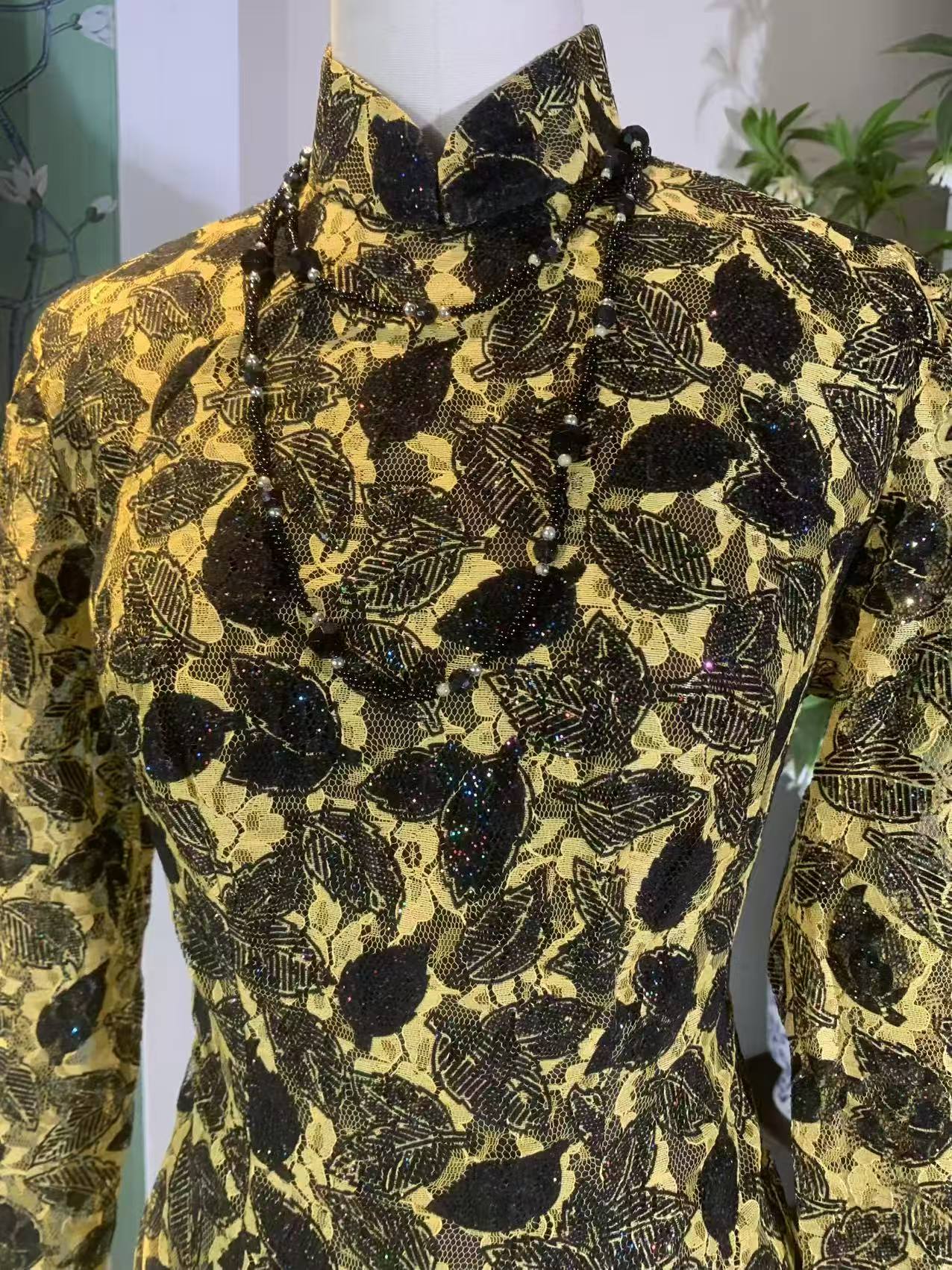
旗袍的图案以“叶”为母题,却非写实的草木摹本,而是经过几何抽象与装饰艺术(Art Deco)变形的“意象之叶”。叶片以黑色蕾丝为骨,边缘缀以细密的黑色闪片,如夜幕中凝结的露珠,又似星辰坠入凡尘。金底并非单一的金属光泽,而是通过蕾丝的网眼结构,形成明暗交错的肌理——光线穿过时,金线如流动的熔金,在叶片的间隙中闪烁,仿佛风过林梢,叶影婆娑,金波荡漾。这种“金黑对比”的配色,既承袭了中国传统“玄金”配色的庄重(《周易·坤卦》:“黄裳元吉,文在中也”,金为土德,黑为水德,水土相生,暗合阴阳调和),又融入了西方装饰艺术的几何冷峻,形成一种既古典又摩登的视觉张力。
二、故事:香江旧梦,衣香鬓影
这件旗袍的诞生,恰逢香港作为“东方之珠”的崛起期。1960年代的香港,是东西方文化的交汇点:一方面,上海裁缝带着海派旗袍的精致工艺南迁,将“海派旗袍”的修身剪裁与西式立体裁剪结合;另一方面,香港本地的制衣业开始引入西方蕾丝、亮片等新材料,以满足新兴中产阶级对“摩登”与“身份”的双重需求。蕾丝的通透感打破了传统旗袍的厚重,闪片的加入则赋予其晚宴装的华丽,使其既能出入中环的写字楼,亦能闪耀于湾仔的夜总会。
三、艺术风格:装饰艺术与东方美学的共生
从艺术风格看,这件旗袍是装饰艺术(Art Deco)与东方美学的完美共生。装饰艺术的核心是“几何化”与“材料对比”,而这件旗袍的叶片图案正是通过几何化的变形,将自然元素转化为抽象的装饰符号;金与黑的色彩对比,蕾丝与闪片的材质碰撞,亦符合装饰艺术“奢华与克制并存”的美学原则。同时,旗袍的立领、斜襟等传统元素,又锚定了其东方身份——这种“中西合璧”并非简单的拼贴,而是通过图案的抽象化与材质的现代化,实现了传统形制的“当代转译”。
在艺术史的脉络中,这种风格可追溯至1920-1930年代的“中国风”(Chinoiserie)浪潮,但1960年代的香港设计师显然更具主体性:他们不再满足于西方对东方的想象性重构,而是主动将本土文化符号与现代设计语言结合,创造出属于香港自己的时尚语法。这件旗袍便是这一语法的典型样本——它既非纯粹的“中国风”,亦非完全的“西方化”,而是一种“香港性”的时尚表达。
四、稀缺性:时间的馈赠,工艺的绝响
古董旗袍的稀缺性,不仅在于其年代久远,更在于其背后工艺与文化的不可复制性。1960年代的香港制衣业虽已初具规模,但高端旗袍仍以手工定制为主,产量极低;而蕾丝与闪片的结合,更是当时“高端定制”的标志,普通市民难以企及。随着1970年代成衣业的兴起,这种耗时的手工旗袍逐渐式微,留存至今且品相完好的更是凤毛麟角。
从物质文化的角度看,这件旗袍的稀缺性还体现在其“历史见证者”的身份——它见证了香港从转口港向工业城市的转型,见证了海派文化与本土文化的融合,更见证了东方女性从“传统闺秀”向“现代职业女性”的身份转变。每一片闪片,都是那个时代的星光;每一根蕾丝,都是历史的脉络。
结语:衣以载道,金叶长存
这件1960年代香港蕾丝闪片旗袍,不仅是一件衣物,更是一部穿在身上的历史。它的图案是叶,却非草木之叶,而是时代的叶片,在风中摇曳,记录着香江的旧梦;它的材质是蕾丝与闪片,却非简单的装饰,而是文化的符号,在光影中闪烁,诉说着东西方的对话。当我们在博物馆的展柜前凝视它时,看到的不仅是一件古董衣,更是一个时代的审美理想、工艺精神与文化自觉——而这,正是古董旗袍最动人的地方:它让历史有了温度,让文化有了形状,让那些逝去的风华,在金叶流丹间,得以永恒。
Gilded Leaves in Flowing Crimson: A Material Culture Narrative of a 1960s Hong Kong Lace and Sequin Cheongsam
Measurements / Size Guide:
Bust / Waist / Hips: 90/76/96 cm
Total Length: 124 cm
Detailed Description:
In the 1960s, before the neon lights of Victoria Harbour fully consumed the daylight of yore, the garment workshops of Hong Kong were interweaving a delicate balance between East and West, tradition and modernity. This Hong Kong-made lace and sequin cheongsam (qipao) is a material crystallization of that era—using gold as its base, black as its ink, lace as its paper, and sequins as its stars. Between the warp and weft, it writes a hidden epic of identity, aesthetics, and craftsmanship.
I. Pattern: Shifting Leaf Shadows, a Gold and Black Symphony
The pattern takes the "leaf" as its motif, yet it is not a realistic botanical copy but an "imaginary leaf" transformed by geometric abstraction and Art Deco. The leaves are structured with black lace and edged with dense black sequins, resembling dew condensed in the night or stars fallen into the mortal realm. The gold base is not a monolithic metallic luster but a shifting texture created by the lace mesh—as light passes through, the gold threads shimmer like molten metal in the gaps, evoking the rustle of leaves in the wind and the undulating golden waves. This "Gold and Black" contrast inherits the solemnity of the traditional Chinese "Xuan-Jin" palette (The Book of Changes: "A yellow lower garment is a source of great good fortune; beauty is contained within"), while integrating the geometric coolness of Western Art Deco, creating a visual tension that is both classical and modern.
II. Story: Old Hong Kong Dreams, Fragrance and Shadows
The birth of this qipao coincided with the rise of Hong Kong as the "Pearl of the Orient." In the 1960s, Hong Kong was the intersection of East and West: Shanghainese tailors migrated south with the exquisite "Haipai" techniques, merging slim-fit silhouettes with Western three-dimensional tailoring. Simultaneously, the local garment industry began introducing Western lace and sequins to meet the dual demands for "modernity" and "status" among the emerging middle class. The transparency of the lace broke the heaviness of traditional qipaos, while the sequins granted it the opulence of evening wear, allowing it to move seamlessly from Central offices to Wan Chai nightclubs.
III. Art Style: Symbiosis of Art Deco and Eastern Aesthetics
From an artistic perspective, this garment is a perfect symbiosis of Art Deco and Eastern aesthetics. The core of Art Deco is "geometrization" and "material contrast," seen here in the leaves transformed into abstract decorative symbols. The gold-black color contrast and the collision of lace and sequins align with the Art Deco principle of "luxury coexisting with restraint." Meanwhile, traditional elements like the standing collar and diagonal bodice anchor its Eastern identity. This "Sino-Western fusion" is not a simple collage but a "contemporary translation" of traditional forms through modernization.
In the lineage of art history, this style traces back to the Chinoiserie wave of the 1920s-30s, but the 1960s Hong Kong designers were more proactive. They were no longer content with Western imaginative reconstructions of the East; they actively combined local cultural symbols with modern design language to create Hong Kong's own fashion syntax.
IV. Scarcity: A Gift of Time, the Swan Song of Craft
The scarcity of antique qipaos lies in the irreproducibility of the craft and culture behind them. While the 1960s garment industry was scaling up, high-end qipaos remained primarily bespoke, with extremely low yields. The combination of lace and sequins was a hallmark of "Haute Couture" at the time, out of reach for the average citizen. With the rise of ready-to-wear in the 1970s, these time-consuming handmade pieces gradually faded; specimens surviving in pristine condition are "phoenix feathers."
From a material culture standpoint, its rarity also stems from its role as a "historical witness"—it witnessed Hong Kong's transition from an entrepôt to an industrial city and the shift of women from "traditional ladies" to "modern professionals." Every sequin is the starlight of that era; every thread of lace is the pulse of history.
Conclusion: Clothing as a Vessel, Eternal Golden Leaves
This 1960s Hong Kong lace and sequin cheongsam is more than a garment; it is history worn on the body. Its pattern is the leaf—not of flora, but of an era, swaying in the wind to record old Hong Kong dreams. Its materials are lace and sequins—not mere decorations, but cultural symbols shimmering in the light to recount the dialogue between East and West. To gaze upon it is to see the aesthetic ideals, artisanal spirit, and cultural consciousness of an age—a piece of history with warmth and shape.
Share