深圳溯源
60年代 - 银树凝霜:六十年代港产提花缎旗袍的东方美学叙事 | 1960s - Silver Trees in Frost: An Eastern Aesthetic Narrative of a 1960s Hong Kong-Made Jacquard Satin Cheongsam
60年代 - 银树凝霜:六十年代港产提花缎旗袍的东方美学叙事 | 1960s - Silver Trees in Frost: An Eastern Aesthetic Narrative of a 1960s Hong Kong-Made Jacquard Satin Cheongsam
Couldn't load pickup availability
银树凝霜:六十年代港产提花缎旗袍的东方美学叙事
衣服尺寸:
胸围/腰围/臀围:104/100/112 厘米
衣长:112 厘米
细节描述:
一、纹样考:银树珊瑚的东方密码
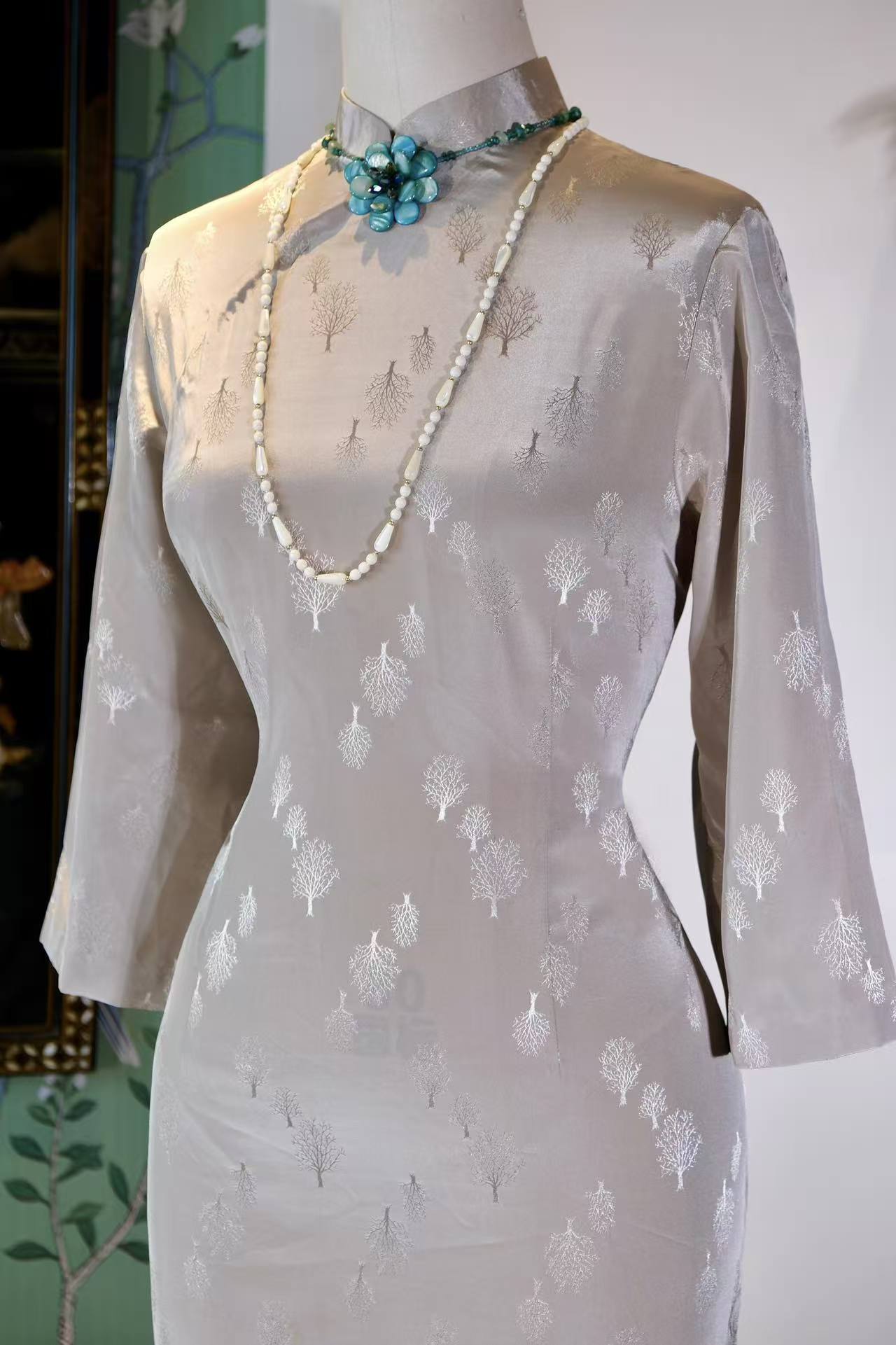
这件旗袍的面料以浅灰提花缎为底,通体遍布银白色“树状纹样”,其形态介于珊瑚枝与冬日枯树之间,枝桠舒展如书法飞白,疏密错落若水墨点染。细观纹样细节,每株“银树”皆以细密的经纬线织就,枝干挺拔处暗合《营造法式》中“材分制”的比例美学,末梢分叉则似《芥子园画谱》里的枯树法,既有自然之趣,又含人工之巧。
这种纹样并非简单的装饰,而是六十年代香港纺织业“中西合璧”的缩影。彼时香港作为远东纺织重镇,设计师常从传统纹样中汲取灵感,将宋瓷冰裂纹的“残缺美”、明代家具的“线条感”与西方Art Deco的几何抽象相融合。此处的“银树”既非写实植物,亦非纯粹抽象,恰如陈从周先生在《说园》中所言:“园林之景,贵在似与不似之间”,这种“意象化”的纹样处理,正是东方美学“以形写神”的绝佳体现。
二、衣以载史:港式旗袍的黄金年代
上世纪六十年代,是香港旗袍的“黄金时代”。彼时上海裁缝南下香江,将海派旗袍的“收腰、开衩、立领”与港式审美结合,形成独特的“港派旗袍”风格——更注重面料的华丽感与剪裁的国际化。这件旗袍的提花缎面料,正是当时香港纺织厂引进日本提花织机后的产物,其光泽度与垂坠感,远胜同期内地旗袍的棉麻材质。
从剪裁看,旗袍采用“一片式”平面剪裁,通过省道(dart)处理塑造胸腰曲线,领口微低呈“水滴领”,袖长及肘呈“喇叭袖”,这些细节均符合六十年代香港旗袍“西化改良”的特征。据《香港时装史》记载,1962年香港出口旗袍超百万件,主要销往东南亚与欧美,这件旗袍的“国际范”剪裁,正是当年“东方巴黎”时尚输出的见证。
三、稀缺性:时光淬炼的孤品价值
作为“古董衣”,这件旗袍的稀缺性体现在两方面:
- 面料绝版:六十年代港产提花缎因工艺复杂(需手工穿综、提花),产量极低,且随纺织技术迭代早已停产。如今所见提花面料,多为现代机器印花,缺乏这种经纬交织的“浮雕感”。
- 工艺失传:旗袍的“滚边”采用“双滚条”工艺——领口、袖口、开衩处均以同色缎面包边,内衬细棉绳,形成“外平内圆”的立体效果。这种工艺需裁缝手工缝制超200针,如今机器包边虽快,却失却了手工的温度。
四、艺术风格:新古典主义的东方表达
这件旗袍的艺术风格,可概括为“新古典主义东方风”。其“新”在剪裁——收腰、开衩的曲线美,暗合西方人体美学;其“古典”在纹样与材质——提花缎的光泽如宋代缂丝,银树纹样的意象化表达,又似明代文人画的“逸笔草草”。
这种风格与同时期西方时尚形成有趣对话:1960年代,Yves Saint Laurent推出“中国风”系列,将旗袍元素融入高级时装;而这件港产旗袍,则以东方视角回应西方潮流,正如艺术史家巫鸿所言:“东方主义不是单向的‘他者化’,而是双向的文化协商。”这件旗袍,正是这种“协商”的物质载体——它既非完全的“传统”,亦非彻底的“西化”,而是在时代浪潮中,东方美学对自身的一次优雅重构。
五、结语:衣褶里的时光诗学
抚摸这件旗袍,指尖能感受到提花缎的细腻肌理,仿佛触碰到六十年代香港的霓虹与海风。它曾属于哪位女子?是在中环写字楼里处理文件的职业女性,还是在半岛酒店参加晚宴的名媛?我们无从知晓,但衣褶里藏着的,是一个时代的审美密码与文化记忆。
如今,这件旗袍已成为“可穿戴的艺术品”——它不仅是服饰,更是研究六十年代香港纺织史、女性史、时尚史的“活化石”。正如本雅明在《机械复制时代的艺术作品》中所言:“原作的‘灵光’(aura)在于其独一无二的存在。”这件孤品旗袍的“灵光”,正在于它承载的时光重量与文化厚度,是任何现代复制品都无法替代的。
Silver Trees in Frost: An Eastern Aesthetic Narrative of a 1960s Hong Kong-Made Jacquard Satin Cheongsam
Measurements / Size Guide:
Bust / Waist / Hips: 104/100/112 cm
Total Length: 112 cm
Detailed Description:
I. Pattern Research: The Eastern Code of Silver Trees and Coral
The fabric of this cheongsam (qipao) uses a light gray jacquard satin as its base, covered with silver-white "tree-like motifs." Their form lies somewhere between coral branches and withered winter trees; the boughs stretch like the "Flying White" (Feibai) stroke in calligraphy, with a rhythmic density akin to ink-wash dabs. A close inspection reveals that each "silver tree" is woven with intricate warp and weft threads. The upright trunks align with the proportional aesthetics of the "Cai-Fen System" from the Yingzao Fashi (State Building Standards), while the forked tips resemble the withered tree techniques in the Manual of the Mustard Seed Garden. It possesses both natural charm and artisanal ingenuity.
This motif is a microcosm of the "East-meets-West" fusion in 1960s Hong Kong textiles. As a Far East textile hub, designers then drew inspiration from tradition, merging the "beauty of imperfection" from Song ceramics' ice-crackle glaze and the "linearity" of Ming furniture with the geometric abstraction of Western Art Deco. These "silver trees" are neither purely realistic nor entirely abstract—much like what Chen Congzhou noted in On Chinese Gardens: "The beauty of a landscape lies between resemblance and non-resemblance." This "imagistic" treatment is a perfect manifestation of the Eastern aesthetic principle of "using form to depict the spirit."
II. History through Raiment: The Golden Age of Hong Kong Qipaos
The 1960s was the "Golden Age" of the Hong Kong qipao. Tailors from Shanghai migrated south, combining the "cinched waist, side slits, and standing collar" of the Shanghainese style with Hong Kong’s evolving tastes, creating the unique "Hong Kong Style"—one that emphasized luxurious fabrics and internationalized tailoring. The jacquard satin of this piece is a product of Hong Kong textile mills utilizing imported Japanese jacquard looms; its luster and drape far surpassed the cotton and linen materials prevalent in Mainland China during the same period.
In terms of cut, the qipao utilizes a "one-piece" flat pattern shaped into curves through darts. The slightly lowered "Teardrop" neckline and elbow-length "Flare" sleeves are classic hallmarks of 1960s Hong Kong's Westernized refinements. According to The History of Fashion in Hong Kong, the city exported over a million qipaos in 1962, primarily to Southeast Asia and the West. This "international" silhouette is a testament to the fashion output of the "Paris of the East."
III. Scarcity: The Unique Value Tempered by Time
As an "antique garment," its scarcity is manifested in two aspects:
-
Extinct Fabric: 1960s Hong Kong-produced jacquard satin required complex processes (manual heddle-threading and weaving) and has long since ceased production due to technological iterations. Modern jacquard is often machine-printed and lacks this woven "relief" texture.
-
Lost Craftsmanship: The piping utilizes the "Double-Roll" (Shuang Gun) technique—the collar, cuffs, and slits are bound with tonal satin, lined with fine cotton cord to create a three-dimensional effect: "flat on the outside, rounded on the inside." This requires over 200 hand-sewn stitches. While modern machine binding is faster, it lacks the warmth of the human hand.
IV. Artistic Style: An Eastern Expression of Neoclassicism
The style of this cheongsam can be summarized as "Neoclassical Chinoiserie." It is "New" in its tailoring—the curves of the waist and slits align with Western body aesthetics. It is "Classical" in its motifs and material—the luster of the satin mirrors Song Dynasty Kesi silk, while the imagistic silver trees echo the "effortless brushwork" of Ming Dynasty literati paintings.
This style engages in an interesting dialogue with contemporaneous Western fashion. In the 1960s, Yves Saint Laurent launched his "Chinoiserie" collections, integrating qipao elements into Haute Couture. Conversely, this Hong Kong-made piece responds to Western trends from an Eastern perspective. As art historian Wu Hung noted: "Orientalism is not a one-way 'othering,' but a two-way cultural negotiation." This qipao is the material carrier of that negotiation—neither entirely "traditional" nor thoroughly "Westernized," but an elegant reconstruction of Eastern aesthetics amid the waves of the era.
V. Conclusion: Temporal Poetics within the Folds
Touching this cheongsam, one can feel the delicate texture of the jacquard, as if touching the neon lights and sea breezes of 1960s Hong Kong. To whom did it belong? A professional woman in a Central office or a socialite at a Peninsula Hotel gala? We may never know, but hidden within the folds are the aesthetic codes and cultural memories of an era.
Today, this qipao has become a "wearable work of art"—a living fossil for studying textile, female, and fashion history. As Walter Benjamin noted in The Work of Art in the Age of Mechanical Reproduction, the "Aura" of an original lies in its unique existence. The "Aura" of this unique piece lies in its weight of time and cultural depth—something no modern replica can ever replace.
Share