深圳溯源
60年代 - 锦瑟华年:六十年代港制团花纹旗袍考释 | 1960s - Years of Splendor: An Archaeological Interpretation of a 1960s Hong Kong-Made Medallion-Pattern Cheongsam
60年代 - 锦瑟华年:六十年代港制团花纹旗袍考释 | 1960s - Years of Splendor: An Archaeological Interpretation of a 1960s Hong Kong-Made Medallion-Pattern Cheongsam
Couldn't load pickup availability
锦瑟华年:六十年代港制团花纹旗袍考释
衣服尺寸:
胸围/腰围/臀围:106/88/106 厘米
衣长:103 厘米
细节描述:
一、纹样解码:青铜器上的吉光片羽
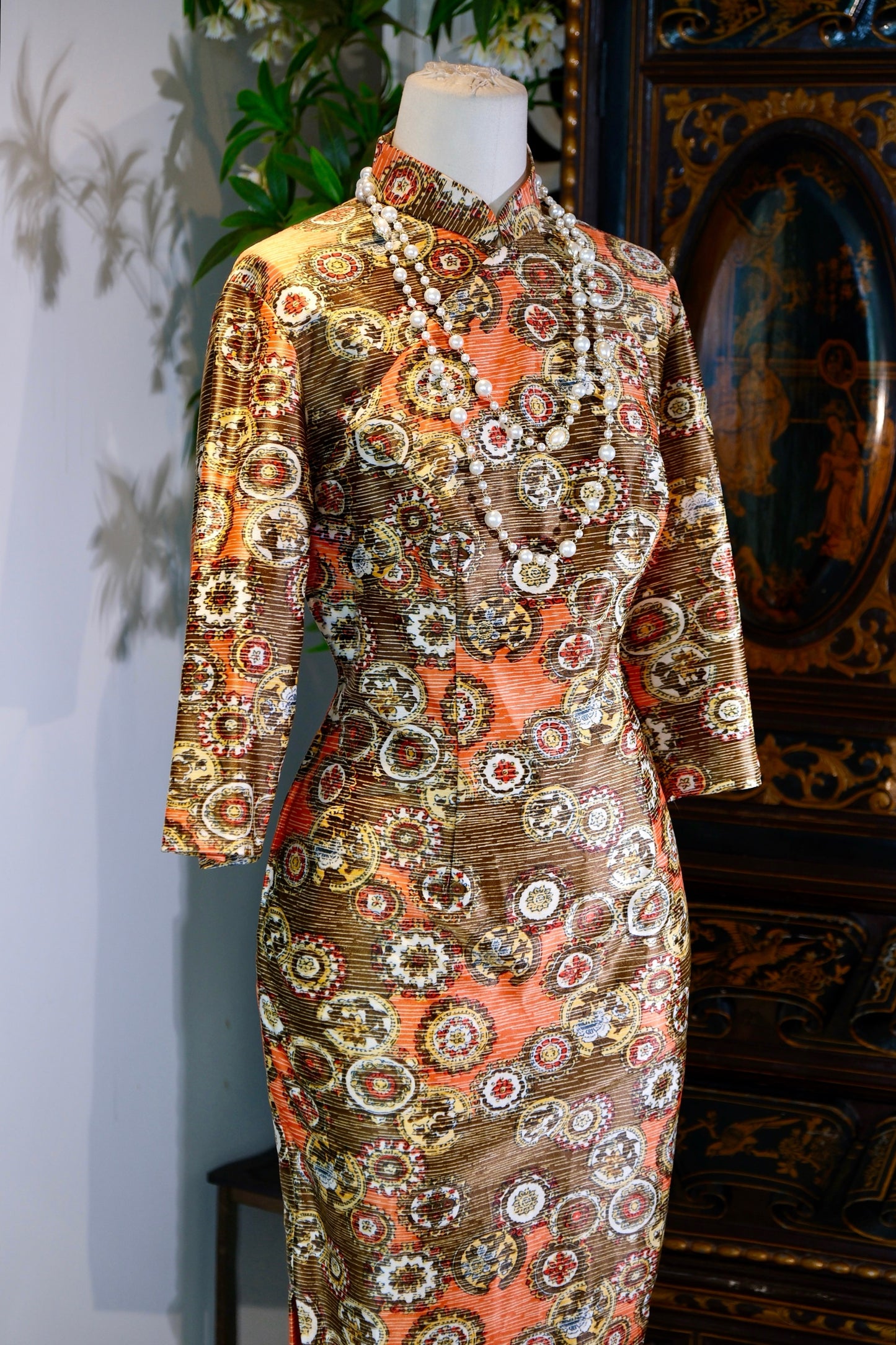
这件旗袍的面料堪称“行走的博物馆”。其主体纹样脱胎于商周青铜器上的“团花”(亦称“团窠纹”),以圆形为基本框架,内部嵌套变形夔龙纹、云雷纹与几何花卉。
- 色彩密码:主色调为“缃叶色”(浅橙黄)与“檀色”(浅赭)交织,间以金线勾勒,暗合《考工记》“青与赤谓之文,赤与白谓之章”的古法配色。纹样单元呈“米”字形排列,既保留青铜器的庄重感,又通过色彩渐变打破沉闷,恰如《长物志》所言“古雅可爱,又坐卧依凭,无不便适”。
二、衣以载史:香江畔的东方衣冠
1960年代的香港,是传统与现代碰撞的熔炉。这件旗袍的诞生,恰是“海派旗袍”南传后的在地化结晶:
- 时代印记:彼时香港制衣业受西方影响,旗袍开始引入“公主线”剪裁(图中可见胸腰省道的立体处理),但依然坚守高领、斜襟、七分袖的传统形制。领口高度约4.5厘米,既非五十年代的“元宝领”夸张,亦非七十年代的“低领”开放,恰是六十年代“含蓄改良”的缩影。
- 文化隐喻:团花纹在青铜器上象征“天命神授”,至明清演变为“吉祥圆满”的世俗符号。六十年代香港社会动荡,穿此纹样旗袍的女性,或借古纹样寄托“团圆安稳”之愿,与张爱玲《更衣记》中“旗袍上的每一道滚边,都是时代的注脚”形成跨时空呼应。
结语:锦灰堆里的东方美学
这件旗袍不是简单的衣物,而是一封“穿在身上的情书”——写给青铜时代的纹样,写给六十年代香江的繁华旧梦,写给所有在时光中坚守东方美学的灵魂。当金线在灯光下流转,我们看到的不仅是面料的光泽,更是一个时代对“古雅”的执着,一种文化在变迁中的韧性。
若说“衣冠是文明的皮肤”,那么这件旗袍,便是六十年代香港最温润的一块“皮肤标本”,值得被收藏,更值得被讲述。
Years of Splendor: An Archaeological Interpretation of a 1960s Hong Kong-Made Medallion-Pattern Cheongsam
Measurements / Size Guide:
Bust / Waist / Hips: 106/88/106 cm
Total Length: 103 cm
Detailed Description:
I. Decoding the Pattern: Shards of Light from Ancient Bronzes
The fabric of this cheongsam (qipao) is essentially a "walking museum." Its primary motif is derived from the "Medallion" (also known as Tuanke pattern) found on Shang and Zhou dynasty bronzewares. It uses a circular frame as its base, nested with stylized Kui-dragon motifs, Cloud-and-Thunder patterns, and geometric florals.
-
Color Code: The palette interweaves "Xiang Ye" (pale orange-yellow) and "Tan" (pale ochre), outlined with gold thread. This aligns with the ancient color theory in the Artificers' Record: "The fusion of blue and red is called Wen; red and white is called Zhang." The pattern units are arranged in a "radial" grid, preserving the solemnity of bronze artifacts while breaking the monotony through color gradients—echoing the Treatise on Superfluous Things: "Ancient and elegant, convenient for both sitting and leaning."
II. Clothing as History: Eastern Vestments by the Fragrant Harbor
1960s Hong Kong was a melting pot of tradition and modernity. The birth of this cheongsam is a localized crystallization of the "Shanghai Style" after its southward migration:
-
Epochal Mark: Influenced by Western tailoring, Hong Kong’s garment industry began incorporating "Princess Seams" (visible in the three-dimensional darting of the chest and waist), yet remained steadfast in traditional forms like high collars, diagonal bodices, and three-quarter sleeves. The collar height is approximately 4.5 cm—neither the exaggerated "Yuanbao collar" of the 50s nor the open "low collar" of the 70s—serving as a microcosm of the 1960s "reserved refinement."
-
Cultural Metaphor: In bronze art, the medallion symbolized "Mandate of Heaven"; by the Ming and Qing dynasties, it evolved into a secular symbol of "Harmony and Perfection." Amidst the social shifts of 60s Hong Kong, women wearing this pattern may have channeled ancient motifs to wish for "stability and reunion," resonating across time with Eileen Chang’s Chronicle of Changing Clothes: "Every piping on a qipao is a footnote to its era."
Conclusion: Eastern Aesthetics within the "Ashes of Splendor"
This cheongsam is not merely a garment; it is a "wearable love letter"—written to the motifs of the Bronze Age, to the flourishing dreams of 1960s Hong Kong, and to every soul that persists in Eastern aesthetics through the passage of time. As the gold threads shimmer under the light, we see more than just the luster of fabric; we witness an era’s obsession with "classical elegance" and the resilience of a culture amidst change.
If "clothing is the skin of civilization," then this cheongsam is the most supple "specimen of skin" from 1960s Hong Kong, worthy of being collected, and even more worthy of being told.
Share