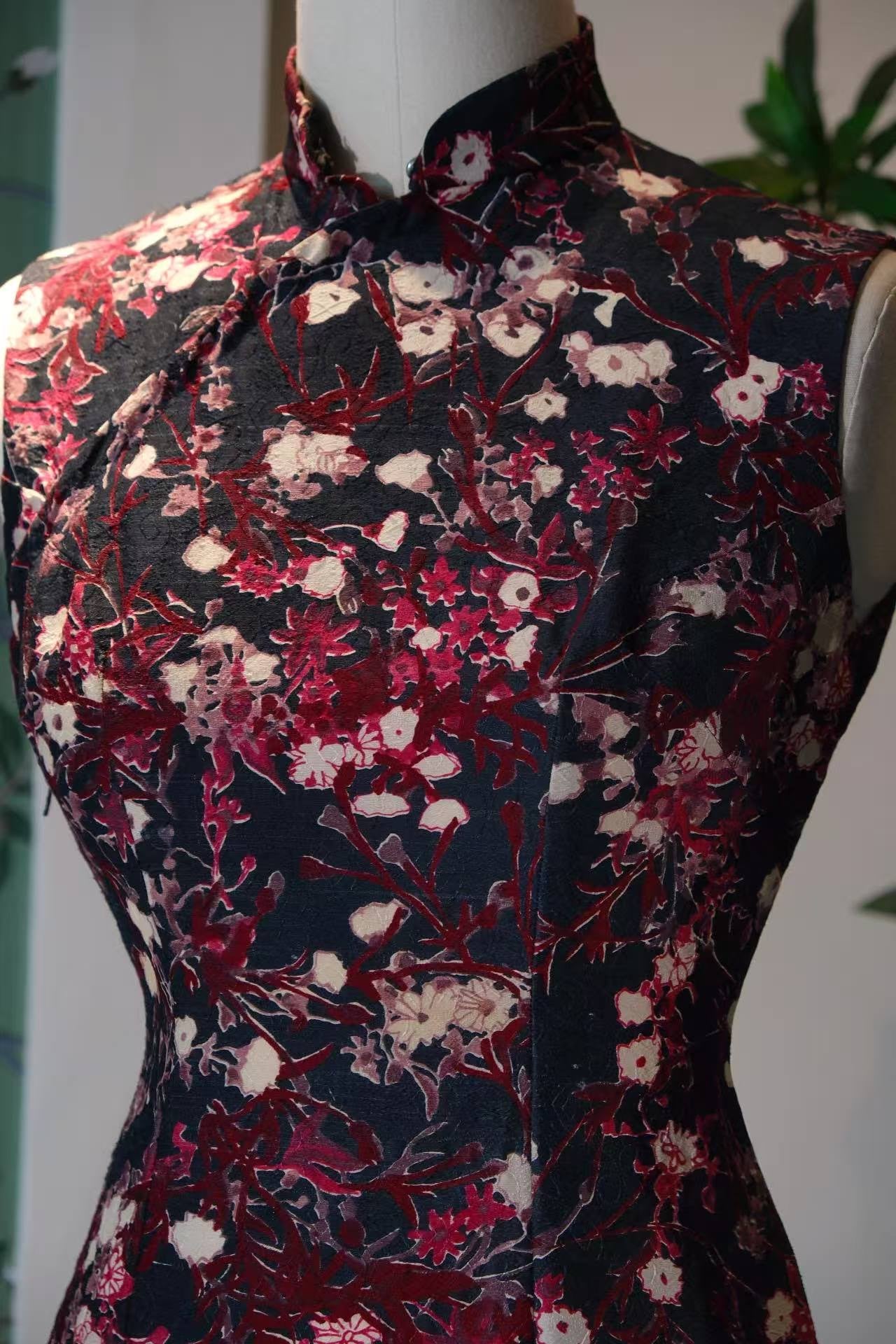
分享一件上世纪六十年代香港产羊毛混纺浮雕提花梅花古董旗袍。
深如夜幕的黑色底料上,一枝枝梅花正以浮雕般的立体姿态悄然绽放——这不是寻常印花,而是羊毛混纺提花工艺的绝响:丝线在布料上浮凸如雪,花瓣层层叠叠,枝干虬劲如铁,暗合王安石“墙角数枝梅,凌寒独自开”的孤高气韵,亦似《红楼梦》中“梅魂竹魄”的文心隐喻。这件六十年代香港高级定制旗袍,以黑为墨,以花为诗,将东方文人精神凝于方寸衣襟,成为时光筛下的“孤本风华”。
旗袍主体以纯黑色羊毛混纺提花面料为底,其上梅花纹样非平面印染,而是通过“提花织造”在上面形成毫米级浮雕。梅花布局取法宋代《梅花谱》的“孤枝独放”构图——无伴花衬,唯一枝傲然自下而上伸展,恰似林逋“疏影横斜水清浅”的孤绝意境,亦暗合《论语》“岁寒,然后知松柏之后凋也”的文人风骨。
六十年代香港设计师将传统梅花意象解构为“抽象浮雕”,以羊毛混纺的天然肌理强化了梅花“冷香浮动”的触感。当灯光掠过,丝线在黑色底面上流转如星,花瓣的立体层次随视角变幻,恍如王维“月出惊山鸟”的动态禅意——一件衣裳,竟成流动的文人画。
这件旗袍记录了六十年代香港“传统文脉的现代转译”——梅花本为江南文人意象,却在殖民地语境下,成为南下女性“守拙持真”的精神隐喻。
今人抚过旗袍的梅花浮雕,指尖能触到半世纪前的时光:羊毛的粗粝感里藏着匠人指尖的温度,金线的冷光中映着维多利亚港的夜色。它不单是一件衣裳,更是东方美学在时代洪流中的“静水深流”——当梅花在黑色绒面上静默绽放,我们听见的,是文人骨血与现代风华的永恒对话。
Sharing a vintage qipao (cheongsam) from 1960s Hong Kong, crafted from a wool-blend jacquard fabric with a raised, bas-relief plum blossom pattern.
Upon a base fabric as deep as the night sky, plum blossoms unfurl silently, rendered in a three-dimensional, bas-relief texture. This is no ordinary print, but the exquisite work of wool-blend jacquard weaving: the threads emerge like snow upon the fabric, the petals layered, and the branches sinewy like iron. This perfectly captures the aloof spirit of the poet Wang Anshi's verse, "A few plum branches by the wall, opening alone in the cold," and mirrors the literary metaphor of "Plum Soul, Bamboo Spirit" found in Dream of the Red Chamber. This piece, a high-end bespoke qipao from 1960s Hong Kong, uses black as ink and flowers as poetry, condensing the Eastern literati spirit into the fabric of a garment, making it a "solitary splendor" sifted by time.
The main body of the qipao utilizes a pure black wool-blend jacquard fabric as its ground. The plum blossom pattern upon it is not flatly dyed, but realized through "jacquard weaving" to form a millimeter-level bas-relief. The composition of the plum blossoms takes inspiration from the Song Dynasty's Plum Blossom Catalogue, favoring the "solitary branch unfolding" arrangement—no accompanying flowers, only a proud branch extending upwards from the base. This resonates with the stark, solitary beauty of Lin Bu's verse, "Sparse shadows slant across the clear, shallow water," and quietly aligns with the literati fortitude of Confucius's saying in The Analects, "It is when the year is coldest that one knows the pine and cypress are the last to fade."
Hong Kong designers of the sixties deconstructed the traditional plum blossom imagery into "abstract bas-relief," using the natural texture of the wool blend to enhance the palpable sensation of the plum blossom's "cold fragrance gently drifting." When the light sweeps over it, the threads shimmer across the black ground like stars, and the three-dimensional layers of the petals shift with the viewer's perspective, creating a dynamic, meditative quality reminiscent of Wang Wei's poetic line, "The moon emerges, startling the mountain birds"—a garment that transforms into a flowing scholar's painting.
This qipao documents Hong Kong's sixties trend of "modern interpretation of traditional cultural lineage." The plum blossom, originally an icon of Jiangnan literati, became a spiritual metaphor for female migrants in the colonial context, representing the spirit of "holding onto simplicity and truth."
When one touches the plum blossom bas-relief today, the fingertips can feel the texture of half a century ago: the roughness of the wool conceals the warmth of the artisan's touch, and the cool sheen of the threads reflects the night lights of Victoria Harbour. It is more than just a garment; it is a "deep stream running quietly" for Eastern aesthetics within the torrent of history. As the plum blossoms bloom silently on the black fleece surface, what we hear is the eternal dialogue between the soul of the literati and the sophistication of the modern era.