深圳溯源
无法加载取货服务可用情况
衣服尺寸:
胸围/腰围/臀围:90/70/94 厘米
衣长:112 厘米
细节描述:
【引言】
张爱玲曾言:“衣服是一种言语,随身带着一种袖珍戏剧。”当我们凝视这件上世纪五十年代的香港产古董旗袍时,我们看到的不仅是一件衣物,更是一段被封存在丝缕间的流金岁月。作为研究服装史的学者,我深知这一时期在旗袍演变史上的特殊地位——它是海派风韵南移后,在香港这片土地上结出的成熟果实,既有传统的骨相,又有现代都市的摩登灵魂。
【面料与纹样:低调的奢华】
这件旗袍最引人入胜之处,在于其面料的独特选择。不同于常见的光面素绉缎或平纹棉布,它采用了一种极具质感的提花肌理面料。
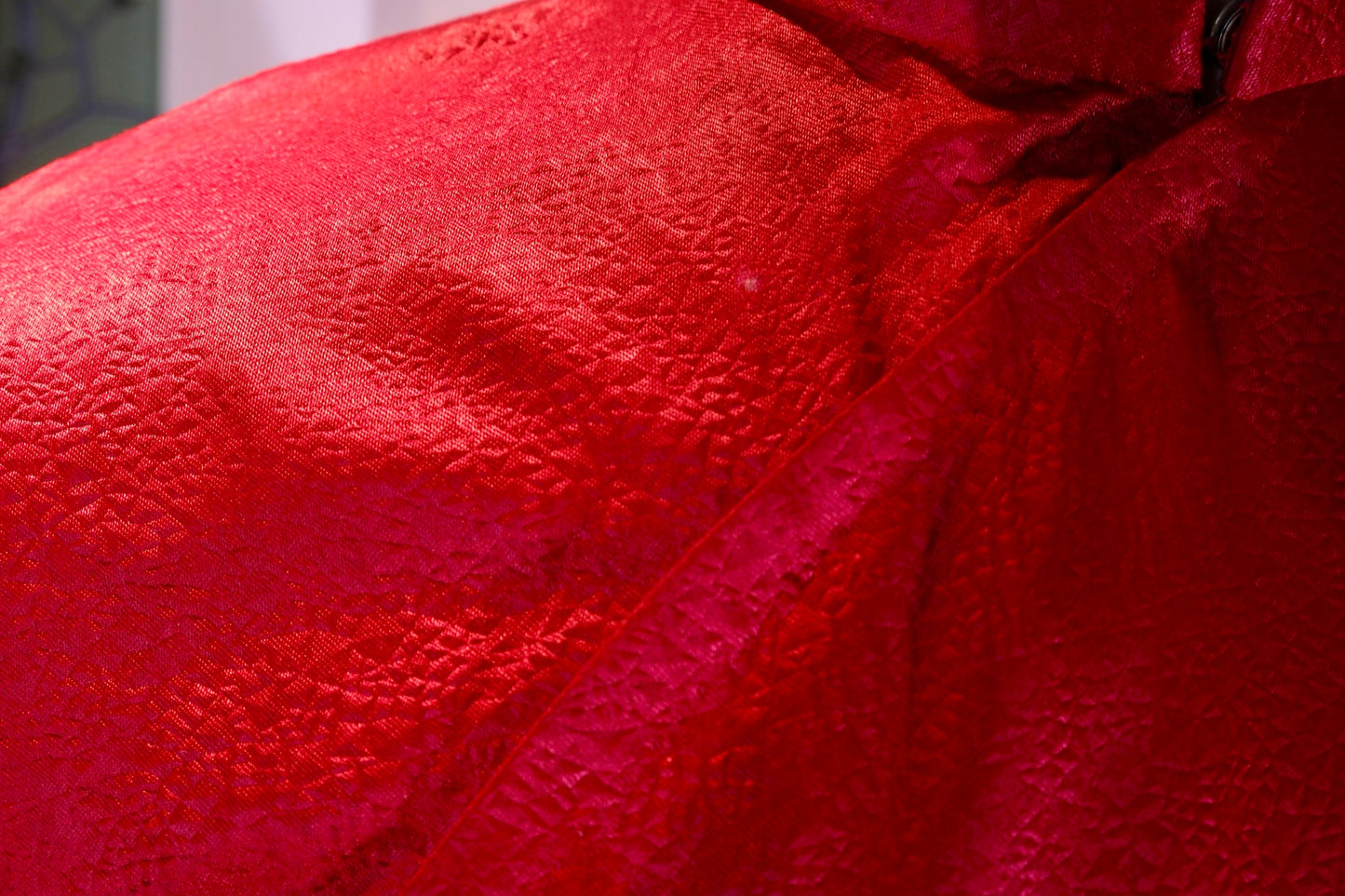
请仔细观察图六与图七的微距细节,这是一种典型的“暗纹织锦”工艺。面料表面布满了细密而规则的几何菱形纹理(类似龟背纹或冰裂纹的变体)。这种纹样并非印染而成,而是通过经纬线的交织变化,在织物表面形成物理上的凹凸触感。
- 视觉语言: 这种肌理在光线下会产生漫反射,使得正红色呈现出一种深邃而不张扬的哑光质感,宛如陈年红酒般醇厚。
- 文化隐喻: 在中国传统纹样学中,这种连绵不断的几何纹路象征着“生生不息”与“富贵不断头”。它摒弃了具象的花鸟龙凤,转而追求抽象的形式美,这正是五十年代受西方现代主义设计思潮影响,追求简约与功能并重的审美体现。
【形制与剪裁:黄金时代的绝唱】
从整体廓形来看,这件旗袍完美诠释了五十年代香港旗袍的精髓——极致的曲线美与克制的含蓄感并存。
- 立领: 领口高度适中,紧扣颈部线条,展现出东方女性特有的端庄与矜持。
- 归拔工艺: 请注意腰部的收省与臀部的圆润过渡。那个年代的裁缝讲究“三分做,七分烫”,通过高超的“归拔”熨烫技艺,使平面的布料顺应人体的起伏,无需过多的分割线便能塑造出S型的曼妙身姿。
- 短袖设计: 微微外扩的短袖口,既修饰了手臂线条,又增添了几分夏日的清凉与俏皮,是那个时代名媛出入社交场合的经典装束。
【历史回响:香江旧梦】
二十世纪五十年代的香港,正处于东西方文化剧烈碰撞与融合的熔炉期。随着上海纺织业精英的南下,香港的旗袍制作技艺达到了巅峰。这件旗袍极有可能出自当时中环或上环某家知名洋服店或老式裁缝铺之手。
想象一下,在那个没有快时尚的年代,一位优雅的淑女,或许是在备战一场重要的晚宴,或许是去利舞台听一曲粤剧,她走进裁缝店,挑选了这匹寓意吉祥的红底肌理绸。裁缝师傅拿着软尺,在她身上反复比划,每一针一线都倾注了对美的敬畏。这件衣服,见证了战后香港社会的复苏与繁荣,也承载了一位女性对美好生活的向往。
【稀缺性与收藏价值】
《诗经·秦风》云:“锦衣狐裘,颜如渥丹。”古人以锦衣华服喻君子之德与盛世之容。
这件旗袍之所以珍贵,不仅因为其保存完好、色泽依旧艳丽如初(这种正红色在经历半个多世纪后极易氧化褪色,能保持如此饱和度实属罕见),更因为它代表了手工成衣时代的终结。
在当今工业化流水线生产的洪流中,这种需要耗费数日工时进行归拔定型、使用复杂提花面料制作的古董旗袍,已成凤毛麟角。它不仅是一件可供穿着的艺术品,更是研究五十年代东亚服饰文化变迁的活化石。
【结语】
穿上它,不仅是穿上一件红色的衣裳,更是披上了一段关于优雅、关于匠心、关于那个回不去的黄金时代的记忆。愿得有心人,续写这段未完的锦绣篇章。
注释:微瑕特价
Measurements / Size Guide:
Bust / Waist / Hips: 90/70/94 cm
Total Length: 112 cm
Detailed Description:
Within the technical domains of textile conservation, structural design history, and material culture analysis, an exceptional historical garment functions as an active social text. It documents a precise intersection of ancestral handcraft and localized modernization.
This magnificent 1950s Hong Kong-produced textured silk jacquard qipao (红地暗纹提花肌理古董旗袍) stands as a pristine physical testament to that rare post-war golden era. It materializes a highly complex sartorial dialogue where traditional mainland tailoring methodologies converge with Westernized, highly disciplined pattern architecture. For curators, textile historians, and institutional archives, this specimen preserves a critical, early chapter in the evolution of the true Hong Kong silhouette.
The physical construction of this qipao exemplifies the zenith of post-war textile manipulation, reflecting the immediate decade following the southward migration of elite mainland master tailors to the colony.
The 1950s Hong Kong tailoring matrix relies on a traditional high Mandarin collar to establish a dignified postural enclosure. This architectural foundation moves into micro-extended cap sleeves for anatomical framing, before utilizing advanced hot-iron blocking and damp-tension manipulation (归拔工艺) to seamlessly shape the torso without excessive cutting lines, resulting in a highly tapered, high-compression S-curve column.
The Mechanics of Gui-Ba Iron Manipulation: Unlike late-century commercial patterns that rely on excessive seam lines and cutting panels to achieve a close fit, this 1950s specimen relies on the ancestral master methodology of Gui-Ba. Through the strategic application of heat, dampness, and physical tension, the master tailor stretched and shrunk the flat, two-dimensional silk matrix directly over structural dress forms. This allowed the fabric to permanently curve around the bust, pinch tightly at the waist, and expand over the hips without unnecessary seam lines, creating a flawless S-curve silhouette that acts like a second skin.
Anatomical Framing: The garment features a disciplined, moderate Mandarin collar that fits snugly against the neck to command an upright, elegant posture. This lines up with micro-extended short sleeves (短袖设计) that subtly flare outward, structural tailoring details designed to soften the shoulder line while offering summer mobility for elite social functions.
The exceptional value of this specimen rests primarily upon its non-traditional material chassis: a high-density, tone-on-tone textured jacquard brocade (暗纹织锦/提花肌理面料) that moves away from superficial surface imagery.
The Physics of Mat-Refraction: Under micro-lens evaluation, the primary base layer reveals a dense, highly disciplined grid of geometric rhombuses (variants of traditional tortoise-shell or ice-crackle matrices). Rather than utilizing metallic threads to catch light in harsh, flat reflections, these physical geometric indentations cause ambient light to scatter in a soft, low-luster matte finish. This allows the deep celebratory red hue to shift between rich wine tones and bright crimson highlights across the tailored curves.
The Modernist Cultural Shift: In traditional Chinese textile semiotics, continuous geometric matrices symbolize eternal generation and unending prosperity (“生生不息、富贵不断头”). However, by choosing an abstract, textured geometric ground over literal representations of dragons, phoenixes, or seasonal flowers, this 1950s textile documents the direct influence of mid-century Western modernist design principles, prioritizing functional textures and sleek abstraction.
To appreciate the rarity of this qipao is to understand the socio-industrial transformation of 1950s Hong Kong—a unique post-war enclave where traditional skills met a rising global economy.
The Ateliers of Central and Sheung Wan: Following mid-century geopolitical shifts, elite tailors from the traditional textile centers of Shanghai relocated to Hong Kong, establishing high-end ateliers across the Central and Sheung Wan districts. This garment is a direct relic of that migratory golden era, likely commissioned by a prominent lady of society for an evening gala or an outing to the historic Lee Theatre (利舞台).
Material Longevity: True 1950s original specimens preserved with this level of color saturation are incredibly rare. High-density red silk dyes from this specific era are exceptionally vulnerable to natural atmospheric oxidation and fading over a seventy-year horizon. The pristine condition of this piece indicates it was protected inside high-tier ancestral heirloom chests or specialized private institutional vaults, shielding it completely from environmental degradation.
To properly situate this artifact within the broader text of material culture, its aesthetics can be cross-referenced with foundational Chinese literature and historical fashion essays:
The Pocket Theater of Identity: As famously observed by Eileen Chang (张爱玲), clothing serves as a silent, personal pocket theater (“衣服是一种言语,随身带着一种袖珍戏剧”). This 1950s qipao acts as a physical script of cultural negotiation—retaining the conservative, dignified collar bone structure of the East while embracing the high-compression silhouette of Western post-war glamour.
The Metaphor of Virtue: The overarching presence of the gown mirrors the classical idioms found in the Book of Odes (诗经·秦风): "锦衣狐裘,颜如渥丹" (Brocade robes and fox furs, a countenance as radiant as cinnabar), where premium garments are treated not merely as decoration, but as physical evidence of personal refinement and dignity.
As an irreplaceable, non-renewable piece of mid-century textile history, this textured jacquard qipao transcends standard vintage classifications, advancing directly into institutional and museum-grade collection spheres.
Collection Compatibility: This artifact is ideally spec'd for inclusion in institutional fashion archives, dedicated museum collections focusing on regional textile histories, high-end fine art auctions, or elite private conservation portfolios.
Preservation Mandate: To ensure the longevity of the organic silk fibers and prevent further oxidation of the red dyes, the garment must be maintained under strict climate-controlled parameters (temperature 18°C–22°C, relative humidity 45%–55%), shielded entirely from direct ultraviolet exposure to prevent fiber breakdown.
Suyuan Archival Textile Registry — Documenting the material culture, preserving the technical lineage of ancestral craft.
Note:As-Is Special Price