深圳溯源
无法加载取货服务可用情况
衣服尺寸:
胸围/腰围/臀围/衣长:100/90/106/93 厘米
细节描述:
这是一件极具研究价值与审美意趣的六十年代台湾产古董旗袍,它不仅是服饰史的实物见证,更是一段跨文化工艺交流的缩影。
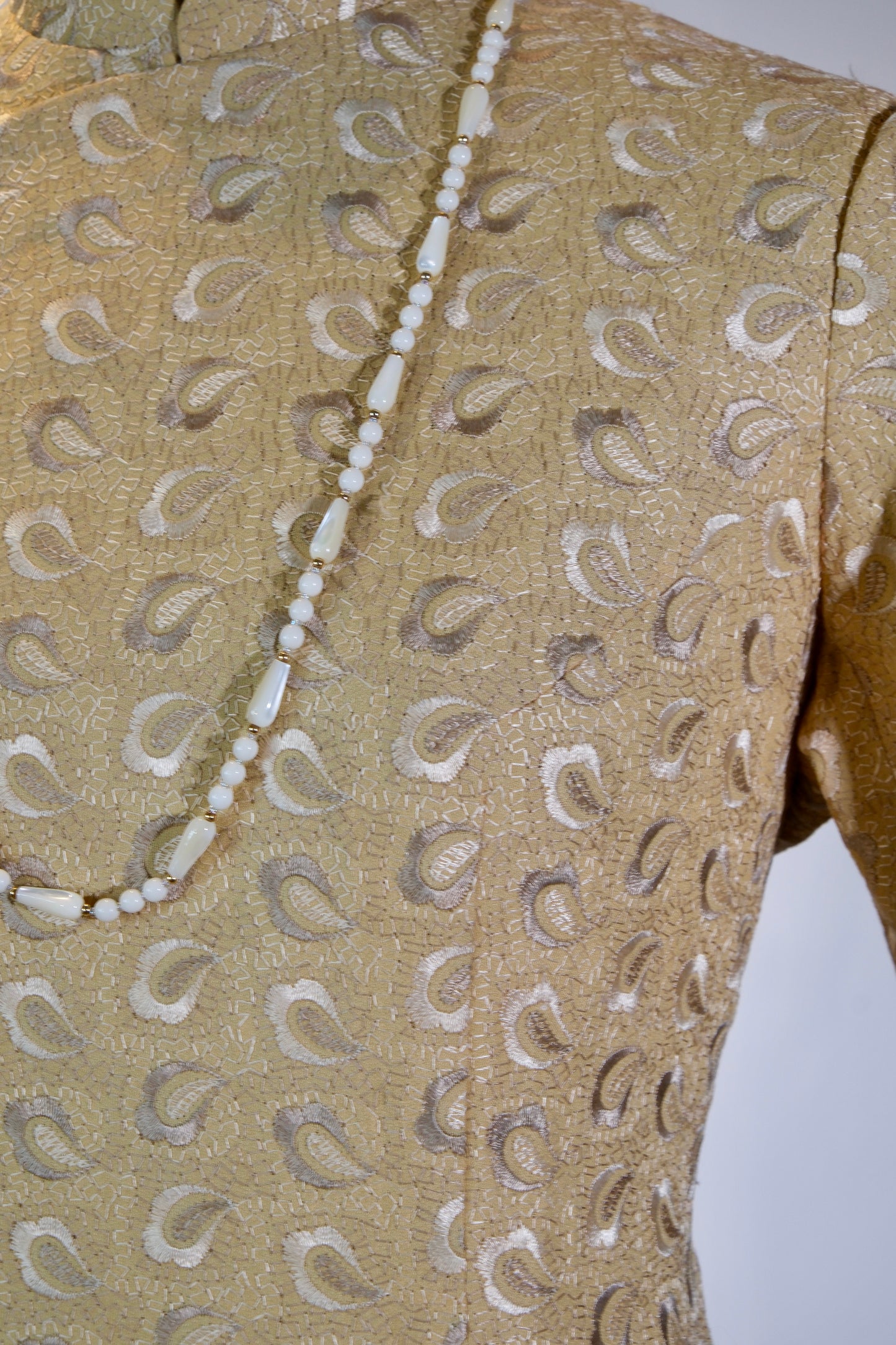
图案描述:佩斯利纹样的东方转译
这件旗袍最引人注目的,是其通体铺陈的佩斯利纹样。这种源自古波斯、形如泪滴或芒果的涡旋花纹,在清代经由丝绸之路传入中国后,被民间称为“火腿纹”或“腰果花”。
在这件作品中,纹样并非传统的平面印染,而是采用了意大利进口机绣工艺。
- 立体肌理:绣线在米金色底料上堆叠出浮雕般的质感,光线流转间,银白与浅褐交织的丝线呈现出微妙的光泽变化。
- 秩序与韵律:纹样以严谨的矩阵排列,却又通过绣线的走向打破了呆板。每一个“泪滴”内部都包含了细腻的填心针法,宛如无数只凝视的眼睛,既有西洋装饰艺术的几何理性,又保留了东方刺绣的温润含蓄。
古董衣的故事:海岛风华与西风东渐
上世纪六十年代的台湾,正处于旗袍发展的“黄金余晖”期。彼时,随着纺织工业的进步与西方时尚观念的涌入,台湾旗袍在继承海派传统的同时,开始大胆吸纳国际元素。
这件旗袍便是那个时代的混血儿。
- 材质的对话:它选用了当时被视为高档面料的进口织锦或混纺料,挺括而不易起皱,适应了亚热带的气候与现代女性的快节奏生活。
- 工艺的革新:不同于旧时全手工的慢工细活,“意大利进口机绣”代表了当时对效率与精致并存的追求。这种机器刺绣并非廉价的代名词,在那个年代,它象征着一种摩登的、工业化的奢华。
- 剪裁的演变:观察其肩线与袖口,采用了典型的六十年代西式装袖结构,而非传统的连袖。这种剪裁更能凸显女性的肩部线条,配合收紧的腰身与及膝的长度,展现了当时女性从“闺秀”向“职业女性”转型的身体解放。
艺术风格与稀缺性:引经据典的审美考证
张爱玲曾在《更衣记》中写道:“对于细节的过分的注意,为这一时期的服装的要点。”这件旗袍正是这一论断的绝佳注脚。
1. 中西合璧的典范:
它将源自波斯的佩斯利纹样、意大利的机械刺绣技术、以及中国传统的立领盘扣结构完美熔于一炉。这种文化杂糅正是六十年代港台服饰文化的核心特征。它不再仅仅是传统的延续,而是全球化早期时尚贸易的活化石。
2. 稀缺的工艺标本:
随着七十年代成衣工业的全面爆发,这种结合了特定进口面料与高精度机绣的古董旗袍存世量日益稀少。如今的机器刺绣往往追求速度而失之于粗糙,而这件作品中的针法密度与光泽控制,即便置于今日的高级定制工坊中,亦属上乘。
3. 色彩的心理学:
其主色调为香槟金配银灰,这是一种极具高级感的配色。古人云“金风玉露一相逢”,这种色彩既避开了正黄的俗艳,又超越了素白的清冷,恰如其分地诠释了六十年代都市女性那种“克制的华丽”。
综上所述,这件旗袍不仅是一件衣物,更是一篇穿在身上的历史论文。它以针线为笔,记录了那个时代东西方文明在远东岛屿上的一次美妙邂逅。
Measurements / Size Guide:
Bust / Waist / Hips / Total Length: 100/90/106/93 cm
Detailed Description:
This 1960s Taiwanese antique qipao holds immense research value and aesthetic charm, serving not only as a physical document of apparel history, but as a vivid microcosm of mid-century cross-cultural craftsmanship.
The most striking feature of this qipao is the all-over Paisley pattern. Originating from ancient Persia and shaped like a teardrop or cashew fruit, this curling botanical motif arrived in China during the Qing dynasty via the Silk Road, where it became known in local terminology as the "cashew flower" (yaoguohua) or "ham motif" (haituiwen).
In this piece, the motif transcends standard surface printing through the execution of imported Italian machine embroidery:
Dimensional Texture: The embroidery threads build up a relief-like, embossed surface over a champagne-gold base fabric. As light sweeps across the garment, the interwoven silver-white and soft brown silk threads express subtle variations in sheen.
Order and Cadence: The pattern is organized in a disciplined matrix, yet the calculated directionality of the stitch work breaks any sense of rigidity. Inside each teardrop shape lies delicate fill-stitching, capturing both the geometric rationality of Western Art Deco and the gentle, understated warmth of Eastern embroidery.
The 1960s in Taiwan represented a "golden afterglow" in the evolution of the qipao. As textile manufacturing advanced and international fashion influences flooded in, Taiwanese dressmakers maintained Shanghai-style (Haipai) foundations while boldly incorporating global elements.
This qipao represents a true hybrid of that era:
Dialogue of Materials: It utilizes imported brocade or fine structured blend fabric—highly regarded as a luxury material at the time. Crisp and resistant to creasing, it accommodated both the subtropical climate and the active lifestyle of modern women.
Innovation in Craftsmanship: Moving beyond slow, completely manual work, imported Italian machine embroidery represented a mid-century pursuit of combined efficiency and technical precision. Far from implying cheap mass production, machine embroidery during this decade symbolized modern, industrialized luxury.
Evolution of Tailoring: Examining the shoulder line and armholes reveals the set-in sleeve structure characteristic of 1960s Western fashion, departing from traditional seamless sleeve cuts. This construction defines the shoulder line, while the tapered waist and knee-length hem celebrate the bodily liberation of women transitioning into professional and civic life.
Eileen Chang noted in Reflections on Clothing (更衣记) that "An obsessive focus on detail formed the core essence of attire during this period." This qipao stands as a textbook illustration of her observation.
A Model of East-West Fusion: It seamlessly unites Persian-origin Paisley motifs, Italian mechanical embroidery technology, and traditional Chinese mandarin collars with frog closures (pankou). This cultural synthesis formed the heart of mid-century garment culture across Hong Kong and Taiwan, preserving an active specimen of early global fashion trade.
A Scarce Craft Specimen: With the surge of ready-to-wear garment manufacturing in the 1970s, antique qipaos combining specialized imported textiles with high-precision machine embroidery became increasingly rare. Modern machine embroidery often prioritizes speed over density, whereas the stitch count, structural stability, and luster control of this piece rival high-fashion haute couture ateliers.
Color Psychology: The palette—champagne gold paired with silver-grey—projects sophisticated elegance. Echoing the classical phrase "When the golden autumn wind meets the shimmering jade dew," the colors avoid gaudy yellow while transcending cold white, perfectly capturing the "restrained opulence" of 1960s urban women.
This qipao is far more than an item of apparel; it is a historical thesis worn upon the body. Written with needle and thread, it records an exquisite encounter between Eastern and Western aesthetics upon a mid-century island.