深圳溯源
无法加载取货服务可用情况
衣服尺寸:
胸围/腰围/臀围:96/80/106 厘米
衣长:109 厘米
细节描述:
一、图案描述:
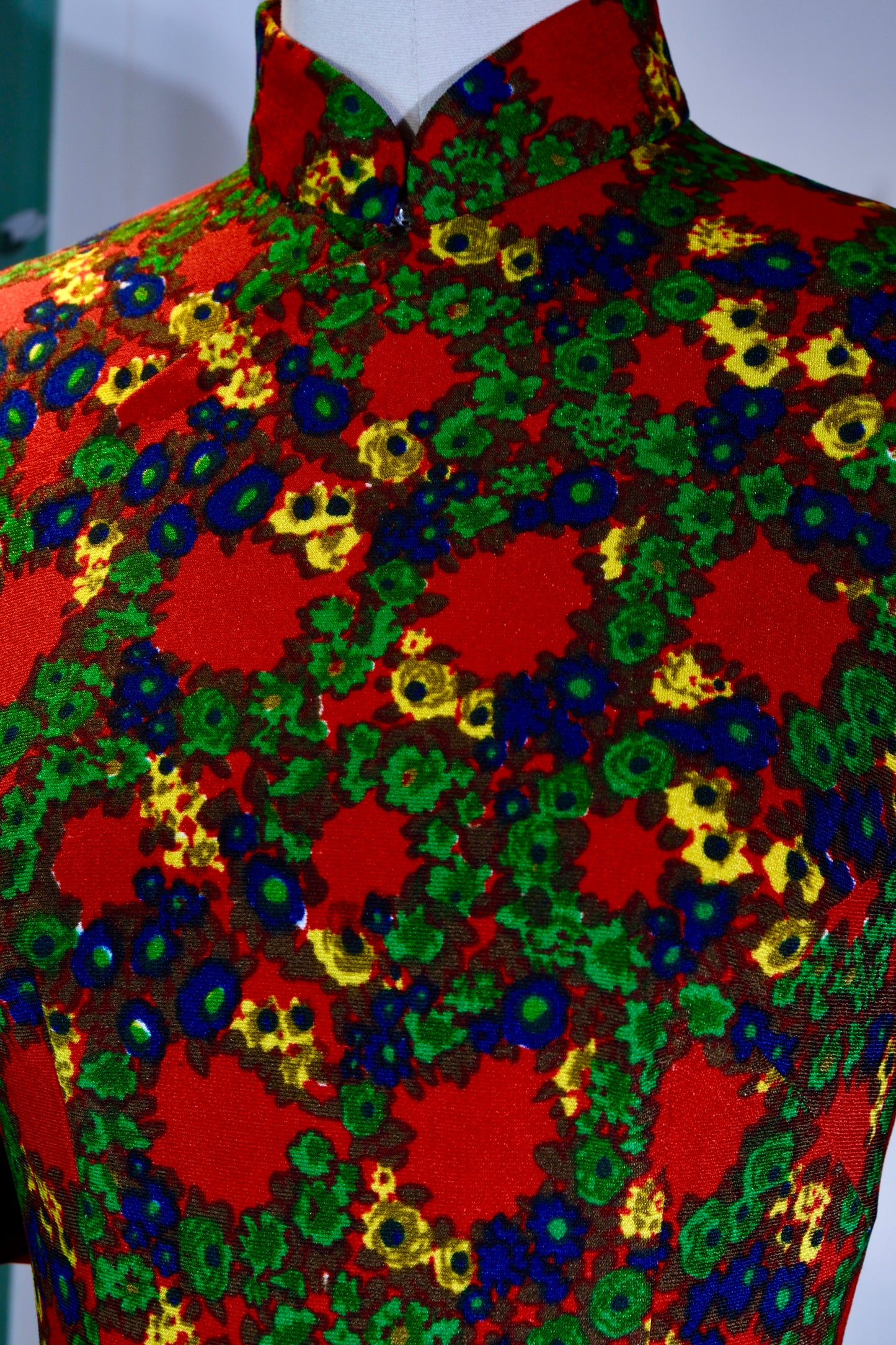
这件旗袍的面料宛如一幅流动的“东方印象派”画作。底色是浓郁热烈的朱红,其上铺陈着极具辨识度的几何化花卉纹样——翠绿的叶片与花萼如翡翠般鲜亮,宝蓝色的花瓣点缀其间,明黄色的花蕊则像跳跃的阳光。这些色彩并非传统工笔的细腻晕染,而是带着一种类似水彩画的晕散感与稚拙感,打破了常规配色的沉稳,形成了一种大胆、明快且充满生命力的“童趣撞色”。这种图案风格在六十年代的台湾纺织业中独树一帜,它融合了西方波普艺术的视觉冲击力与中国传统织锦的繁复美感,呈现出一种天真烂漫的现代性。
二、古董衣的故事与历史背景:
时光回溯至20世纪60年代,那是台湾经济腾飞的前夜,也是旗袍发展的“黄金余晖”期。彼时的台湾,正处于东西方文化剧烈碰撞与融合的熔炉之中。一方面,传统的苏杭丝绸依然备受推崇;另一方面,受欧美时尚风潮的影响,合成纤维(如人造丝、尼龙混纺)开始大量进入市场,带来了更鲜艳、更不易褪色的印染技术。
这件旗袍正是那个时代的缩影。它不再仅仅是旧式名媛的专属,而是走向了更年轻的群体,甚至成为了当时台湾出口创汇的重要轻工业产品之一。它见证了那个时代女性审美意识的觉醒——她们渴望摆脱灰暗,拥抱色彩,用一种近乎孩童般的直率去表达对生活的热爱。这不仅仅是一件衣服,它是那个激荡年代里,一位台湾裁缝师用针线写下的关于“自由”与“新生”的诗篇。
三、艺术风格与稀缺性(引经据典):
张爱玲曾在《更衣记》中写道:“对于不会说话的人,衣服是一种语言,随身带着的是袖珍戏剧。”这件旗袍,便是一出永不落幕的彩色戏剧。
从服装史的角度审视,其稀缺性体现在三个维度:
1. 面料的不可复制性:这种高饱和度的撞色提花或印花面料,带有鲜明的60年代“太空时代”审美前奏特征。随着环保标准的提升和审美轮回,现代工业已很难再生产出这种带有独特“塑料光泽感”却又不失温润的复古化纤混纺面料。
2. 剪裁的时代印记:请注意其立领的高度与袖口的弧度。相比50年代的极度收敛,60年代的旗袍剪裁开始适度放松,追求一种自然的身体曲线美,这符合当时国际上流行的“年轻风暴”(Youthquake)趋势。这种中西合璧的版型,是海派旗袍在台湾落地生根后的变异与进化。
3. 保存的完好度:历经六十载岁月,衣物最忌虫蛀与脆化。这件旗袍色泽依旧艳丽如初,结构完整,实属凤毛麟角。
正如《诗经·卫风·硕人》所云:“衣锦褧衣”,古人讲究锦衣之美。而这件旗袍,以红为底,绿蓝黄交织,恰似“桃之夭夭,灼灼其华”。它不仅是一件御寒蔽体之物,更是一段被封存的鲜活历史,等待着懂它的藏家,续写下一段关于美的传奇。
Measurements / Size Guide:
Bust / Waist / Hips: 96/80/106 cm
Total Length: 109 cm
Detailed Description:
The fabric of this qipao operates as a fluid "Eastern Impressionist" canvas. The foundational ground features a rich, passionate cinnabar red, overlaid with highly recognizable, geometric botanical motifs—emerald-green foliage and sepals appear as brilliant as jade, accented by royal-blue petals and bright-yellow stamens that mimic dancing sunlight. Rather than relying on the meticulous, smooth shading typical of traditional Gongbi painting, these colors possess a bleeding, diffused quality akin to fluid watercolors, executing an honest, child-like naivety.
This layout breaks entirely away from conventional, muted color rules, creating a bold, bright, and vital "whimsical contrast." This pattern style was unique within the 1960s Taiwanese textile landscape, seamlessly fusing the visual impact of Western Pop Art with the structural complexity of traditional Chinese textiles to present an innocent, radiant modernity.
Transporting back to the 1960s, Taiwan was positioned on the eve of its post-war economic takeoff, a window that marked the "golden twilight" of the qipao's historical evolution. During this period, the island enclave operated as a cultural crucible where Eastern traditions and Western influences intensely collided and dynamically coexisted. While traditional Suzhou and Hangzhou silks remained highly prized by high society, the rapid emergence of synthetic fibers—such as rayon and nylon filament blends—began flooding the consumer market, introducing higher color saturation and colorfast printing technologies.
This qipao stands as a pristine miniature of that socio-industrial transition. It completely shed its exclusive classification as an elite heirloom reserved solely for old-money madams, moving instead toward a younger demographic and establishing itself as an essential consumer product within Taiwan's light-industrial export sector. It bears physical witness to the awakening aesthetic consciousness of mid-century women who desired to break away from muted tones, embracing bright color fields to express vitality with almost childlike directness. It transcends its primary utility as clothing; it is a silent poem of freedom and rebirth written by an anonymous master tailor using the fresh textiles of an exciting era.
As Eileen Chang famously remarked in Chronicle of Changing Clothes: "To those who cannot speak, clothes are a language, a pocket theater carried around with oneself." This colorful qipao functions precisely as a brilliant, endless theatrical production.
From the standpoint of textile conservation and design history, its absolute rarity is verified across three distinct dimensions:
The Irreproducibility of the Material Chassis: This highly saturated, contrasting jacquard or print layout carries the distinct avant-garde design markers that preceded the global "Space Age" aesthetic. Following decades of chemical reformulations, environmental regulations, and shifting style cycles, modern commercial mills can no longer replicate this specific vintage synthetic blend—a textile that commands a unique, mid-century technical sheen while safely retaining an honest, warm antique patina.
The Structural Stamp of the Era: Close inspection of the standing collar height and the curvature of the armscye reveals a distinct structural shift. Compared to the extreme, restrictive tailoring constraints of the 1950s, 1960s pattern drafting introduced a balanced ease, pursuing a natural, unforced expression of the female form. This design adjustment perfectly mirrors the global "Youthquake" trend that was redefining international fashion. This hybrid layout represents the evolution and localization of the traditional Shanghai style (海派) after taking root in Taiwan.
The Horizon of Preservation: Spanning a sixty-year natural timeline, textile artifacts are highly vulnerable to localized fiber embrittlement, atmospheric fading, and mechanical breakdown. For a specimen to retain its original, vivid coloration and total structural integrity qualifies it directly as a true rarity among surviving mid-century archives.
As the classical verse from The Book of Songs • Wei Wind • Shuo Ren states: "She wears a splendid embroidered robe covered by a plain cloak," celebrating the absolute majesty of fine attire. Utilizing red as its canvas, interwoven with green, blue, and yellow filaments, this qipao beautifully materializes the ancient poetic sentiment: "The peach tree is young and elegant, brilliant are its blossoms." It is far more than a functional garment; it is a beautifully preserved capsule of living history, awaiting a discerning custodian to curate the next chapter of its peerless glamour.
Suyuan Archival Textile Registry — Documenting the material culture, preserving the technical lineage of ancestral craft.