深圳溯源
无法加载取货服务可用情况
衣服尺寸:
胸围/腰围/臀围/衣长:84/76/92/108 厘米
细节描述:
一、 衣上锦绣:纹样中的文人风骨
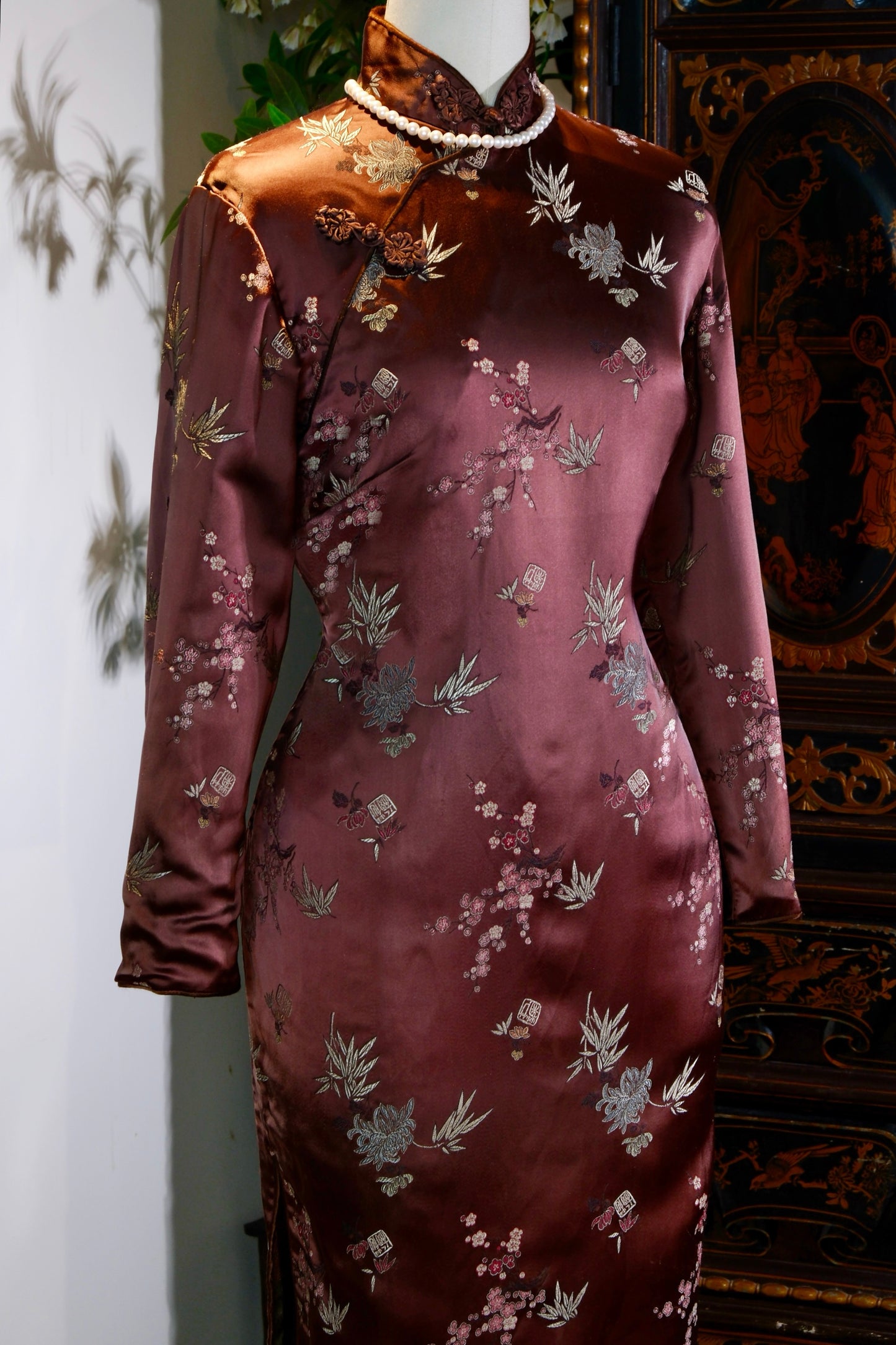
此件旗袍最引人入胜之处,在于其面料纹样的雅致与深意。
观其衣身,底色为沉稳内敛的栗紫色(亦有称酱紫或古铜紫),这种颜色在色谱中属于低明度暖色,既有皇家的贵气,又兼具文人的沉静,极衬东方女性肤色之白皙。
面料采用高定级别的提花织锦缎,光泽感如流动的液体金属。细察其图案,并非俗艳的大红大绿牡丹,而是错落有致地分布着“岁寒三友”——松、竹、梅的变体纹样,间或点缀着象征吉祥的方胜纹(菱形几何纹)与团花。
* 梅枝疏影横斜,花朵以银灰与淡粉交织,似雪中初绽;
* 竹叶修长挺拔,以银线勾勒叶脉,清风徐来;
* 菊花(或为变体牡丹)盛开于枝蔓间,寓意长寿与高洁。
这种散点式的构图,打破了传统对称的呆板,宛如一幅徐徐展开的水墨长卷。正如《长物志》所言:“宁古无时,宁朴无巧”,这种纹样设计摒弃了晚清的繁缛堆砌,回归了宋明以来的清雅审美,是典型的“文人旗袍”风格。
二、 工艺考究:六十年代香港裁缝的巅峰技艺
此衣产自上世纪六十年代的香港,彼时正是上海裁缝南下后,香港旗袍制作的鼎盛时期。
1. 线香绲边:请注意领口、襟边及袖口的滚边工艺。这是极细的“线香绲”,细如灯芯草,圆润饱满。这种工艺对工匠的手艺要求极高,稍有不慎便会起皱或断裂。它如同画框的线条,勾勒出旗袍的轮廓,体现了“惜墨如金”的高级感。
2. 花扣盘纽:领口处采用了同色系的织锦缎制作的花扣,隐蔽而精致,不仅起到了固定的实用功能,更在颈部形成了一种装饰性的节奏感。
3. 立体剪裁:六十年代的港产旗袍,已经完全吸收了西式立体剪裁的精髓。收腰极度合体,省道(Darts)处理得隐形而流畅,完美贴合女性S型曲线,既保留了东方的含蓄,又展露了现代的性感。
三、 岁月回响:一件古董衣的流金故事
每一件古董衣,都是时间的容器。
想象一下,在1960年代的香港,中环的写字楼里或是浅水湾的舞会上,曾有一位风华绝代的女性穿着它。那时的香港,东西方文化剧烈碰撞又完美融合。她或许刚刚听完一场粤剧,正赶去赴一场英文晚宴;她或许手里夹着一支细长香烟,在半岛酒店的下午茶时光里,用流利的英语谈论着股市与时尚。
这件旗袍见证了那个时代的“摩登”。它不仅仅是一件衣服,它是张爱玲笔下那个“乱世中的安稳”,是王家卫电影里那抹挥之不去的暧昧光影。它经历过繁华,也沉淀了岁月,那微微泛起的包浆,是时光给予的最昂贵的涂层。
四、 学术价值与稀缺性:为何值得珍藏?
从服装史的角度来看,这件旗袍具有极高的标本价值:
1. 断代标准器:其立领的高度、袖长的比例(七分袖至九分袖之间)、开衩的位置以及线香绲的运用,完全符合1960年代中后期的形制特征,是研究战后香港服饰变迁的实物佐证。
2. 面料的绝唱:这种老式提花织锦缎,随着传统织机的淘汰,如今已难以复刻。现代化学纤维的光泽往往显得“贼亮”,而老织锦缎的光泽是温润的、有厚度的,带着蚕丝特有的呼吸感。
3. 品相难得:丝绸极难保存,易脆化、易虫蛀。此件历经六十载寒暑,依然色泽如新,结构完整,无明显的破损与污渍,实属博物馆级品相。
【结语】
《诗经》云:“岂曰无衣?与子同袍。”
这不仅是一件御寒的衣物,更是一段可以触摸的历史。穿上它,你穿上的不仅是六十年代的风情,更是中国传统美学中那份独有的、不张扬的高贵。
适合场景:高端雅集、私人晚宴、艺术展览开幕、作为传世家珍收藏。
Measurements / Size Guide:
Bust / Waist / Hips / Total Length: 84/76/92/108 cm
Detailed Description:
The defining artistic quality of this qipao resides in the understated sophistication and symbolic depth of its textile motifs.
The ground color is rendered in a quiet, composed chestnut purple (also known as sauce purple or bronze purple)—a low-luminosity, warm hue within the spectrum. It balances imperial dignity with literati restraint, exceptionally flattering to East Asian skin tones.
The fabric itself is a high-grade jacquard brocade satin featuring a liquid, metallic luster. Rather than displaying loud, conventional crimson-and-green peony prints, the surface is patterned with scattered, stylized variations of the "Three Friends of Winter" (saihuan sanyou)—pine, bamboo, and plum blossom—interspersed with auspicious diamond-shaped double-square motifs (fangshengwen) and stylized floral medallions (tuanhua):
Plum Blossoms: Slender, angular branches cross delicately across the fabric, with blossoms woven in silver-grey and pale pink, evoking petals opening amidst first snow.
Bamboo Foliage: Erect, elongated bamboo leaves are articulated with fine silver threads, capturing the kinetic movement of wind passing through stalks.
Chrysanthemums/Peonies: Fully opened blooms interlace through climbing vines, symbolizing longevity, nobility, and endurance.
This scattered, asymmetric composition (sandianshi gouting) avoids rigid formal symmetry, unfolding like a traditional handscroll painting. Echoing Wen Zhenheng's famous maxim in Treatise on Superfluous Things (Zhangwu Zhi)—"Better classical than trendy; better plain than overly ornate"—the pattern discards Late Qing redundancy in favor of Song and Ming dynasty literati aesthetics.
Produced during the 1960s in Hong Kong, this piece originates from the peak era of qipao production following the southward migration of Shanghainese master tailors.
Incense-Cord Piping (Xianxiang Gun): The stand collar, lapels, and cuffs are finished with ultra-narrow, round piping no thicker than a rush stem. Executed through precise bias-strip folding and cord insertion, this technique requires master-level hand control to prevent puckering or twisting. Serving as a structural frame, it outlines the garment's architecture with elegant restraint.
Hand-Crafted Fabric Buttons (Pan Kou): The collar closure utilizes self-fabric brocade buttons (huakou), seamlessly integrated yet serving as refined visual accents around the neck.
Structural Contouring & Darts: By the 1960s, Hong Kong qipao makers had fully integrated Western three-dimensional pattern-making into traditional Chinese dressmaking. Bust and waist darts are concealed smoothly within the brocade pattern, sculpting an ergonomic silhouette that balances Eastern modesty with mid-century modern lines.
Every antique garment functions as a physical vessel of time.
Contextualized within 1960s Hong Kong, this garment belongs to an era when Eastern heritage and Western cosmopolitanism met across Victoria Harbour. The wearer navigated a changing social landscape—equally composed attending a Cantonese opera performance, reading modern literature in Central offices, or conversing in fluent English over tea at The Peninsula.
This qipao records that specific iteration of "modernity." It represents the sartorial poise described in Eileen Chang's essays and captured in the cinematic textures of Wong Kar-wai—a physical object that has weathered decades while retaining its structural form and warm, oxidized patina.
From the perspective of textile and apparel history, this qipao possesses significant reference and collection value:
Dating Reference Benchmark: The height of the mandarin collar, the three-quarter sleeve length, the side-slit placement, and the execution of the incense-cord piping align precisely with the structural features of mid-to-late 1960s Hong Kong production.
Discontinued Weaving Technology: Traditional jacquard brocade satins of this density and thread count were phased out as shuttleless power looms replaced traditional equipment. Modern synthetic fabrics often produce a harsh, artificial shine (zeiliang), whereas vintage silk-blend brocades exhibit a deep, breathable luster.
Museum-Grade Preservation: Natural silk-blend fabrics are notoriously vulnerable to embrittlement, UV damage, and insect degradation. Weathering six decades while retaining vibrant coloration, structural tension, and clean seams makes this an exceptional archival specimen.
As recorded in the Classic of Poetry (Shijing): "How can it be said that you have no clothes? I will share my robe with you."
This qipao is far more than a garment; it is a tangible piece of material history. Preserving its chestnut-purple ground, intricate "Three Friends of Winter" brocade, and precise incense-cord piping, it remains a quiet, timeless testament to 20th-century Chinese textile art.