深圳溯源
无法加载取货服务可用情况
衣服尺寸:
胸围/腰围/臀围:80/60/90 厘米
衣长:135 厘米
细节描述:
【图案·锦绣乾坤】
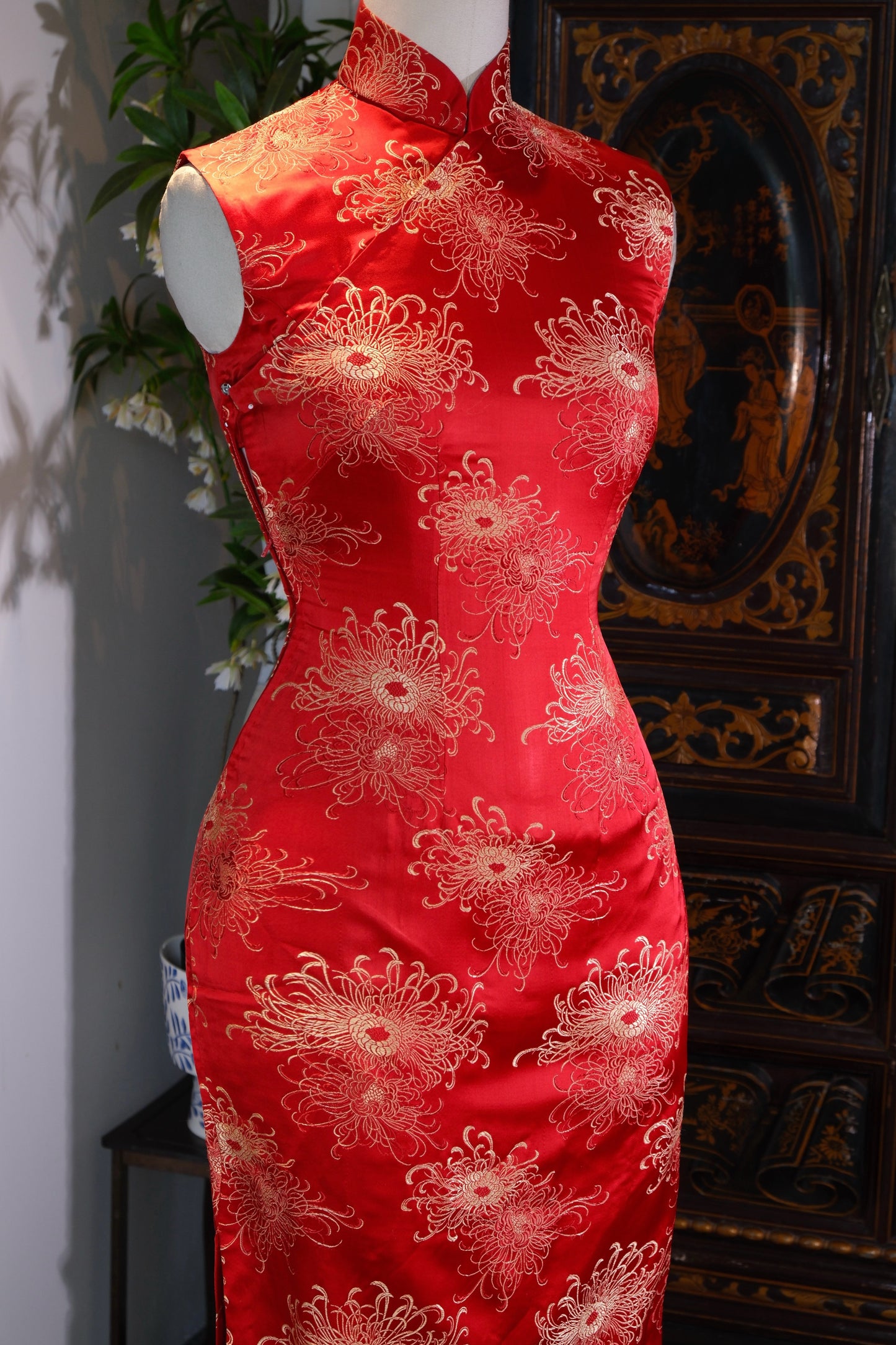
这件上世纪六十年代的香港产织锦缎旗袍,以正红为底,金菊满幅,将传统纹样与时代审美凝练于方寸之间。菊花纹样取法宋明工笔之韵,花瓣层叠如云,花蕊点染似星,金丝银线交织出“疏影横斜”的灵动;而织锦缎特有的光泽感,让每一朵菊都似在光影中流转,既有“采菊东篱下”的文人雅趣,又暗合六十年代香港社会对“富贵吉祥”的世俗祈愿——彼时工商业勃兴,红色象征兴旺,金菊寓意高洁与丰饶,恰是时代精神的具象化表达。
【故事·衣冠春秋】
上世纪六十年代的香港,是中西文化碰撞的熔炉,亦是旗袍艺术的“黄金余晖”。彼时,上海裁缝南迁带来精湛技艺,本地匠人融合西式立体剪裁(如收腰、垫肩的微妙改良),让旗袍从“平面裹身”蜕变为“曲线塑形”的艺术品。这件旗袍,正是这一转型期的活化石:它保留了传统立领、盘扣的东方骨相,又以贴合人体的版型呼应现代审美,仿佛一位穿越时空的佳人,既带着老上海的温婉,又透着新香港的利落。
想象半个多世纪前,它或许被某位名媛珍藏于樟木箱中,出席过中环的晚宴、浅水湾的茶会;又或许是一位普通女子的“嫁衣级”珍藏,承载着家族对美好生活的期许。如今,它褪去主人的体温,却以更永恒的姿态,成为连接过去与现在的纽带——那些藏在针脚里的匠心、纹样中的隐喻,都在诉说着一个时代的呼吸与心跳。
【典籍·文脉溯源】
从《诗经》“有女同车,颜如舜华”的服饰咏叹,到《红楼梦》里“缕金百蝶穿花大红洋缎窄裉袄”的华彩描写,中国服饰史从来是“衣以载道”的文化史诗。而这件旗袍,正是这条文脉上的璀璨珠玉:
- 材质之珍:织锦缎自明清便是宫廷贡品,《天工开物》载“锦为丝织之极”,其工艺需经数十道工序,经纬交织间藏着千年匠心的密码;
- 形制之变:六十年代旗袍的“收腰放量”,暗合沈从文《中国古代服饰研究》中“服饰随世变而移”的论断——它既是传统的延续,更是现代的觉醒;
- 纹样之魂:菊花纹在《本草纲目》中是“延龄客”,在文人画里是“隐逸士”,当它以金线绣于红缎之上,便成了“雅俗共赏”的时代注脚。
【稀缺·孤品传世】
作为六十年代的古董旗袍,它的稀缺性不仅在于“时间沉淀”——历经半世纪仍色泽鲜亮、织锦完好,更在于“时代标本”的价值:彼时香港旗袍产业虽盛,但能留存至今且品相上乘者凤毛麟角。它不仅是服装史的实物教材,更是东方美学的“活态传承”——当我们触摸那温润的织锦缎,凝视那灵动的金菊纹,便是在与一段风华绝代的历史对话。
结语:这件旗袍,是衣物,更是文物;是装饰,更是叙事。它以丝线为笔,以岁月为墨,书写着东方的优雅与坚韧。若你懂它的美,便懂了一个时代的浪漫与重量。
Measurements / Size Guide:
Bust / Waist / Hips: 80/60/90 cm
Total Length: 135 cm
Detailed Description:
Within the discipline of textile preservation, an archival garment functions as far more than mere apparel; it operates as a live three-dimensional canvas capturing the political, economic, and cultural cross-currents of its specific chronological anchor. This exceptional 1960s Hong Kong-produced woven gold brocade (织金织锦缎 / zhijin zhijindan) antique qipao uses a rich crimson ground and an all-over gilded botanical pattern layout to stage a highly sophisticated dialogue between ancestral imperial textile traditions and post-war colonial modernization.
The foundational material matrix consists of heavy, high-density woven gold brocade—a textile that since the Ming and Qing dynasties represented the absolute pinnacle of luxury. Song Yingxing’s legendary late-Ming industrial treatise Tiangong Kaiwu (天工开物) famously noted that "Brocade represents the absolute ultimate manifestation of silk weaving." It requires dozens of specialized manual and mechanical steps to coordinate the dense warp and weft registers.
Regarding the layout of the brocade surface architecture, the primary motif features saturated gold bullion chrysanthemums executed with precise gongbi fine-line realism, while the secondary motif displays interlocking metallic silver tendrils arranged in a balanced "sparse shadows" design across a light-absorbent pure crimson silk weave ground.
The Primary Iconography: The entire dress body is populated by a dense, hyper-saturated layout of blooming chrysanthemums executed with the precise, sharp linework characteristic of Song and Ming dynasty gongbi (工笔) fine-line realism. The gilded petals layer over one another like dense clouds, while the center pistils shimmer like micro-constellations under changing light planes.
The Ideological Duality: The chrysanthemum successfully balances two distinct cultural frequencies: the elite literary tradition of reclusive, high-minded purity (as celebrated by Tao Yuanming’s famous poetic line, "Plucking chrysanthemums by the eastern fence"), and the pragmatic, mid-century material desires of a booming colony. In 1960s British Hong Kong, a massive industrial explosion was underway. The choice of an unthrottled crimson base signified immediate commercial fortune, while the golden blooms represented prosperity, longevity, and structural prestige—making the textile a literal materialization of the zeitgeist.
The 1960s represented both a cross-cultural pressure cooker and the definitive "golden twilight" of the traditional Chinese qipao. Following the geopolitical shifts of the mid-twentieth century, master tailors from Shanghai migrated south en masse to Hong Kong, bringing with them generations of elite dressmaking techniques. Within the colony, these artisans encountered Western industrial pattern cutting, Hollywood cinema imagery, and post-war modernization.
This specific qipao stands as an immaculate, living fossil of that historical transition:
The S-Curve Chassis: Moving completely away from the early-century flat, rectangular cutting methods that merely wrapped the body, this garment integrates sophisticated Western anatomical draping. Through precise bust and waist darting combined with highly technical iron-molding manipulation (归拔 / gui-ba)—using heat and steam to manually shrink and stretch the heavy brocade—the tailors forced the flat textile to map the natural curves of the figure.
The Structural Balance: While the pattern layout forces a sharp, modern waist-taper and an erect, commanding posture, it proudly safeguards traditional Eastern architectural elements. The mandarin collar rises tall and resolute, held in place by dense internal interlining, and is anchored by hand-sculpted frog closures (pankou). It effortlessly blends the soft, reserved dignity of old Shanghai with the sharp, decisive, and streamlined efficiency of a rising Hong Kong metropolis.
An antique garment of this exceptional caliber serves as an intimate material witness to twentieth-century social history. Over half a century ago, this piece was likely shielded from environmental degradation inside a cedar chest within a high-society household. It was custom-engineered to command attention at formal evening banquets in Central or elite, sophisticated afternoon tea circuits along Repulse Bay.
As the legendary modern writer Eileen Chang famously detailed in her archival fashion critique Chronicle of Changing Clothes (更衣记):
"For those who are unable to speak, clothes are a language—a pocket drama that they carry around with them everywhere."
This specific qipao stands as the undisputed protagonist of that mid-century pocket drama. It records an era where cosmopolitan women confidently weaponized archival garments to claim modern, independent identities within a rapidly changing global landscape.
From an academic costume history perspective, this artifact commands immense museum-grade valuation based on three strict criteria:
The Law of Shifting Material Cultures: As the legendary cultural scholar Shen Congwen detailed in Research on Ancient Chinese Costumes, apparel shifts naturally alongside societal transformation ("服饰随世变而移"). The unique "waist-taper with controlled hem volume" design precisely tracks the exact historical decade of female empowerment and social awakening.
Chronological Discontinuity of Craft: The authentic silk-to-gold yarn density found in mid-century brocades requires immense machine configuration and structural precision that modern automated industrial looms cannot replicate. Contemporary high-speed synthetic copies entirely lack the heavy, warm, and substantial tactile drop of this vintage老料子.
A Miracle of Textile Preservation: Organic silk and metallic bullion filaments are incredibly sensitive material matrixes, highly prone to natural atmospheric oxidation, moisture damage, and fiber brittleness over a sixty-year horizon. For this garment to survive with its color registers fully saturated, its gold threads entirely un-tarnished, and its iron-molded chassis perfectly uncollapsed is an exceptional rarity within material collections.
This 1960s woven gold brocade qipao transcends the parameters of standard fashion; it exists as a sealed piece of historical literature—a complex narrative of Eastern grace and resilience woven into gold thread. To step into its presence is to cease being a mere spectator of history, transitioning instead into an active guardian of its continuing poem. It stands as an immutable anchor of tactile artistry, offering an uncompromising standard of cross-cultural elegance that time can never diminish.
Suyuan Silk Archive — Preserving the soul of historic textiles, documenting the lineage of master craft.