深圳溯源
无法加载取货服务可用情况
衣服尺寸:
胸围/腰围/臀围/衣长:100/90/110/109 厘米
细节描述:
【纹样解码:腰果花里的丝路回响】
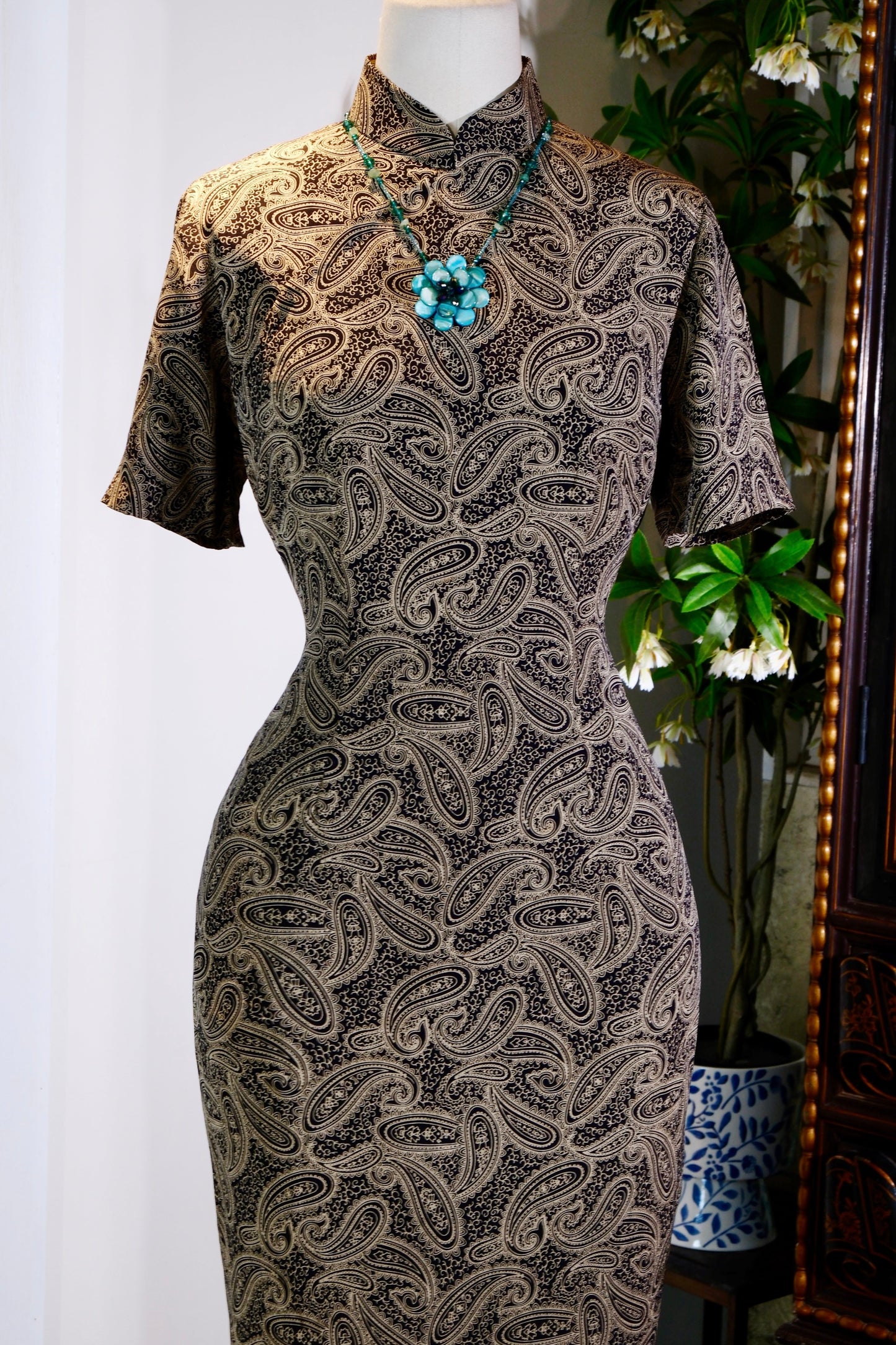
目光所及,这件旗袍最摄人心魄之处,在于其满铺的佩斯利(Paisley)纹样。
在服装史学中,这种形如“泪滴”或“弯月”的图案,实则源自古波斯语中的“Boteh”,意为灌木丛或花簇。它沿着古老的丝绸之路东渐西传,在克什米尔的羊绒披肩上绽放,最终在二十世纪的纺织工业中化作经典的“腰果花”。
细观此衣,匠人并未采用艳俗的大红大绿,而是以深邃的墨色为底,银灰与暗金交织勾勒。纹样繁而不乱,线条如行云流水般蜿蜒缠绕,既有巴洛克式的繁复华丽,又蕴含着东方水墨般的写意留白。这种高密度的印花工艺在五十年代极为考究,它打破了传统旗袍仅用龙凤、牡丹的刻板印象,展现出一种中西合璧、摩登与古典并存的独特审美。
【历史溯源:海峡对岸的绝代风华】
“锦衣旗袍诗,曼玉花样时。”
上世纪五十年代的台湾,是旗袍发展史上一个特殊而迷人的“黄金余晖”时期。彼时,随着大批江浙裁缝与名媛淑女迁台,上海滩的精致剪裁工艺在宝岛落地生根,并与当地的风土人情发生了奇妙的化学反应。
这件旗袍正是那个时代的见证者。
- 剪裁之妙: 它继承了海派旗袍的立体剪裁精髓。请注意其归拔工艺(通过高温熨烫使平面布料产生立体弧度),使得衣身如第二层肌肤般贴合人体曲线,胸腰差处理得极尽委婉,既不过分紧绷,又勾勒出女性含蓄的性感。
- 稀缺之源: 那个年代的布料多依赖进口或老旧库存,能保留如此完整、色泽如此鲜亮的佩斯利纹样面料,实属凤毛麟角。七十载光阴流转,丝绸易脆,染料易褪,而这件衣裳依然挺括有型,可见当年穿着者对其珍视有加,保存环境之优越。
【艺术风格:低调的奢华】
它不似清宫服饰那般张扬权力的威仪,也不像六十年代后期那样激进地追求迷你与暴露。它处于一种优雅的平衡点。
那枚点缀其间的绿松石色花朵项链(虽为配饰,却与衣裳相得益彰),更是点睛之笔,打破了黑白灰的沉静,透出一股属于五十年代女性的知性与从容。这不仅是一件衣服,更是一首穿在身上的散文诗,诉说着那个白衣飘飘年代里,关于美、关于流离、关于重生的故事。
【收藏寄语】
张爱玲曾言:“对于不会说话的人,衣服是一种语言,随身带着的是袖珍戏剧。”
这件五十年代台湾产佩斯利纹样旗袍,便是那出未曾落幕的戏剧。它是博物馆级的藏品,是研究战后东亚服饰变迁的实物标本,更是每一位爱衣之人梦寐以求的传世孤品。
Measurements / Size Guide:
Bust / Waist / Hips / Total Length: 100/90/110/109 cm
Detailed Description:
At first glance, the most breathtaking aspect of this qipao lies in its all-over Paisley motif.
In apparel history, this pattern—shaped like a teardrop or a crescent moon—originates from the ancient Persian word Boteh, meaning a floral spray or bush. Traveling East and West along the ancient Silk Road, it blossomed upon Kashmir cashmere shawls before eventually transforming into the classic "cashew floral pattern" (腰果花) within twentieth-century textile manufacturing.
Inspecting the garment closely, the artisan refrained from using vulgar, bright reds or greens. Instead, a deep obsidian backdrop serves as the base, framed by an interlacing of silver-grey and muted gold line work. The pattern is rich without being chaotic; its lines wind and curve like floating clouds and flowing water, embodying both Baroque complexity and the expressive empty space (liubai) of Eastern ink paintings. This high-density textile printing technique was exceptionally demanding in the 1950s—it shattered the rigid stereotype of qipaos relying solely on dragons, phoenixes, or peonies, presenting a unique aesthetic that bridges East and West, modernity and classicism.
"A poem captured in a splendid qipao, reflecting Maggie Cheung's timeless moments in fashion."
The 1950s in Taiwan represented a unique and enchanting "golden afterglow" in the developmental history of the qipao. During this period, as a large wave of elite Jiangnan tailors and socialites relocated to Taiwan, the refined tailoring techniques of Shanghai took root on the island, creating a wonderful chemical reaction with the local culture.
This qipao stands as a direct witness to that era:
Mastery of Tailoring: It inherits the essence of Shanghai-style (Haipai) three-dimensional tailoring. Note the iron-shaping technique (Gui-Ba, where high-temperature ironing coaxes flat fabric into three-dimensional curves), allowing the dress to fit like a second skin. The transition between bust and waist is handled with utmost subtlety—never overly tight, yet beautifully contouring a woman's restrained sensuality.
Source of Scarcity: Fabrics from that era relied heavily on imports or archival stock; finding a piece with such a complete, vibrant Paisley pattern preserved into the present day is an absolute rarity. Across seven decades of shifting time, silk is prone to brittleness and dyes to fading, yet this garment remains crisp and structurally sound—a testament to how deeply its original owner cherished it and the superior environment in which it was preserved.
It lacks the ostentatious display of imperial authority seen in Qing court attire, nor does it radically pursue mini hemlines and exposure like designs of the late 1960s. It exists at an exquisite point of balance.
The turquoise-toned floral necklace accenting the neckline (though an accessory, it complements the garment flawlessly) serves as a brilliant finishing touch, breaking the quietude of the dark tones to reveal the intellectual composure characteristic of 1950s women. This is more than an item of apparel; it is a prose poem worn upon the body, telling a story of beauty, displacement, and rebirth from a bygone era.
Eileen Chang once stated: "For those who cannot speak, clothes are a language, a pocket theater carried upon the body."
This 1950s Taiwanese Paisley pattern qipao represents a theatrical play that has never closed its curtains. It is a museum-grade archival piece, a physical specimen for studying postwar East Asian textile evolution, and an irreproducible treasure that every vintage connoisseur dreams of acquiring.