深圳溯源
无法加载取货服务可用情况
衣服尺寸:
胸围/腰围/臀围/衣长:90/78/100/130 厘米
细节描述:
一、 织物上的诗学:图案与工艺解析
凝视这件旗袍,首先映入眼帘的是那如云霞般铺陈的机绣玫瑰纹样。这并非寻常的平面印花,而是上世纪六十年代极具代表性的法国进口蕾丝面料(French Imported Lace)。
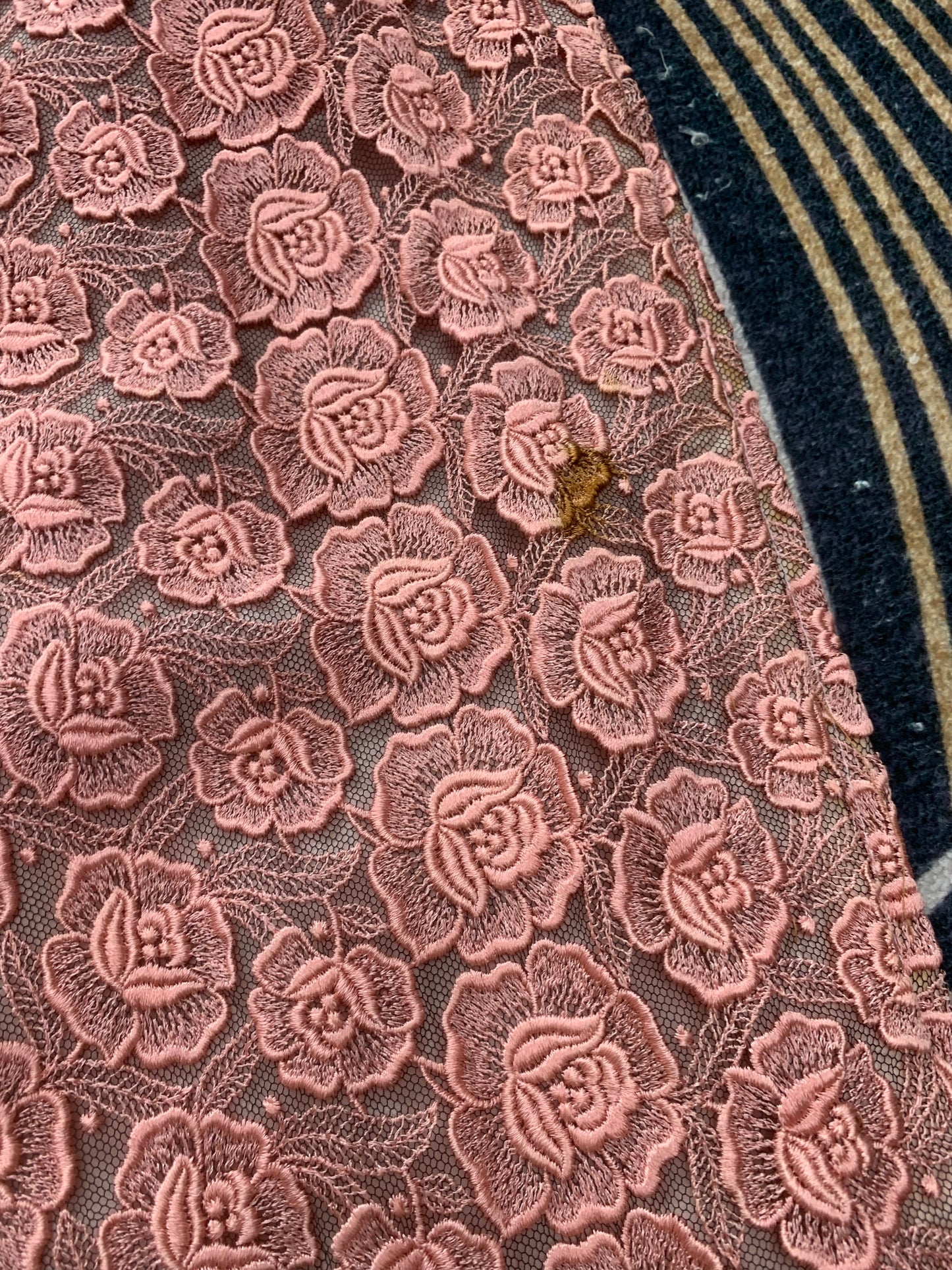
从微观视角(如图6、图7)审视,我们可以清晰地看到其精湛的纺织结构:底网细密如蝉翼,呈现出半透明的朦胧美感;而主体花纹则是通过高难度的柯根纱刺绣(Organza Embroidery)技法,将丝线层层堆叠,构建出具有浮雕感的立体玫瑰。每一朵花都仿佛正在呼吸,花瓣边缘的针脚细密流畅,花蕊处的打籽绣法更是点睛之笔,赋予了花朵蓬勃的生命力。这种“透肉不见肉”的视觉效果,正是那个年代高级时装所追求的含蓄与性感并存的极致表达。
这种粉色调,非艳俗之粉,而是一种带有灰度的“藕荷色”或“干枯玫瑰粉”。在自然光下,它随着穿着者的步履流转,泛着温润的珠光,宛如旧时光里的一声叹息,温柔而坚定。
二、 历史的经纬:跨洋而来的时尚叙事
这件旗袍的身世,本身就是一部微缩的战后时尚交流史。
1. 材质的全球化:
上世纪五六十年代,台湾正处于旗袍制作的黄金时代,也是东西方纺织贸易的枢纽。彼时,台湾不仅保留了精湛的中式剪裁技艺,更大量进口欧洲(特别是法国和瑞士)的高级蕾丝与尼龙面料。这件旗袍选用法国进口蕾丝,证明了其原主人在当时拥有不凡的经济实力与极高的审美品位——她不愿局限于传统的织锦缎,而是渴望拥抱来自巴黎的浪漫风情。
2. 剪裁的西化演变:
观察其廓形(如图1-4),这是典型的“海派旗袍”晚期风格向现代礼服过渡的产物。
* 立领与无袖: 经典的元宝领依然挺括,象征着东方的端庄;但肩部采用了西式连衣裙的无袖剪裁(Sleeveless),露出了优美的肩颈线条,这是受好莱坞电影明星(如格蕾丝·凯利)着装风格影响的直接体现。
* 省道与曲线: 注意腰部的收省(Darts)处理极其精准,紧紧包裹住女性的胸腰臀曲线。这种立体剪裁完全脱离了传统中式平面裁剪的逻辑,转而追求雕塑般的身体美感。
三、 岁月留痕:关于稀缺性与收藏价值的注脚
作为一件近六十年的古董衣,它的存在本身就是一个奇迹。
蕾丝面料因其网状结构的脆弱性,极难保存。稍有受潮便易脆化断裂,或因氧化而发黄变黑。然而,这件旗袍的粉色依然保持着惊人的鲜活度,网眼结构完整,仅有岁月留下的些许微小痕迹(如图7中细微的岁月斑点),这不仅不是瑕疵,反而是时间的包浆,是它真实存在的铁证。
四、 结语:穿在身上的《花样年华》
张爱玲曾言:“对于不会说话的人,衣服是一种语言。”
这件六十年代的玫瑰蕾丝旗袍,诉说的是一位女性在那个激荡年代里的优雅与独立。它既有中国传统女性的内敛风骨,又有西方现代女性的自信张扬。它不仅仅是一件衣服,它是那个“黄金时代”的遗梦,是不可再生的孤品。
Measurements / Size Guide:
Bust / Waist / Hips / Total Length: 90/78/100/130 cm
Detailed Description:
Gazing upon this qipao, the first thing that catches the eye is the machine-embroidered rose motif layered across the fabric like soft evening clouds. This is no ordinary flat print; it is a highly representative French imported lace fabric from the 1960s.
From a microscopic perspective (as shown in Figure 6 and Figure 7), its masterful textile structure is clearly visible: the base mesh is as fine as a cicada's wing, presenting a semi-transparent, hazy aesthetic; while the primary motifs are brought to life through a highly challenging organza embroidery technique, where threads are layered to construct three-dimensional roses with an embossed texture. Each flower appears to breathe, the stitching along the petal edges is dense and fluid, and the knot embroidery (dazixiu) at the pistils adds a brilliant finishing touch that gives the blossoms vibrant vitality. This visual effect—revealing a hint of skin through a delicate veil—perfectly expresses the ultimate combination of modesty and sensuality pursued in high fashion of that era.
Rather than a garish pink, this color palette features a desaturated, dusty rose or lotus-root pink hue. In natural light, it shifts gracefully with the wearer's movements, casting a gentle, pearlescent luster, resembling a soft yet resilient sigh from yesteryear.
The origin of this qipao is, in itself, a miniature history of postwar fashion exchange.
During the 1950s and 1960s, Taiwan was in a golden age of qipao production and served as a vital hub for East-West textile trade. At that time, Taiwan not only retained exquisite traditional Chinese cutting techniques, but also imported large quantities of luxury lace and nylon fabrics from Europe (particularly France and Switzerland). The selection of French imported lace for this garment demonstrates that its original owner possessed significant economic means and exceptional aesthetic taste—she looked beyond traditional brocades, choosing instead to embrace the romance of Paris.
Looking at its overall silhouette (as shown in Figures 1–4), this garment is a textbook example of late "Shanghai-style" (海派) qipao transitioning into modern evening wear.
Standing Collar and Sleeveless Cut: The classic high mandarin collar remains structured and crisp, symbolizing Eastern dignity; however, the shoulder features a Western-style sleeveless cut that beautifully frames the neckline, a direct reflection of the global glamour popularized by Hollywood film stars (such as Grace Kelly) of the era.
Darting and Contours: The execution of the waist and bust darts is incredibly precise, closely hugging the female silhouette. This three-dimensional draping completely departs from the logic of traditional Chinese flat pattern cutting, pursuing instead a sculpted, architectural beauty.
As an archival garment approaching six decades of age, its survival into the present day is a true miracle.
Due to the fragile nature of its open mesh structure, lace fabric is notoriously difficult to preserve. Even minor exposure to humidity can cause fibers to become brittle and snap, while oxidation frequently leads to severe yellowing or discoloration. Yet, the rose-pink tone of this qipao remains astonishingly fresh, and the underlying mesh remains sound, with only a few minute markings left behind by the decades (such as the subtle age spots in Figure 7). These are not flaws; they represent a natural patina—the ironclad proof of its genuine historical journey.
Eileen Chang once stated: "For those who cannot speak, clothes are a language."
This 1960s rose lace qipao speaks of a woman's grace and independence during a vibrant, changing era. It balances the interior restraint of traditional Chinese character with the confident charm of Western modernity. Far more than an item of apparel, it stands as a beautiful remnant of that "Golden Age"—an irreproducible unique treasure.
In today's landscape of fast fashion, owning an antique qipao like this—one that has been washed by time, hand-stitched by artisans, and carries the weight of transnational cultural fusion—means possessing a tangible, living piece of history.