深圳溯源
无法加载取货服务可用情况
衣服尺寸:
胸围/腰围/臀围:94/88/104 厘米
衣长:114 厘米
细节描述:
一、图案与工艺:方寸间的东方美学
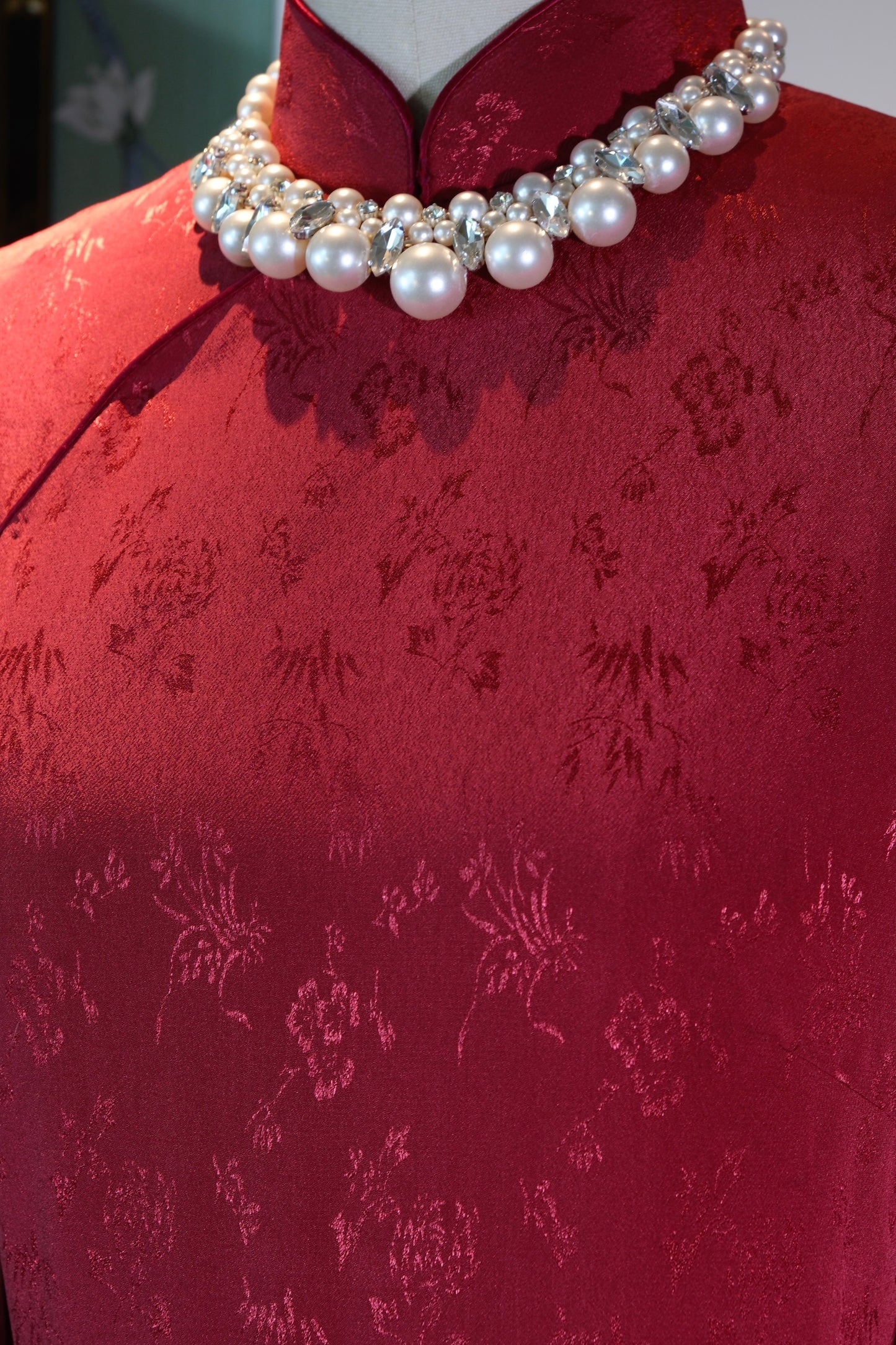
这件旗袍的面料,是上世纪六十年代香港纺织工业的缩影。其暗纹提花并非简单的平面印染,而是通过复杂的提花织机,将经纬线交织出立体的肌理。
图案解析:
细观衣身,这是一种经典的“折枝花卉”纹样。不同于清代服饰中繁复堆砌的团花,六十年代的审美趋向于清雅与疏朗。面料上的花枝形态修长,似兰非兰,似梅非梅,枝叶扶疏,花朵含苞或微绽,呈现出一种文人画般的写意感。这种暗纹设计极为考究,在室内光线下显得沉稳内敛,而在自然光或灯光流转间,丝线的折射会让花纹浮现出若隐若现的光泽,正如古人所云“暗香浮动月黄昏”,极具含蓄之美。
工艺细节:
领口至襟边的处理,采用了极为传统的“线香绲”。这是一种极细的滚边工艺,因细如线香而得名。它要求工匠拥有极高的定力与手艺,滚条必须均匀、挺拔,紧贴衣缘而不显臃肿。这道细细的边,不仅勾勒出了旗袍利落的线条,更像是一笔工笔画的勾勒,锁住了整件衣服的精气神。
二、历史回响:黄金时代的优雅注脚
这件古董衣,不仅仅是一件服装,它是上世纪六十年代香港社会风貌的实物见证。
时代背景:
六十年代的香港,正处于经济腾飞的前夜,也是中西文化剧烈碰撞与融合的时期。彼时的香港名媛与影星(如林黛、尤敏等),将海派旗袍的精致与西式剪裁的立体感完美结合。这件旗袍的版型,明显区别于二十年代的宽大或四十年代的极度收腰,它更强调自然的身体曲线,袖长适中,既保留了东方的端庄,又适应了当时日益活跃的社交生活节奏。
稀缺性:
随着成衣工业的兴起和化纤面料的普及,这种全真丝或高定混纺的提花面料早已停产。加之“线香绲”这种费时费力的手工技艺,在现代流水线生产中几乎绝迹。能够保存至今且品相如此完好的六十年代港产旗袍,如同博物馆中的藏品一般稀缺。每一处针脚,都记录着那个时代裁缝师傅的温度。
三、艺术风格与文学意象:引经据典
张爱玲在《更衣记》中曾写道:“对于不会说话的人,衣服是一种语言,随身带着的是袖珍戏剧。”这件旗袍,便是一出无声的折子戏。
它的红色,不是张扬的大红,而是一种经过岁月沉淀的“檀色”或“胭脂红”。这种色彩在古诗词中常与闺阁、雅集相连。李清照词云:“绣面芙蓉一笑开,斜飞宝鸭衬香腮。”这件旗袍上的暗纹花卉,恰似那“绣面芙蓉”,不事雕琢却天生丽质。
从艺术风格上看,它体现了“哀而不伤,乐而不淫”的中庸美学。提花的繁复被暗色的基调压制,显得高贵而不俗艳;修身的剪裁被长袖和高领平衡,显得性感而不轻浮。这正是中国传统服饰哲学的最高境界——克制中的绽放。
四、结语
这不仅是一件用来穿着的衣服,更是一段可以触摸的历史。当你穿上它,你便与六十年前那位在香江畔顾盼生姿的女性产生了跨越时空的连接。它是孤品,是绝唱,是值得珍藏的艺术品。
Measurements / Size Guide:
Bust / Waist / Hips: 94/88/104 cm
Total Length: 114 cm
Detailed Description:
The fabric of this qipao is a miniature reflection of the golden era of the Hong Kong textile industry during the 1960s. Its damask jacquard texture is not a simple flat print, but a three-dimensional surface architecture woven through complex multi-shuttle looms that interlace the warp and weft lines.
Close inspection of the garment body reveals a classic "detached sprig floral" motif (折枝花卉). Moving away from the heavily stacked and dense medallion clusters characteristic of Qing dynasty dress, the aesthetic of the 1960s gravitated toward refinement, clarity, and open spacing. The floral branches on the textile present elongated forms—resembling orchid yet not quite orchid, resembling plum blossom yet not quite plum—with sparse foliage and blossoms either in bud or gently unfolding, projecting the freehand poetry of a literati painting. This damask design is exceptionally sophisticated; under indoor ambient lighting, it remains steady and reserved, whereas under direct natural light or moving spotlights, the refraction of the silk threads coaxes the pattern to emerge in a shifting, low-refraction shimmer. It perfectly materializes the classical poetic imagery of "subtle fragrance floating under the yellow dusk," capturing an ultimate beauty of modesty.
The execution running from the collar down along the diagonal lapel utilizes the deeply traditional "incense-line" piping (线香绲). Named for being as hyper-fine as a slender stick of incense, this finishing process demands absolute composure and peak hand-skills from the artisan. The piped strip must remain perfectly uniform and upright, gripping the structural edges of the garment without appearing bulky. This fine boundary line does more than frame the clean silhouette of the qipao; it acts like the sharp ink outline of a traditional Gongbi painting, locking in the essential spirit and energy of the entire garment.
This antique garment transcends standard clothing; it stands as a physical witness to the social landscape of 1960s Hong Kong.
During the 1960s, Hong Kong was on the eve of its economic takeoff, marking a rare historical window where Eastern and Western cultures intensely collided and merged. The prominent madams and cinema stars of Hong Kong at the time (such as Lin Dai and You Min) perfectly fused the meticulous refinement of Shanghai-style (海派) qipaos with the three-dimensional modeling of Western tailoring. The structural framework of this qipao is distinctly separated from the expansive fits of the 1920s or the extreme waist reductions of the 1940s; it places emphasis on a natural body contour paired with a calibrated sleeve length, preserving traditional Eastern dignity while adapting flawlessly to the fast-paced rhythm of mid-century social life.
Following the rise of mass ready-to-wear production and the total adoption of synthetic chemical fibers, this type of pure silk or high-end custom-blend jacquard yardage long ago ceased production. Furthermore, a time-consuming manual skill like "incense-line" piping has almost entirely vanished from modern automated assembly lines. An authentic 1960s Hong Kong-produced qipao preserved in such unblemished condition today is an absolute rarity, comparable to an institutional museum archive. Every single stitch pass records the human warmth of a mid-century master tailor.
As Eileen Chang famously noted in her essay Chronicle of Changing Clothes (更衣记): "To those who cannot speak, clothes are a language, a pocket theater carried around with oneself." This qipao functions precisely as that—a silent, independent theatrical scene.
Its red coloration is not a loud, boasting primary red, but an enriched shade of "sandalwood" or "carmine red" (“檀色”或“胭脂红”) settled by the passage of decades. In classical poetry, this specific color palette is consistently linked to private boudoirs and refined literati gatherings. As the poet Li Qingzhao penned: "A lotus-painted face opens into a smile, as the jade hairpin tilts to frame a fragrant cheek." The hidden floral jacquard across this qipao mirrors that "lotus-painted face"—unadorned by superficial finishes, yet naturally exquisite.
From the standpoint of design theory, the piece embodies the traditional golden mean of Chinese aesthetics: "sorrowful but not distressed, joyful but not debauched" (“哀而不伤,乐而不淫”). The inherent complexity of the jacquard weave is structurally grounded by the deep, dark baseline tone, rendering it noble without a hint of vulgarity; concurrently, the body-conscious contour is perfectly counterbalanced by the long sleeves and a high stiffened collar, presenting allure without frivolity. This represents the absolute pinnacle of traditional Chinese dress philosophy—the ultimate blossom found within strict restraint.
This is far more than a functional garment meant for wear; it is a tangible piece of chronology. When you slip it on, you establish an absolute connection across space and time with a woman who moved with grace along the Fragrant Harbour sixty years ago. It is a single surviving piece, a final song, and a work of art deeply worthy of archival curation.
Suyuan Archival Textile Registry — Documenting the material culture, preserving the technical lineage of ancestral craft.