深圳溯源
无法加载取货服务可用情况
衣服尺寸:
胸围/腰围/臀围:84/68/84 厘米
衣长:99 厘米
细节描述:
一、纹样赏析:暗香浮动的东方美学
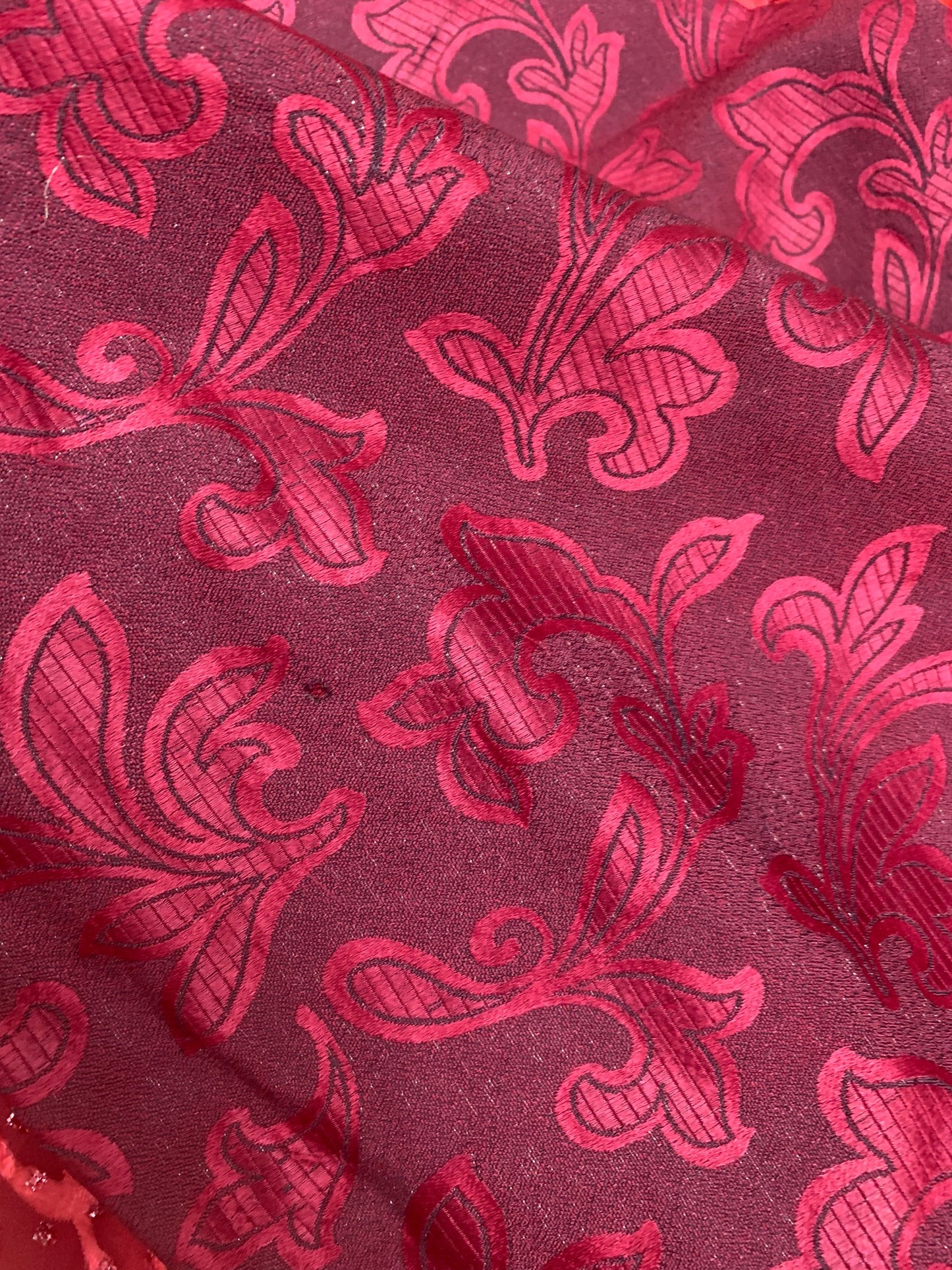
这件旗袍的面料堪称“低调的奢华”。它并非大红大绿的俗艳印花,而是采用了提花织金(Brocade)工艺。
- 色彩与质感:底色为深沉醇厚的勃艮第红(酒红),这种颜色在光谱中处于红色与紫色的交界,既有红色的热烈,又有紫色的神秘与高贵。在光线下,面料表面泛着微微的金属光泽,这是“织金”工艺特有的质感,仿佛将夕阳的余晖编织进了丝线之中。
- 图案寓意:仔细观察其纹样,这是一种变体的缠枝莲纹(Arabesque/Interlocking Branches)与卷草纹的结合。
- 这种纹样源于佛教艺术中的“宝相花”,经过千年的演变,去除了宗教的庄严,留下了世俗的富贵与连绵不断的生命力。
- 叶片舒展,藤蔓缠绕,线条流畅而富有韵律感,如同书法中的行草,笔断意连。这种“满而不乱”的布局,正是中国传统美学中“气韵生动”的最佳注脚。它不似牡丹般张扬,却有着“润物细无声”的雅致,象征着生生不息、福寿绵长。
二、工艺溯源:指尖上的乾坤
作为服装史研究者,我必须强调这件旗袍在剪裁与细节上的极高造诣,它代表了上世纪六十年代台湾旗袍制作的巅峰水准。
1. 线香绲(Piping)的艺术:
请注意领口、襟边以及袖窿处的黑色滚边。这在行话里叫做“线香绲”。不同于宽边的滚条,线香绲细如线香,极难制作。它要求工匠在缝纫时,既要保证边缘圆润饱满,又要贴合衣身曲线,稍有偏差便会显得臃肿或松垮。在这件旗袍上,黑色的线香绲如同一道劲瘦的墨线,勾勒出旗袍的轮廓,不仅起到了加固作用,更在视觉上分割了色块,使得酒红色的面料更加立体深邃,体现了“计白当黑”的构图智慧。
2. 六十年代的“海派”遗风与“台式”改良:
这件旗袍的版型非常挺括,收腰精准,省道(Darts)处理得极为干净利落。这反映了60年代台湾旗袍受西方立体剪裁影响,开始更加注重展现女性身体的自然曲线(S型),但同时又保留了中式立领的含蓄。这种“中西合璧”的审美,正是那个时代独有的文化印记。
三、历史回响:流金岁月的见证
张爱玲曾在《更衣记》中写道:“对于不会说话的人,衣服是一种语言,随身带着的是袖珍戏剧。”这件旗袍,便是一出无声的戏剧。
- 时代的缩影:上世纪五六十年代,随着局势变迁,大量江浙沪的裁缝师傅迁往台湾。他们将上海滩最精湛的技艺带到了宝岛,并结合当地的气候与审美进行了改良。这件产自台湾的古董旗袍,正是这段“海上繁华梦”在台湾延续的铁证。它身上流淌着老上海的血液,却又沾染了台北的烟雨。
- 稀缺性与收藏价值:在那个年代,这样一件采用重工提花面料、配合精细手工线香绲的旗袍,绝非普通人家日常穿着,往往是出席重要场合(如婚宴、晚宴)时的“战袍”。历经六十载光阴,丝绸虽脆,但这件衣服保存完好,色泽依旧如初,实属凤毛麟角。它不仅是一件衣物,更是一段被织物封存的时光。
四、结语
穿上它,你穿上的不仅仅是一件衣服,而是六十年的风华流转。那酒红色的提花在灯光下摇曳,仿佛旧时光里的留声机在低吟浅唱。它是博物馆级的藏品,也是你可以拥有的、触手可及的历史。
注释:微瑕特价
Measurements / Size Guide:
Bust / Waist / Hips: 84/68/84 cm
Total Length: 99 cm
Detailed Description:
The fabric of this qipao is the epitome of "understated luxury." Instead of loud, gaudy prints in bright reds and greens, it utilizes a sophisticated metallic jacquard (brocade) weaving process.
Color and Texture: The ground color is a deep, mellow Burgundy (wine red). Positioned at the intersection of red and purple on the spectrum, it carries both the warmth of red and the mystery and nobility of purple. Under light, the surface gleams with a subtle metallic luster—a unique texture achieved through the weaving of gold threads, as if the soft glow of sunset has been spun into the fibers.
Iconography and Symbolism: Close inspection of the motif reveals a variation of the classic interlocking lotus pattern (arabesque/interlocking branches) combined with scrolling foliage.
This design traces its lineage back to the Baoxiang flower found in classical Buddhist art. Over thousands of years of evolution, it shed its solemn religious austerity while retaining secular associations with nobility and unbroken vitality.
With leaves spreading and vines intertwining, the lines flow with a rhythmic grace reminiscent of semi-cursive calligraphy, where strokes break but the intent remains continuous. This "dense yet orderly" layout perfectly illustrates the concept of "vivid artistic vitality" (qi yun sheng dong) in traditional Chinese aesthetics. It does not boast the loud grandeur of the peony, yet it possesses a quiet refinement that nurtures its surroundings without a sound, symbolizing eternal generation and longevity.
As a fashion historian, I must emphasize the exceptional craftsmanship found in the tailoring and structural details of this garment. It represents the pinnacle of 1960s Taiwanese qipao production.
Please turn your attention to the black piping along the collar, diagonal lapel, and armscyes. In the terminology of the trade, this is known as "incense-line" piping (线香绲). Unlike wide structural fabric borders, incense-line piping is as hyper-fine as a slender stick of incense and is incredibly difficult to execute. It demands that the artisan ensure the border remains rounded and full while perfectly contouring to the body lines; the slightest deviation would look bulky or loose. On this qipao, the black piping runs like a lean stroke of calligraphic ink, framing the silhouette. It serves a crucial dual function: structurally reinforcing the edges while visually dividing the color fields, giving the Burgundy fabric more three-dimensional depth and reflecting the compositional wisdom of "treating white space as ink" (ji bai dang hei).
The structural framework of this qipao is remarkably crisp, featuring highly precise waist reduction and clean, sharp dart manipulation. This reflects the direct influence of Western three-dimensional tailoring on 1960s Taiwanese qipao design, emphasizing the natural S-curve silhouette of the female body while preserving the modest restraint of the traditional Chinese standing collar. This "East-meets-West" aesthetic serves as a distinct cultural imprint of that specific era.
As Eileen Chang famously wrote in her essay Chronicle of Changing Clothes (更衣记): "To those who cannot speak, clothes are a language, a pocket theater carried around with oneself." This qipao is precisely that—a silent drama.
A Miniature of an Era: During the 1950s and 1960s, driven by historical shifts, a large collective of master tailors from Shanghai, Jiangsu, and Zhejiang migrated to Taiwan. They brought the most exquisite tailoring techniques of the Shanghai Bund to the island, adapting and modifying them to suit the local climate and changing lifestyle. This authentic antique qipao from Taiwan stands as physical proof of that historic continuation of the "Shanghai Dream." It carries the ancestral bloodline of old Shanghai, yet it is touched by the misty rains of Taipei.
Scarcity and Archival Value: In that era, a garment crafted from heavy jacquard brocade and finished with meticulous, hand-turned incense-line piping was never intended for daily wear. It served as a ceremonial "battle dress" (战袍) commissioned exclusively for pinnacle high-society events like formal wedding galas or elite evening banquets. Over a sixty-year horizon, vintage silk naturally becomes highly vulnerable to fiber embrittlement, making this unblemished specimen—with its original colors perfectly intact—an absolute rarity. It is not merely a garment, but a piece of time preserved in textile form.
To wear this piece is not simply to put on a dress, but to wrap oneself in sixty years of elegance and history. As the Burgundy jacquard shimmers beneath the ambient light, it evokes the low hum of a vintage gramophone playing from a bygone era. This is an artifact of museum-grade caliber, yet it remains a piece of tangible, living history you can touch and hold.
Suyuan Archival Textile Registry — Documenting the material culture, preserving the technical lineage of ancestral craft.
Note: As-Is Special Price