深圳溯源
无法加载取货服务可用情况
衣服尺寸:
胸围/腰围/臀围:86/68/90 厘米
衣长:140 厘米
细节描述:
【器以载道,衣以传神】
在服装史的浩瀚长河中,上世纪六十年代的香港旗袍,无疑是一颗璀璨的明珠。它处于中西文化剧烈碰撞与融合的交汇点,既保留了传统东方的含蓄韵味,又大胆吸纳了西方的立体剪裁美学。今日所呈之这件古董旗袍,便是那个黄金时代的缩影。它不仅仅是一件衣物,更是一段被封存的香江往事,一位无声诉说着旧日风华的历史见证者。
【色泽与材质:流光溢彩的视觉盛宴】
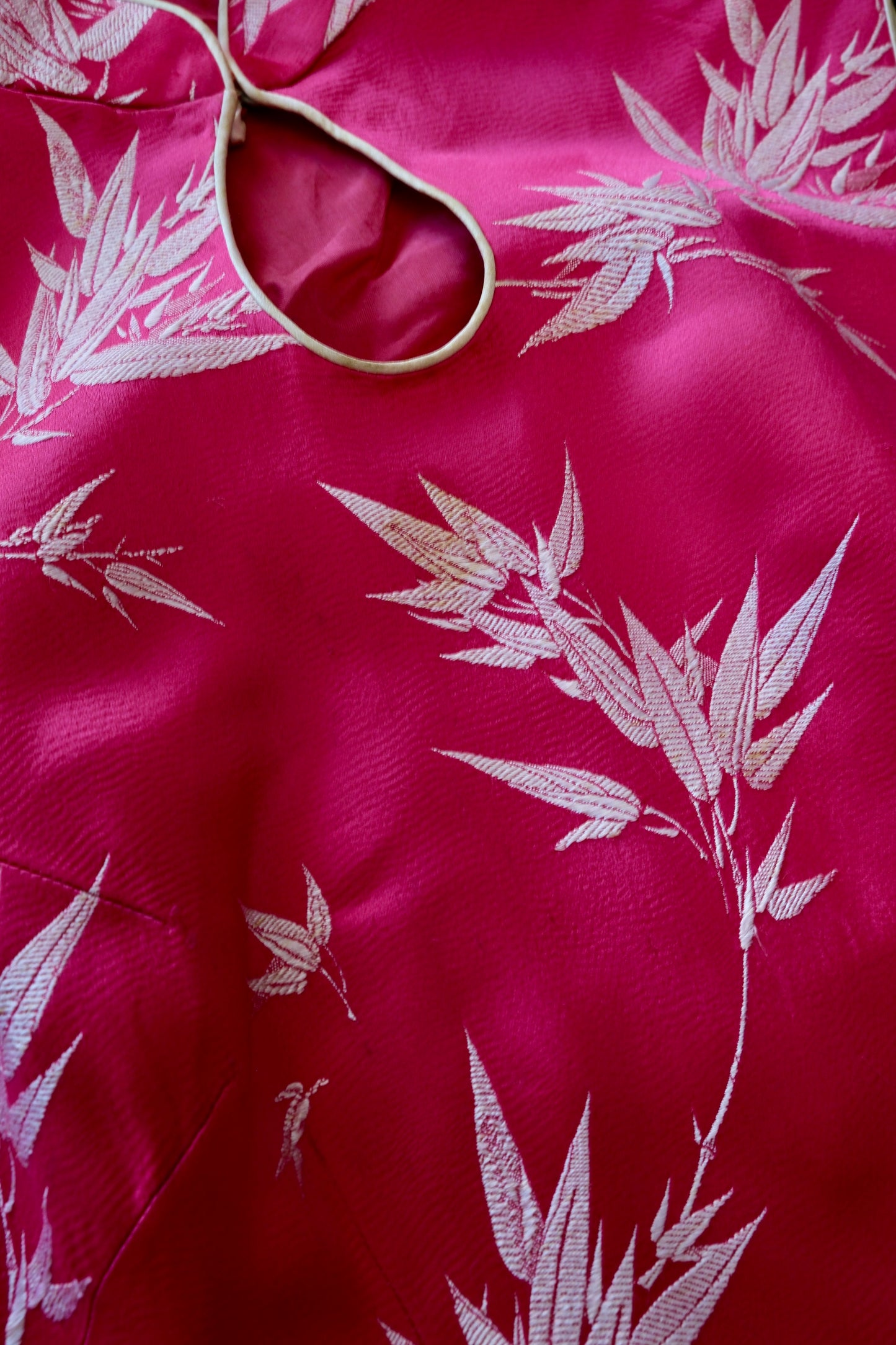
此袍选用上乘的提花织锦缎为料,这种面料在六十年代极为珍贵,以其质地紧密、光泽华丽著称。其色调并非寻常的正红或俗艳的粉,而是一种极具高级感的“玫瑰色”(Rose Madder)。这种颜色介于深红与紫红之间,如盛放的玫瑰般热烈,又似陈年的红酒般醇厚。在光线的流转下,织锦缎特有的光泽感赋予了裙身如水波般的流动质感,仿佛将那一抹醉人的春色永久定格。
【纹样解析:虚心劲节,君子之风】
细观衣身图案,乃是经典的“竹叶纹”。在中国传统文化语境中,竹子绝非凡草。
- 引经据典: 苏东坡有云:“宁可食无肉,不可居无竹。”郑板桥亦赞其:“千磨万击还坚劲,任尔东西南北风。”
- 艺术寓意: 设计师巧妙地将白色的竹叶纹样散落于玫瑰色的底料之上,疏密有致,错落生姿。白竹象征高洁、清雅与坚韧,而底色之玫瑰红则代表女性的柔美与热情。这种“刚柔并济”的设计语言,完美诠释了六十年代新女性独立而不失温婉的精神特质。竹叶随风摇曳的姿态,被织造工艺捕捉得栩栩如生,仿佛能听到风吹竹林的沙沙声。
【形制之美:水滴领与线香绲的极致考究】
这件旗袍在形制上展现了极高的工艺水准,是典型的“海派”与“港式”风格的结合体。
- 水滴领(Keyhole Neckline): 领口处采用了精巧的水滴状镂空。这一设计打破了传统高领的沉闷,隐约露出锁骨肌肤,增添了几分俏皮与性感,是六十年代追求解放与自由的时尚符号。
- 线香绲(Piping): 请注意领口、袖口及襟边的滚边工艺。这是极细的“线香绲”,细如线香,圆润饱满。在织锦缎这种厚重且光滑的面料上做如此纤细的滚边,极度考验工匠的手艺。它不仅起到了加固边缘的作用,更像是一条精致的金线,勾勒出旗袍流畅的建筑感线条,使得整件衣服挺括而不僵硬。
【稀缺性与收藏价值】
作为一件产自六十年代香港的古董衣,其稀缺性不言而喻。
1. 面料断代: 那个年代的织锦缎多采用真丝与人造丝混纺,手感与现代化纤截然不同,随着时间推移,这种老料已近乎绝迹。
2. 手工痕迹: 从平整的归拔工艺到精细的手工撬边,无不透露出当年裁缝师傅的匠心。那是机器流水线无法复制的温度。
3. 保存状况: 历经半个多世纪,织物依然色泽鲜亮,无明显破损,实属难得。
【结语】
张爱玲曾说:“对于不会说话的人,衣服是一种语言,随身带着的是袖珍戏剧。”这件玫瑰色竹叶纹旗袍,就是一出关于优雅、关于坚守、关于美的独角戏。它等待着另一位懂它的主人,穿上它,续写那段未完的流金岁月。
此件藏品不仅是服饰艺术的瑰宝,更是研究二十世纪中叶东亚女性审美变迁的重要实物史料。
注:瑕疵特价
Measurements / Size Guide:
Bust / Waist / Hips: 86/68/90 cm
Total Length: 140 cm
Detailed Description:
Within the sweeping chronological lineage of costume history, the 1960s Hong Kong qipao operates undisputedly as a radiant, monumental milestone. Positioned precisely at the geopolitical and cultural intersection where Eastern heritage and Western modernist design systems collided with immense force, it successfully safeguarded the interiorized, understated grace of the Orient while boldly assimilating Western three-dimensional ergonomic pattern-drafting. The antique specimen curated here serves as an impeccable physical distillation of that golden epoch. It transcends its utility as a luxury garment to function as a sealed time capsule of old Victoria Harbour society—a silent, magnificent primary document archiving the departed elegance of a historic timeline.
The structural foundation of this garment utilizes a supreme-tier jacquard woven brocade (Tihua Zhijinduan), a textile matrix of extreme preciousness during the 1960s, universally celebrated for its high-density thread count, structural weight, and opulent surface luster. Its tonal calibration entirely rejects generic true reds or vulgar, low-grade magentas, opting instead for a highly poised, sophisticated "Rose Madder." This specific hue occupies the precise boundary between deep carmine and rich crimson-violet—as fervent as a rose in full bloom, yet as interiorized and mellow as an aged vintage wine. Under shifting angles of illumination, the specialized reflective parameters native to the brocade structure endow the garment chassis with a fluid, water-like kinetic topography, permanently arresting that intoxicating vernal radiance within the textile grain.
Close appraisal of the surface ornamentation reveals a classical execution of the "Bamboo Leaf Motif" (Zhuyewen). Within the semiotic matrix of traditional Chinese iconography, bamboo is never categorized as mere vegetation.
Textual Lineage: The legendary Song Dynasty scholar Su Shi famously recorded: "One would rather dine without meat than reside without bamboo." Similarly, the master artist Zheng Banqiao lauded its resilience: "Battered and shattered by a thousand strikes, it remains unyielding and strong; letting wind strike it from East, West, South, or North."
Artistic Semiotics: The designer masterfully engineered a scattering of white bamboo leaf silhouettes across the deep rose-madder chassis, calculating the density and spatial cadence with immense precision. The white bamboo signifies lofty purity, refined elegance, and absolute structural fortitude, while the grounding rose-madder canvas articulates the ultimate expression of feminine softness and passion. This calculated synthesis of structural rigidity and organic fluidity (Gangrou Bingji) masterfully decodes the psychological profile of the mid-century modern woman: fiercely autonomous yet fundamentally graceful. The kinetic posture of the bamboo leaves swaying in the current is captured with such lifelike weaving precision that it visually mimics the very whisper of a vernal breeze rustling through a secluded grove.
Architecturally, this qipao demonstrates the absolute peak capabilities of the mid-century tailoring guild, materializing as a definitive textbook synthesis of the Shanghai lineage (Haipai) and metropolitan Hong Kong stylistic paradigms.
The Keyhole Cut-Out Architecture: Localized at the collar assembly is a meticulously drafted teardrop cut-out, classified as a keyhole neckline (Keyhole Neckline). This structural intervention breaks the heavy, monolithic containment native to traditional high collars, faintly revealing the anatomical lines of the clavicle to inject a sophisticated layer of playful allure. It performs as a vital fashion signifier of the 1960s volition toward physical liberation and autonomous freedom.
The Filament-Gauge Linear Cord Piping: Particular attention must be directed toward the edge-finishing execution tracing the collar circumference, abbreviated cuffs, and overlapping bodice boundary. This is an immaculate manifestation of "Filament-Gauge Cord Piping" (Xianxianggun)—a technique where the piping is rendered as remarkably slender and perfectly cylindrical as a traditional stick of incense. Executing a decorative border of such microscopic calibration atop a heavy, slippery, high-density brocade matrix demanded an extraordinary tier of manual tension control and fine tool mastery from the artisan. It transcends its mechanical function of edge reinforcement to operate as a disciplined architectural contour line, ensuring the garment remains highly structured and crisp without ever lapsing into physical rigidity.
As a authenticated holotype specimen emerging from 1960s Hong Kong, the item's non-reproducible status within the global antique asset registry is absolute.
Chronological Fabric Discontinuity: The brocade textiles of this specific timeline utilized a highly specialized structural blend of natural mulberry silk and premium regenerated cellulose rayon. The resulting tactile handle and structural drape are fundamentally irreplicable by modern petrochemical synthetic fibers. Following the total transformation of the textile trade, these vintage yardages have entered absolute depletion.
Permanent Material Evidences of Artisanal Human Labor: From the flawless execution of the thermal Guiba ("shaping through ironing and stretching") technique to the absolute precision of the blind manual whipstitched hems (手工撬边), every square inch proclaims the absolute discipline of the master tailor. This delivers an irreplaceable human warmth and structural nuance that automated, mass-production factory assembly lines can never replicate.
State of Conservation: Having navigated more than half a century of environmental oxidation and atmospheric duress, the textile matrix retains its original chromatographic saturation and exhibits zero structural breakdown—a true miracle of textile preservation.
Eileen Chang famously observed in The Record of Changing Clothes: "To those who cannot speak, clothes are a language; what one carries with them is a pocket drama." This rose-madder bamboo-motif qipao performs precisely as a supreme solo drama tracking eternal elegance, structural discipline, and absolute beauty. It stands in monumental composure, waiting for its next rightful custodian—one who possesses the archival literacy to decode its structural language—to step into its architecture and continue its cross-generational narrative of liquid gold.
Note:As-Is Special Offer