深圳溯源
无法加载取货服务可用情况
衣服尺寸:
胸围/腰围/臀围:90/78/104 厘米
衣长:130 厘米
细节描述:
【衣上繁花:烧花工艺里的东方美学】
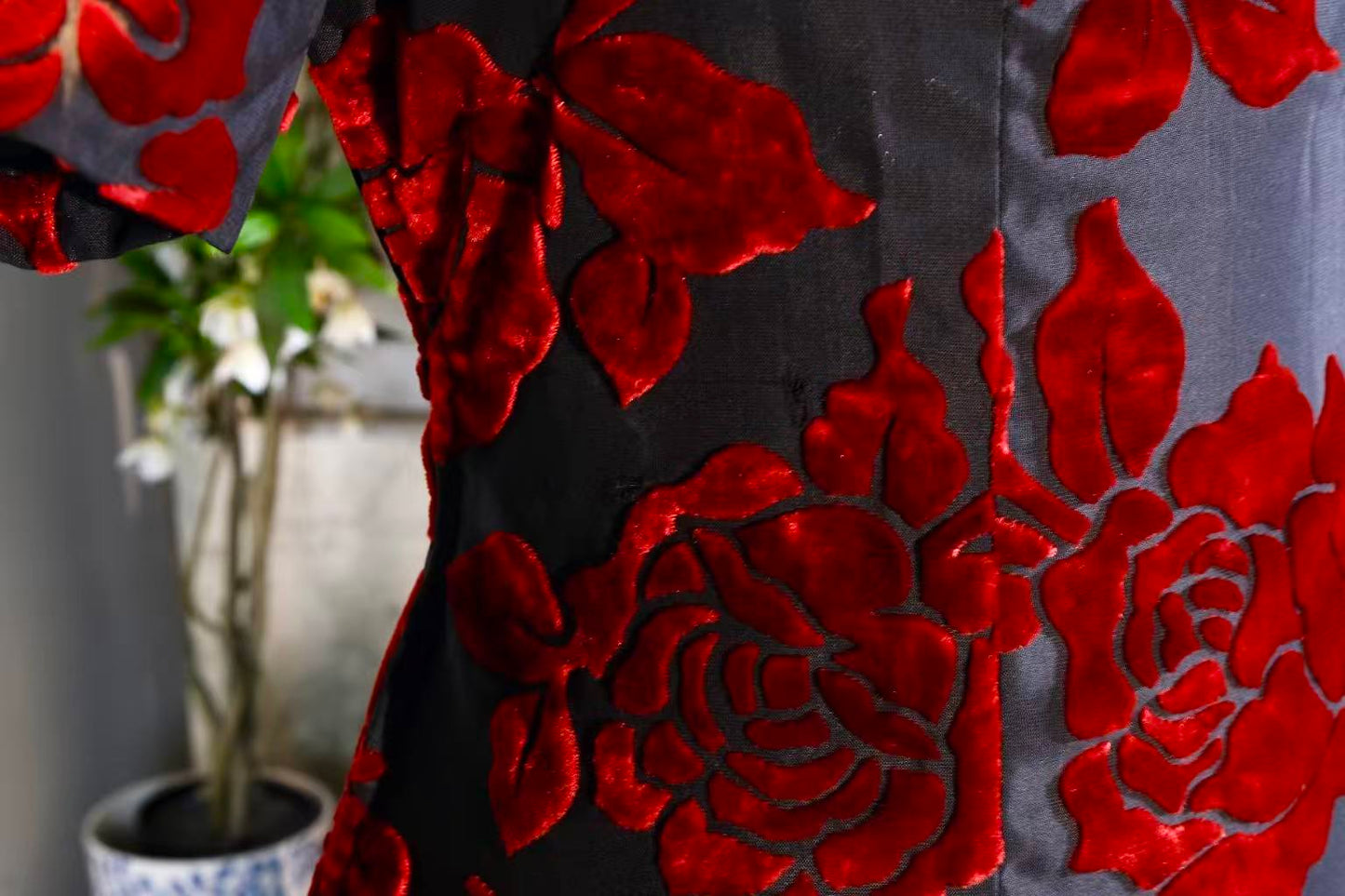
这件上世纪六十年代的香港产古董旗袍,以烧花丝绒为面料基底,将“减”与“加”的工艺哲学演绎得淋漓尽致。深灰蓝的丝绒如静谧夜空,而大朵盛放的红玫瑰则是夜空中最热烈的星辰——工匠以高温“烧蚀”掉部分丝绒表层,仅留花瓣轮廓与叶脉肌理,使玫瑰呈现出浮雕般的立体感;未烧蚀的底布则保留丝绒原本的柔滑光泽,一明一暗、一凸一平间,花朵仿佛正从布料深处“生长”而出,连叶片的卷曲弧度都藏着匠人对自然之美的精准捕捉。这种“以火为笔,以布为纸”的烧花技艺,是六十年代香港纺织业黄金时代的缩影:彼时中西文化碰撞,传统丝绸工艺与西方现代审美交融,让旗袍既保有东方的含蓄雅致,又添了几分摩登的热烈张力。
【时光褶皱:一件旗袍里的香江往事】
若要追溯这件旗袍的故事,需回到1960年代的香港——那是个“衣香鬓影,霓虹初上”的年代。彼时的香港,既是东方之珠,也是中西文化的熔炉:老上海的裁缝带着精湛手艺南迁,西洋的时尚风潮随轮船涌入,旗袍便在这股浪潮中完成了“自我革新”。
这件旗袍的主人,或许是中环写字楼里干练的女职员,下班后换上它赴一场茶餐厅的约会;也可能是湾仔戏院里的名伶,穿着它在后台对镜描眉,准备登台唱一曲《帝女花》。丝绒的厚重与玫瑰的艳丽,恰是那个时代女性精神的隐喻:她们不再是被困于闺阁的“弱质纤纤”,而是能在商海、舞台、家庭中游刃有余的“新女性”——旗袍裹住的是曲线,撑起的却是独立与自信。
更难得的是,这件旗袍历经六十载岁月,仍保存着近乎完美的品相:丝绒的光泽未被时光磨蚀,玫瑰的红艳依旧鲜活。这般“穿越时空”的完整度,在古董衣市场中堪称凤毛麟角——要知道,丝绒面料本就娇贵,加之烧花工艺的复杂性,能留存至今且状态上乘者,十不存一。
【引经据典:从《诗经》到张爱玲的玫瑰意象】
玫瑰之美,自古便是文人墨客的偏爱。《诗经·郑风》有云:“有女同车,颜如舜华”,虽咏木槿,却道尽了女子如花般娇艳的神韵;而至近现代,张爱玲笔下的白流苏,身着旗袍在浅水湾的月色下回眸,那抹风情里,何尝没有玫瑰的影子?这件旗袍上的玫瑰,既有古典诗词中“花开堪折直须折”的热烈,又有张爱玲式“低到尘埃里,开出花来”的倔强——它是东方美学的载体,更是时代精神的注脚。
从艺术风格而言,这件旗袍完美诠释了“海派旗袍”的精髓:剪裁上,收腰设计贴合人体曲线,却又不过分紧绷,保留了东方女性的温婉体态;图案上,大朵玫瑰打破了传统旗袍“小碎花”的婉约,以浓烈的色彩与夸张的造型,呼应了六十年代全球范围内的“波普艺术”风潮;工艺上,烧花丝绒的运用,既延续了清代“织金缎”“妆花缎”的奢华基因,又以现代技术赋予其新的生命力。这般“守正创新”的设计,让它成为研究二十世纪中叶服饰史的活标本。
【稀缺性:不可复制的时代孤品】
如今,当我们凝视这件旗袍,看到的不仅是一件衣服,更是一段被丝绒包裹的历史。它的稀缺性,不仅在于“烧花丝绒”工艺的失传(当代虽有仿制,却难复刻当年的火候与匠心),更在于它所承载的“时代情绪”——那是一个新旧交替、东西方碰撞的年代,是女性意识觉醒、时尚产业崛起的年代,是所有美好与矛盾交织的年代。
若说古董衣是“穿在身上的历史”,那么这件六十年代的烧花丝绒玫瑰旗袍,便是历史中最绚烂的一章。它等待着下一个懂它的人,续写属于这个时代的“玫瑰故事”。
Measurements / Size Guide:
Bust / Waist / Hips: 90/78/104 cm
Total Length: 130 cm
Detailed Description:
This antique qipao produced in Hong Kong during the 1960s of the last century utilizes burnout velvet as its fabric foundation, executing the manufacturing philosophy of "subtraction" and "addition" to absolute perfection. The deep gray-blue velvet resembles a quiet night sky, while the massive, blossoming red roses operate as the most passionate stars within that firmament—artisans utilize high-temperature "etching" to dissolve portions of the velvet surface layer, preserving solely the petal contours and leaf-vein textures to grant the roses a relief-like, three-dimensional depth. The unetched ground fabric retains the original smooth luster of the velvet pile; between light and shadow, protrusion and flatness, the blossoms appear to be "growing" directly out of the deep matrix of the textile, where even the curling angles of the leaves conceal the artisan's precise capture of natural beauty. This specialized burnout technique of "using fire as a brush and cloth as paper" serves as a miniature portrait of the golden age of the 1960s Hong Kong textile sector: during this timeline, Eastern and Western cultures collided, and traditional silk craft integrated with modern Western aesthetics, allowing the qipao to preserve Eastern reserve and refinement while adding a layer of modern, passionate tension.
To retrace the narrative of this qipao, one must return to 1960s Hong Kong—an era defined by "the fragrance of apparel, the shadow of hair buns, and the initial lighting of neon signs." Hong Kong during this phase operated simultaneously as the Pearl of the Orient and a melting pot of Eastern and Western cultures: tailors from old Shanghai migrated south bringing their exquisite handcraft, while Western fashion trends poured in alongside commercial steamships, causing the qipao to complete its "self-evolution" within this grand wave.
The original custodian of this qipao might have been a capable female clerk working in a Central district office tower, changing into this garment after work to attend a rendezvous in a neighborhood tea restaurant; or perhaps she was a celebrated actress in a Wan Chai theater, painting her eyebrows before a mirror backstage, preparing to step under the lights to perform a selection from The Peony Pavilion. The structural weight of the velvet paired with the brilliance of the roses serves as a precise metaphor for the female spirit of that generation: they were no longer the "fragile and delicate" figures confined to inner chambers, but "New Women" capable of navigating the commercial seas, theatrical stages, and domestic spheres with absolute ease—the qipao bound their physical curves, but held up their independence and self-confidence.
Even more remarkable is that after crossing through sixty years of timeline, this qipao still preserves a near-flawless state of archival condition: the luster of the velvet pile remains unmarred by time, and the crimson brilliance of the roses stays entirely vital. This manner of "trans-temporal" completeness stands as exceptionally rare within the antiquarian garment market—one must recognize that velvet fabrics are inherently delicate, and coupled with the complexity of the burnout process, fewer than one in ten matching specimens from this era have survived to the present day in premium condition.
The beauty of the rose has remained a favored subject for literary figures since antiquity. The ancient text The Book of Songs · Odes of Zheng states: "A maiden travels in the same carriage, her face like a blossoming hibiscus," which, though singing of the hibiscus flower, completely captures the exquisite, flower-like grace of a woman. Moving into the modern era, the character Bai Liusu written by Eileen Chang looks back beneath the moonlight at Repulse Bay while clad in a qipao; within that specific elegance, how could there not be the shadow of a rose? The roses covering this qipao carry both the passionate intensity of "gather the blossoms while they may" found in classical poetry, and the fierce stubbornness of Chang's philosophy: "lowering oneself into the dust, yet blossoming into a flower from it"—it operates as a carrier of Eastern aesthetics and a definitive footnote to the spirit of the generation.
In terms of pure artistic style, this garment flawlessly interprets the core essence of the "Shanghai-style qipao" (海派旗袍): structurally, the waist reduction conforms precisely to human curves without being overly constricting, preserving the gentle, fluid posture of Eastern women; pattern-wise, the massive roses break away from the understated modesty of traditional "small scattered calico prints," relying on concentrated coloration and exaggerated forms to echo the global "Pop Art" trends of the 1960s; technically, the application of burnout velvet inherits the luxurious genetic lineage of Qing Dynasty "woven gold satin" (织金缎) and "raised blossom satin" (妆花缎), while injecting fresh vitality through mid-century technical execution. This manner of "preserving the foundational truth while innovating" transforms this piece into a living museum specimen for the study of mid-20th-century costume history.
Today, when we gaze upon this qipao, what we perceive is far more than a functional article of clothing; we are looking at a segment of history permanently wrapped in velvet. Its scarcity resides not merely in the loss of this specific "burnout velvet" handcraft (contemporary manufacturers attempt replications, yet find it impossible to duplicate the precise heat calibration and artisan devotion of the original era), but in the distinct "emotional landscape of the generation" it anchors—it was born during an era of transition between the old and the new, an intersection where East and West collided, a timeline where female consciousness awakened and the fashion sector rose, a historical moment where all things beautiful and contradictory were tightly interwoven.
If one accepts that antique garments operate as "history worn upon the body," then this 1960s burnout velvet rose qipao stands as the most magnificent chapter within that history. It hangs silently, awaiting its next discerning custodian to continue writing the "rose narrative" belonging to this generation.