深圳溯源
无法加载取货服务可用情况
衣服尺寸:
胸围/腰围/臀围:88/72/100 厘米
衣长:110 厘米
细节描述:
【形制与色彩:东方美学的极致凝练】
这件诞生于上世纪六十年代的香港产朱砂红旗袍,是“黄金时代”海派与港式剪裁融合的孤品。其色如朱砂点染,取自《诗经·秦风》中“锦衣狐裘,颜如渥丹”的古典意象,却以现代印染工艺呈现出特有的流动光泽。衣身采用无袖削肩设计,精准贴合女性肩颈线条,腰身收束处暗藏省道工艺,将六十年代追求“S型曲线”的审美推向极致。下摆开衩至膝上三寸,行走间步履生风,恰如张爱玲笔下“那是一种冷艳的、不近人情的红”,既保留了传统旗袍的含蓄,又注入了摩登时代的张扬。
【纹样与细节:针尖上的立体诗学】
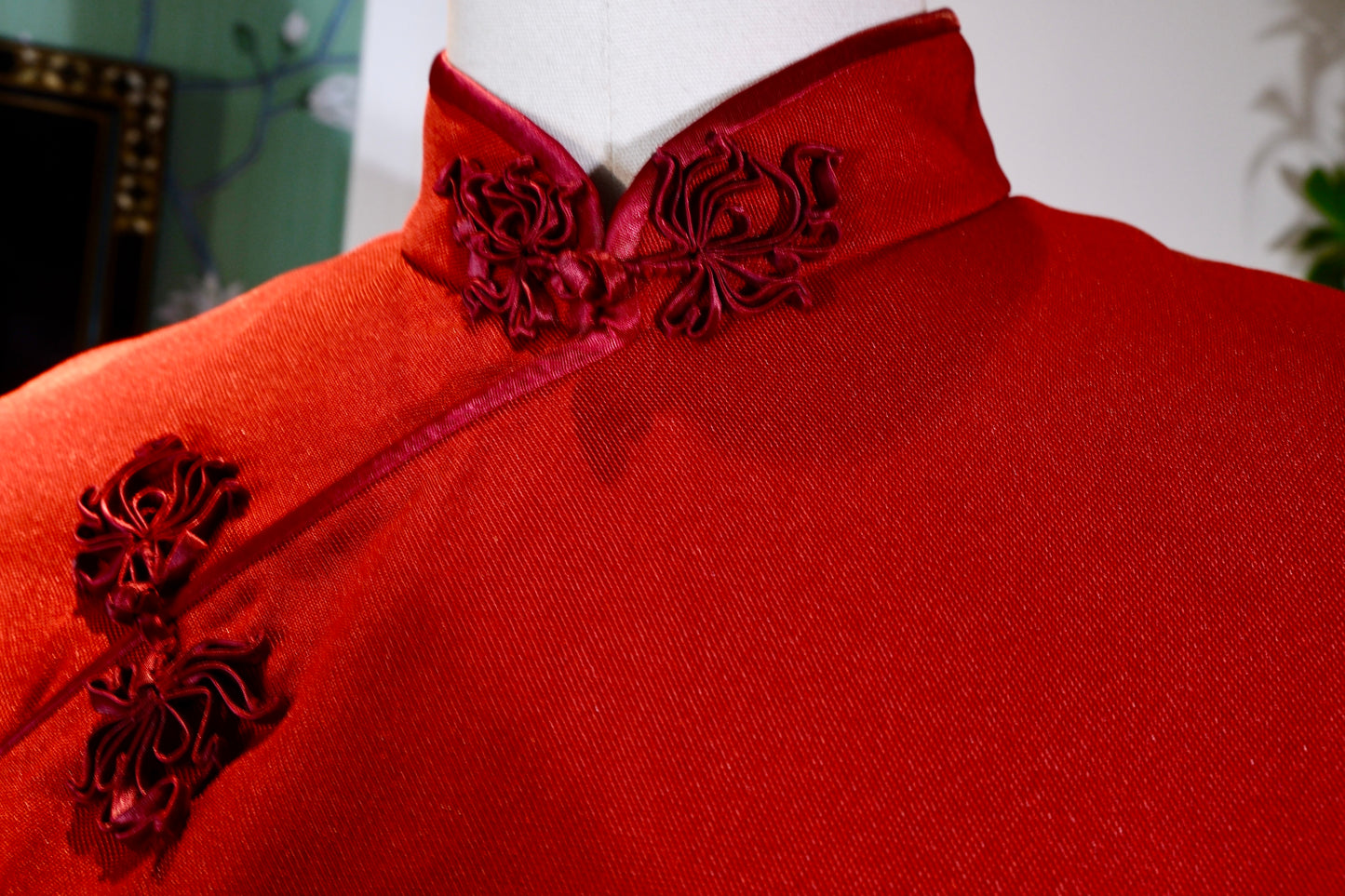
最引人注目的是领口与襟侧的立体盘花扣。这并非普通的布纽,而是采用同色系重磅缎带,经由匠人手工折叠、缠绕、定型而成的嵌丝硬花扣。这种工艺在服装史中被称为“盘扣艺术化”,它摒弃了传统的平面一字扣,转而追求雕塑般的体积感。花朵形态饱满,花瓣层叠错落,宛如两朵盛开的墨菊静卧于锁骨之间。这种装饰手法在当时极为罕见,它不仅起到了固定衣襟的功能性作用,更将女性的颈部线条衬托得修长优雅,是“less is more”设计理念在东方的早期实践。
【历史回响:霓虹灯下的东方绮梦】
六十年代的香港,正处于东西方文化剧烈碰撞的熔炉期。这件旗袍便是那个时代的缩影。彼时,邵氏电影公司的片场里,林黛、乐蒂等女星身着此类改良旗袍,在大银幕上演绎着才子佳人的故事;而现实中的名媛闺秀,则穿着它出入半岛酒店的下午茶会。
它不仅仅是一件衣服,更是一段被封存的时光。
【学术注脚:稀缺性与艺术价值】
从服装社会学的角度来看,这件旗袍见证了“国服”向“时装”转型的关键节点。它脱离了清末民初宽大平直的旧制,完全拥抱了西式立体剪裁(Darting),是研究二十世纪中叶中国女性身体解放与审美变迁的珍贵实物标本。
正如沈从文先生在《中国古代服饰研究》中所言:“服饰是文化的皮肤。”这件大红旗袍,以其热烈而不俗艳的色彩、繁复而克制的盘花细节,以及不可复制的时代剪裁,成为了一件穿在身上的艺术品。它稀缺的不仅是六十年的岁月包浆,更是那份再也无法复刻的、属于香江流金岁月的精致与从容。
Measurements / Size Guide:
Bust / Waist / Hips: 88/72/100 cm
Total Length: 110 cm
Detailed Description:
Born in Hong Kong during the 1960s, this cinnabar-red qipao stands as a surviving masterpiece tracking the historic fusion of Shanghainese (海派) and Hong Kong bespoke tailoring during the post-war "golden twilight." Its coloration resembles pure, layered cinnabar, drawing direct inspiration from the classical poetic imagery found within The Book of Songs • Qin Wind: "Dressed in fine brocades and fox furs, her face is as radiant as red cinnabar." Yet, this traditional shade is realized through a specialized mid-century application that endows the surface with a unique, fluid luster.
The primary chassis features a modern sleeveless, cutaway shoulder design (无袖削肩) that contours precisely to the natural slope of the neck and shoulder girdle. At the waist, structural reduction is achieved through meticulously calculated, concealed internal darting (暗藏省道), carrying the 1960s pursuit of the sharp "S-curve" profile to its absolute peak. The lateral side slits terminate exactly three inches above the knee, unleashing fluid kinetic movement with every step. It perfectly materializes the visual atmosphere famously captured by Eileen Chang: "That was a cold, detached, almost unearthly red." This structural design safely preserves the modest reserve of ancestral attire while injecting the unvoiced, expressive confidence of a cosmopolitan era.
The defining technical accent of this specimen is the group of three-dimensional structural frog closures (立体盘花扣) positioned along the Mandarin collar and diagonal lapel line. Moving far beyond functional cloth closures, these fixtures utilize heavy-gauge, color-matched satin ribbons that have been manually folded, coiled, and structurally reinforced by an expert artisan into wire-core stiffened flower buttons (嵌丝硬花扣). This technique represents the artistic elevation of the traditional frog closure (“盘扣艺术化”), discarding flat, linear configurations in favor of a bold, sculptural volume.
The blossoms are full in form, with layered petals cascading as if two ink chrysanthemums are resting quietly across the clavicle. This decorative execution was exceptionally rare during that horizon; it fulfills its mechanical function of sealing the lapel while visually elongating the neck contours into a graceful, elegant line—standing as an early Eastern manifestation of the "less is more" design philosophy.
Hong Kong in the 1960s operated as a cultural crucible where Eastern traditions and Western influences intensely collided and dynamically coexisted. This qipao functions as a pristine miniature of that socio-industrial chapter. During this exact window, on the soundstages of the Shaw Brothers Studio, iconic cinema stars like Lin Dai and Betty Loh Ti wore modified qipaos of this caliber to project timeless elegance across the silver screen; concurrently, prominent madems and daughters of affluent merchant families donned identical styles to attend afternoon tea service at The Peninsula Hotel. It transcends its primary classification as a functional garment, acting as a beautifully sealed capsule of time.
Evaluated through the lens of fashion sociology, this qipao documents the critical milestone when traditional regional dress fully transitioned into modern global haute couture. It completely breaks away from the wide, flat, and straight rules characteristic of the late Qing and early Republican garments, fully embracing Western three-dimensional structural pattern drafting (Darting). Consequently, it serves as an irreplaceable physical specimen for studying the structural liberation of the female form and the evolution of twentieth-century East Asian design aesthetics.
As Shen Congwen noted in Studies of Ancient Chinese Clothing: "Clothing is the skin of culture." This brilliant crimson qipao—commanding a warm, rich palette entirely free of vulgarity, balanced by complex yet highly restrained sculptural closures and an irreproducible mid-century fit—stands proudly as a wearable work of art. Its absolute scarcity rests not merely on its sixty-year chronological age and settled natural patina, but on the unrepeatable spirit of poise, refinement, and absolute composure belonging to that golden generation of the Fragrant Harbour.
Suyuan Archival Textile Registry — Documenting the material culture, preserving the technical lineage of ancestral craft.