深圳溯源
无法加载取货服务可用情况
衣服尺寸:
胸围/腰围/臀围:98/78/100 厘米
衣长:117 厘米
细节描述:
【图案解析:丝缕间的东方诗画】
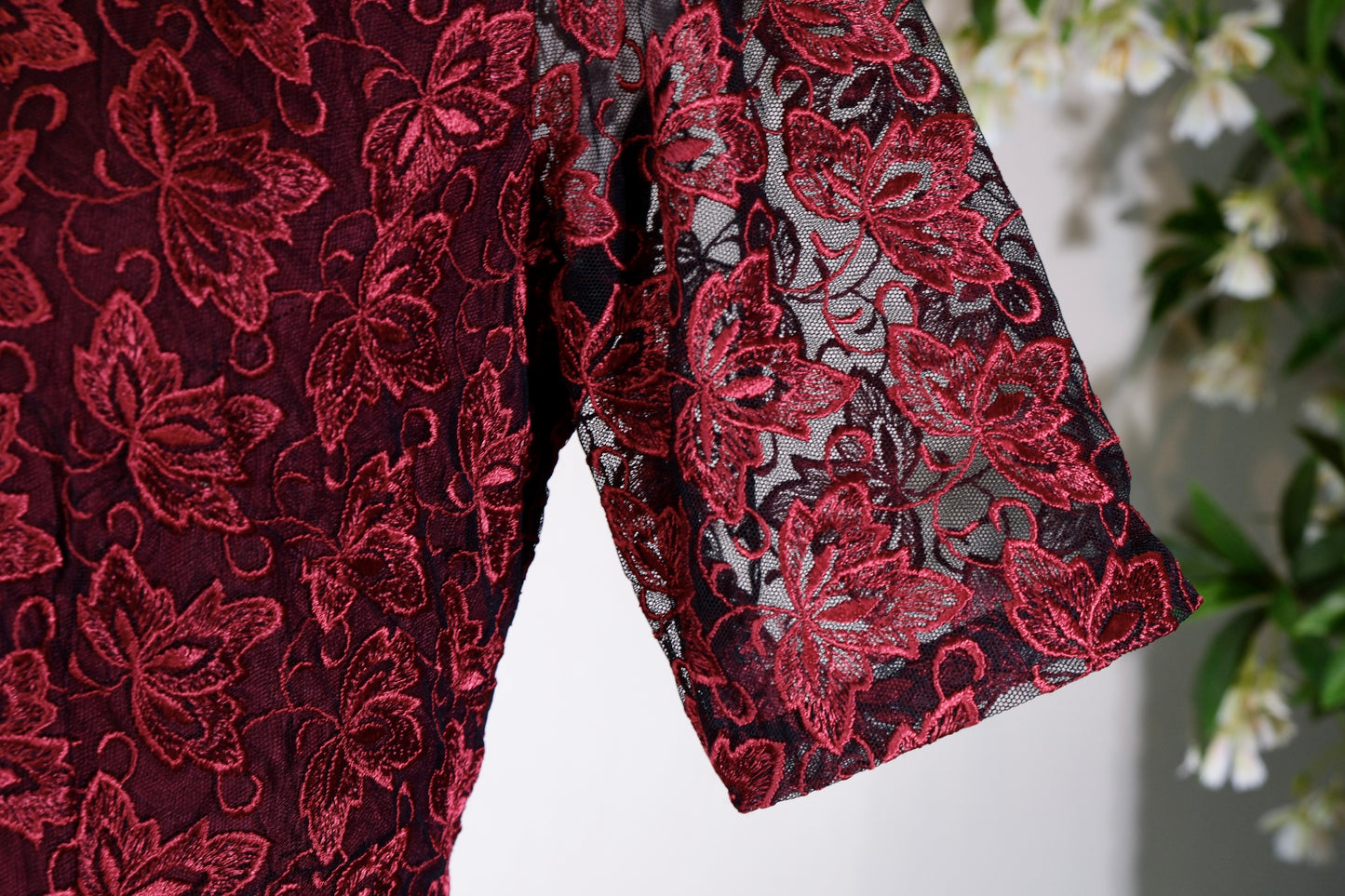
这件旗袍以酒红为底,铺陈着机绣蕾丝枫叶纹样。枫叶脉络如游丝般细腻,叶片层叠错落,似秋风中轻颤的枝桠;蕾丝镂空处透出朦胧光影,将“霜叶红于二月花”(杜牧《山行》)的诗意凝于织物。酒红底色如陈年佳酿,沉稳中透着热烈,与枫叶纹样的灵动形成张力——既承袭传统刺绣“以针代笔”的工笔意趣,又借机绣工艺赋予图案工业时代的精致秩序,恰是六十年代东西方美学碰撞的缩影。
【历史叙事:海峡彼端的衣香鬓影】
上世纪六十年代,台湾纺织业正值黄金期,依托日本进口机绣设备与本土匠艺,孕育出这批“混血”旗袍。彼时,台北大稻埕的裁缝铺里,师傅们以日本蕾丝为材,沿袭海派旗袍的修身剪裁,将东方女性的婉约与战后经济的活力织入衣褶。
这件旗袍的主人,或许是某位穿梭于洋场舞厅的名媛,或许是出席家宴的闺秀——她身着此衣,步履间枫叶摇曳,珍珠项链(图中配饰)衬得颈项如玉,恰应了张爱玲笔下“旗袍是女人的第二层皮肤”的私密与张扬。它见证了台湾从农业社会向工业转型的阵痛与新生,也承载着那个时代女性对“美”的执着:在物资尚不丰裕的年代,仍愿为一件衣裳倾注匠心,让日常穿着成为艺术表达。
【文化溯源:针脚里的文明对话】
蕾丝工艺,本是欧洲宫廷的奢华象征。当日本机绣技术嫁接台湾匠人的巧思,这件旗袍便成了跨文化的载体:枫叶纹暗合中国“秋思”意象(如“停车坐爱枫林晚”),蕾丝镂空却藏着西方浪漫主义基因;立领盘扣坚守东方礼制,修身曲线又呼应现代审美解放。
正如沈从文所言:“服饰是穿在身上的历史。”这件旗袍的每一寸针脚,都是六十年代东亚时尚交流的注脚——它不是简单的“复古”,而是特定历史语境下,技术、文化与身份的复杂缝合。
【稀缺性:时光淬炼的孤品价值】
历经六十载风雨,能完整保存至今的古董旗袍已属凤毛麟角。其稀缺性不仅在于年代久远,更在于工艺的不可复制性:当年日本进口的机绣设备早已迭代,台湾老裁缝的手艺也多随岁月消逝;加之蕾丝面料易脆化、刺绣易脱线,能保持如此色泽与结构的存世品,堪称“活着的文物”。
它不仅是衣橱里的珍藏,更是研究六十年代东亚时尚史、纺织技术史的实物标本——每一道褶皱里,都藏着未被书写的故事;每一片枫叶上,都凝结着时代的体温。
【结语:穿在身上的史诗】
若说旗袍是东方的诗,这件六十年代的台产古董旗袍,便是诗中带着异域韵味的绝句。它以枫叶为墨,以蕾丝为纸,书写着一个时代的优雅与挣扎、传承与创新。当你触摸它的瞬间,指尖传来的不仅是织物的温度,更是历史的脉搏——那是属于一个时代的衣香鬓影,也是属于所有爱美之人的永恒浪漫。
Measurements / Size Guide:
Bust / Waist / Hips: 98/78/100 cm
Total Length: 117 cm
Detailed Description:
This qipao utilizes a wine-red ground, completely overlaid with a machine-embroidered lace maple leaf motif. The veins of the maple leaves are as delicate as continuous threads, with layers of foliage overlapping and cascading to resemble branches gently trembling in an autumn breeze. The hollowed-out gaps of the lace let a hazy play of light and shadow filter through, freezing the classic poetic sentiment of "frost-bitten leaves are redder than early spring flowers" (from Du Mu’s Mountain Trip) directly onto the textile. The wine-red ground resembles an aged vintage wine—steady yet holding an underlying warmth—creating a powerful tension with the dynamic movement of the maple leaf motifs. It both inherits the meticulous Gongbi artistry of traditional embroidery, which "substitutes the needle for the brush," and utilizes machine embroidery to endow the pattern with the refined order of the industrial era, capturing a perfect miniature of the collision between Eastern and Western aesthetics in the 1960s.
During the 1960s, the Taiwanese textile industry was in its golden era. Relying on machine embroidery equipment imported from Japan paired with local artisanal skill, it gave birth to this specific generation of cross-bred qipaos. At that time, in the custom tailor shops of Taipei's Dadaocheng district, master tailors used imported Japanese lace as their raw material, following the body-conscious lines of the Shanghai style (海派) to weave both the gentle restraint of Eastern women and the vitality of the post-war economy directly into the garment creases.
The original owner of this qipao might have been a prominent madam navigating high-society dance halls, or a young lady attending an exclusive family banquet. As she moved in this dress, the maple leaves would ripple with every step, and her pearl necklace (pictured as an accessory) would beautifully frame a neck as fair as jade, perfectly capturing the intimate yet expressive posture famously described by Eileen Chang: "The qipao is a woman's second skin." It stands as a physical witness to the labor pains and rebirth of Taiwan as it transitioned from an agricultural society to an industrial economy, while carrying that generation's unyielding pursuit of beauty: in an era when material resources were not yet abundant, they were still willing to pour ultimate craftsmanship into a single garment, transforming everyday attire into an artistic statement.
Lace craftsmanship was originally a symbol of luxury within European royal courts. When Japanese machine-embroidery technology was grafted onto the clever ingenuity of Taiwanese artisans, this qipao transformed into a cross-cultural vessel: the maple leaf motif secretly aligns with the traditional Chinese imagery of "autumn reflection" (as in "I stop my carriage to admire the maple woods at dusk"), while the hollowed-out lace conceals the genetic markers of Western Romanticism. Concurrently, the standing collar and fabric closures firmly hold onto traditional Eastern etiquette, while the body-conscious silhouette echoes the modern liberation of aesthetics.
Just as Shen Congwen noted: "Clothing is history worn on the body." Every single inch of stitching across this qipao serves as a footnote to the exchange of East Asian fashion in the 1960s—it is not a simplistic case of "retro revival," but a complex stitching together of technology, culture, and identity within a highly specific historical context.
Spanning a sixty-year horizon of wind and rain, authentic antique qipaos preserved in unblemished condition have become exceptionally rare. Their scarcity rests not only on chronological age but on the complete irreproducibility of their craftsmanship: the imported Japanese machine embroidery equipment of that era has long since been upgraded through multiple iterations, and the handcraft of Taiwan’s old master tailors has mostly vanished with the passage of decades. Furthermore, because vintage lace materials are highly vulnerable to fiber embrittlement and embroidered threads are prone to splitting, a surviving specimen that retains its original structural integrity and vivid coloration operates as a true "living cultural relic."
It transcends a standard archive inside a private wardrobe, acting as an irreplaceable physical specimen for the study of 1960s East Asian fashion history and textile technology development—every individual crease conceals an unwritten story, and every single maple leaf encapsulates the living warmth of that generation.
If the qipao is considered the poetry of the East, this 1960s Taiwan-produced antique qipao stands as a classic four-line verse carrying an exotic rhythm. It uses maple leaves as its ink and lace as its paper, chronicling the elegance, struggles, heritage, and innovations of an entire generation. The exact moment you touch its textile surface, what transfers to your fingertips is far more than the physical warmth of the weave; it is the pulse of history itself—the sophisticated silhouettes belonging to a golden era, and a timeless romance for all who cherish beauty.
Suyuan Archival Textile Registry — Documenting the material culture, preserving the technical lineage of ancestral craft.