深圳溯源
无法加载取货服务可用情况
衣服尺寸:
胸围/腰围/臀围/衣长:88/64/88/92 厘米
细节描述:
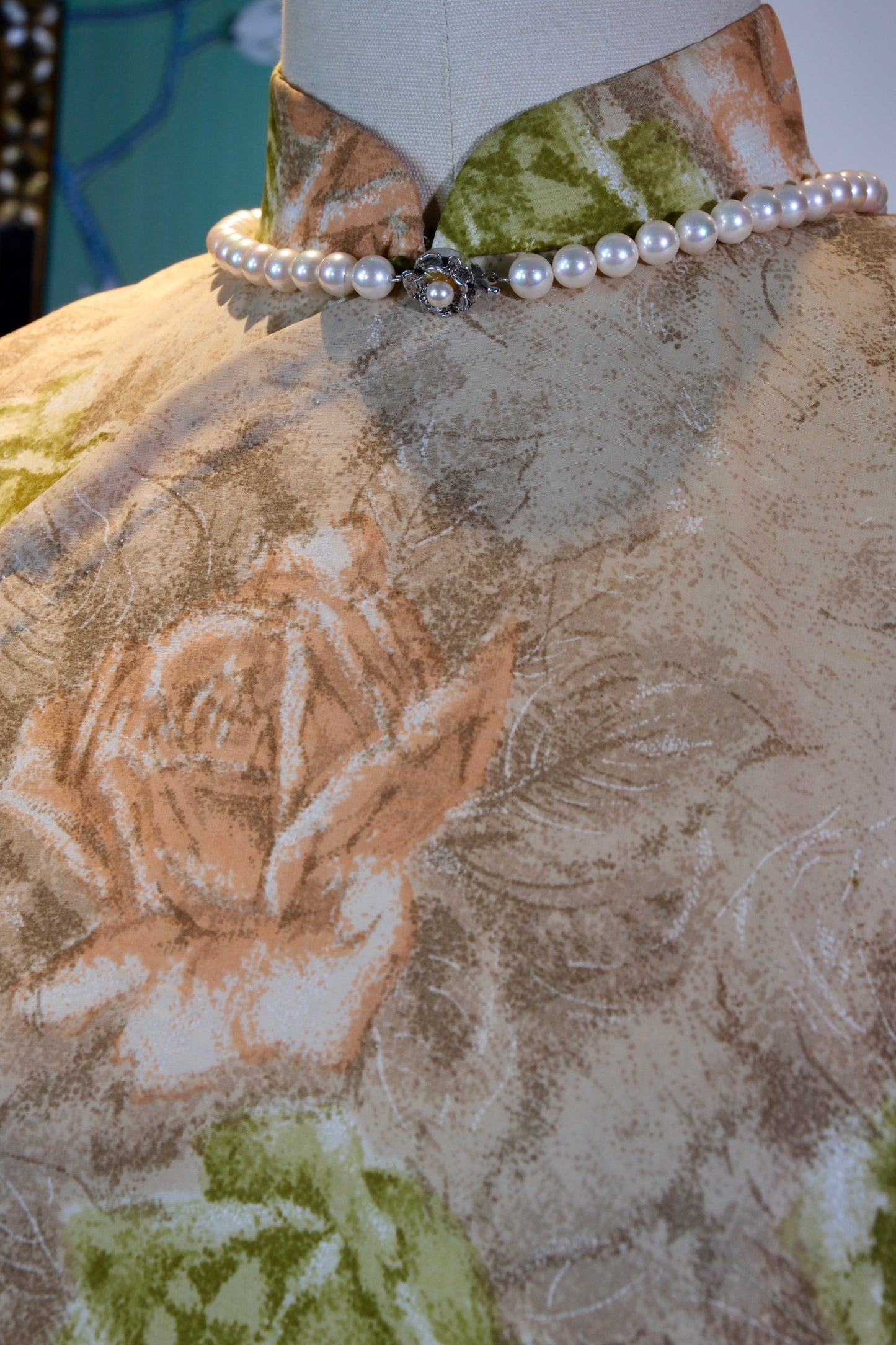
【图案描述:穿在身上的印象派画布】
这件旗袍的视觉核心,在于其面料上那独具匠心的油画风格玫瑰印花。不同于传统中式旗袍常见的工笔花鸟或几何纹样,它大胆采用了西式绘画的笔触。
- 色彩美学: 底色呈现出一种经过岁月沉淀的暖米灰调(Taupe),宛如老旧宣纸或泛黄的画布。其上盛开的玫瑰并非艳俗的大红大紫,而是采用了莫兰迪色系中的干枯玫瑰粉与复古橄榄绿。这种低饱和度的配色,使得花朵仿佛笼罩在一层薄雾之中,极具高级感。
- 笔触质感: 仔细观察花朵的边缘,没有清晰的轮廓线,而是通过色块的堆叠与晕染来表现花瓣的层叠感。这种技法酷似19世纪末的印象派画作,讲究光影的瞬息变化而非精准的写实。绿叶部分则运用了类似刮刀涂抹的厚重感,与花朵的柔和形成虚实对比。
- 布局章法: 花型分布疏密有致,既保留了中式留白的意境,又具有西式满印花的繁复华丽,完美诠释了“中西合璧”的视觉张力。
【历史溯源:香江畔的流金岁月】
这件旗袍诞生于20世纪50年代的香港,那是中国服装史上一个极为特殊且辉煌的“黄金时代”。
彼时,随着上海裁缝师傅的大规模南下,海派旗袍的精髓与香港的国际化视野在香江碰撞融合。50年代的香港旗袍,在继承30、40年代经典形制的基础上,开始吸收西方立体剪裁的精髓(如省道的使用更加隐蔽且贴合),同时面料选择上更加大胆,大量引入进口的印花棉布、蕾丝与合成纤维。
这件旗袍正是那个时代的缩影:它保留了传统的高领,但在审美上已经完全走向了现代与摩登。它不仅是一件衣服,更是那个动荡年代里,女性追求精致生活、坚守东方韵味的历史见证。正如张爱玲所言:“对于不会说话的人,衣服是一种语言,随身带着的是袖珍戏剧。”这件旗袍,便是一出无声的《花样年华》。
【艺术风格与稀缺性:不可复制的孤品】
从学术角度审视,这件古董衣的艺术价值体现在其“跨文化的视觉转译”。
它将西方的油画艺术语言,成功转译到了东方的丝绸或棉麻载体上。这种风格在当时属于极为前卫的尝试,往往只出现在接受过高等教育或深受西方文化影响的名媛闺秀身上。
稀缺性在于:
1. 面料的不可再生性: 50年代的印染工艺多采用活性染料或早期的涂料印花,经过70年的时光洗礼,能保存如此完好、色泽依然温润而不褪色的面料凤毛麟角。
2. 版型的断代特征: 其袖型短小且微微外撇,腰身收束极其合体,这是典型的50年代“海派余韵”剪裁。现代仿制品往往难以复刻那种为了适应当时女性体态而精心调整的微妙弧度。
3. 岁月的包浆: 古董衣的魅力在于“人气”。这件旗袍上隐约的光泽,是时光赋予的包浆,是新衣永远无法模仿的质感。
【结语】
“锦衣雪华玉颜色,回眸一笑百媚生。”这件五十年代的油画玫瑰旗袍,不仅是一件遮体的衣物,更是一首凝固的诗,一幅流动的画。它静静地诉说着那个关于美、关于优雅、关于东西方文化交融的旧梦。收藏它,便是收藏了一段触手可及的流金岁月。
"For those who cannot speak, clothes are a language, a pocket theater carried upon the body."
— Eileen Chang, Reflections on Clothing (更衣记)
Measurements / Size Guide:
Bust / Waist / Hips / Total Length: 88/64/88/92 cm
Detailed Description:
The visual core of this qipao resides in its distinct oil-painting style rose print. Moving away from the fine-line brushwork (gongbi) or strict geometric patterns typical of traditional Chinese attire, it boldly adopts the tactile brushstrokes of Western fine art.
Color Aesthetics: The base fabric displays a warm, aged taupe, echoing weathered Xuan paper or an antique linen canvas. The roses blossoming across this surface eschew loud crimsons for dusty rose pinks and vintage olive greens. This muted palette casts a soft veil over the blooms, giving the garment an elevated, quiet elegance.
Impressionist Texture: Inspecting the contours of the petals reveals an absence of rigid outline ink. Instead, the form emerges through layered color blocks and soft tonal gradients, mirroring 19th-century Impressionism—where light and atmosphere take precedence over strict realism. The foliage incorporates structured, knife-palette-like application, offering a rich contrast against the delicacy of the petals.
Spatial Composition: The distribution of the print balances density with breathing space, preserving the Eastern concept of intentional negative space (liubai) while capturing the lush abundance of Western floral textiles.
Crafted in 1950s Hong Kong, this qipao belongs to a pivotal chapter in East Asian fashion history.
During this decade, a major migration of Shanghai master tailors to Hong Kong brought the core techniques of Shanghai-style (Haipai) dressmaking into direct contact with Hong Kong’s cosmopolitan trade. The 1950s Hong Kong qipao retained classic structural proportions from the 1930s and 1940s while seamlessly incorporating Western pattern-making—such as discrete, form-fitting darts—and adopting imported printed cottons, fine laces, and early synthetic weaves.
This piece stands as a physical archive of that transition. While keeping the traditional mandarin collar, its artistic expression is thoroughly modern—a silent witness to mid-century women who held fast to Eastern grace while embracing modern life.
Examined through an academic lens, the garment's primary value rests in its cross-cultural visual translation—transposing the painterly language of European oil art onto an Eastern textile silhouette.
Irreplaceable Vintage Textiles: Printed textiles from the 1950s utilized early reactive dyes and pigment formulations. Across seven decades, fabrics that maintain their structural integrity without fading or breakdown are exceptionally rare.
Mid-Century Tailoring Markers: The concise short sleeves with a subtle outward curve, paired with structured waist suppression, reflect authentic 1950s Shanghai-Hong Kong tailoring. Modern reproductions rarely replicate the subtle curvature engineered specifically for the posture and foundation garments of mid-century women.
Patina of Time: The gentle, muted luster across the surface is a natural patina granted strictly by decades of careful preservation—a tactile depth that contemporary fabrics cannot simulate.
This 1950s oil-painting rose qipao is far more than a vintage garment; it is a frozen slice of mid-century elegance, bridging Eastern tradition and Western artistic influence in a single, fluid silhouette.