溯源
无法加载取货服务可用情况
【文物概况】
* 名称:象牙白泡泡袖垂褶V领长裙(晚礼服/茶舞装)
* 断代:中华民国二十年代末至三十年代中期(约1930-1935年)
* 工艺:立体剪裁、背部排扣、褶皱(Ruching)处理、泡泡袖(Puff Sleeve)
【史学考证与工艺析解】
在民国服饰史的流变中,20世纪30年代是一个极具张力的时代。彼时,西方好莱坞电影工业的黄金时代与中国“海派文化”的鼎盛期不期而遇,造就了中西合璧、典雅与摩登并存的审美图景。
此件藏品,便是这一历史切片下诞生的杰作。其版型深受西方爱德华时代(Edwardian era)遗风与30年代好莱坞银幕美学(如影星琼·克劳馥、琼·芳登的服饰风格)的双重影响。
* 肩部廓形(The Shoulder Silhouette):
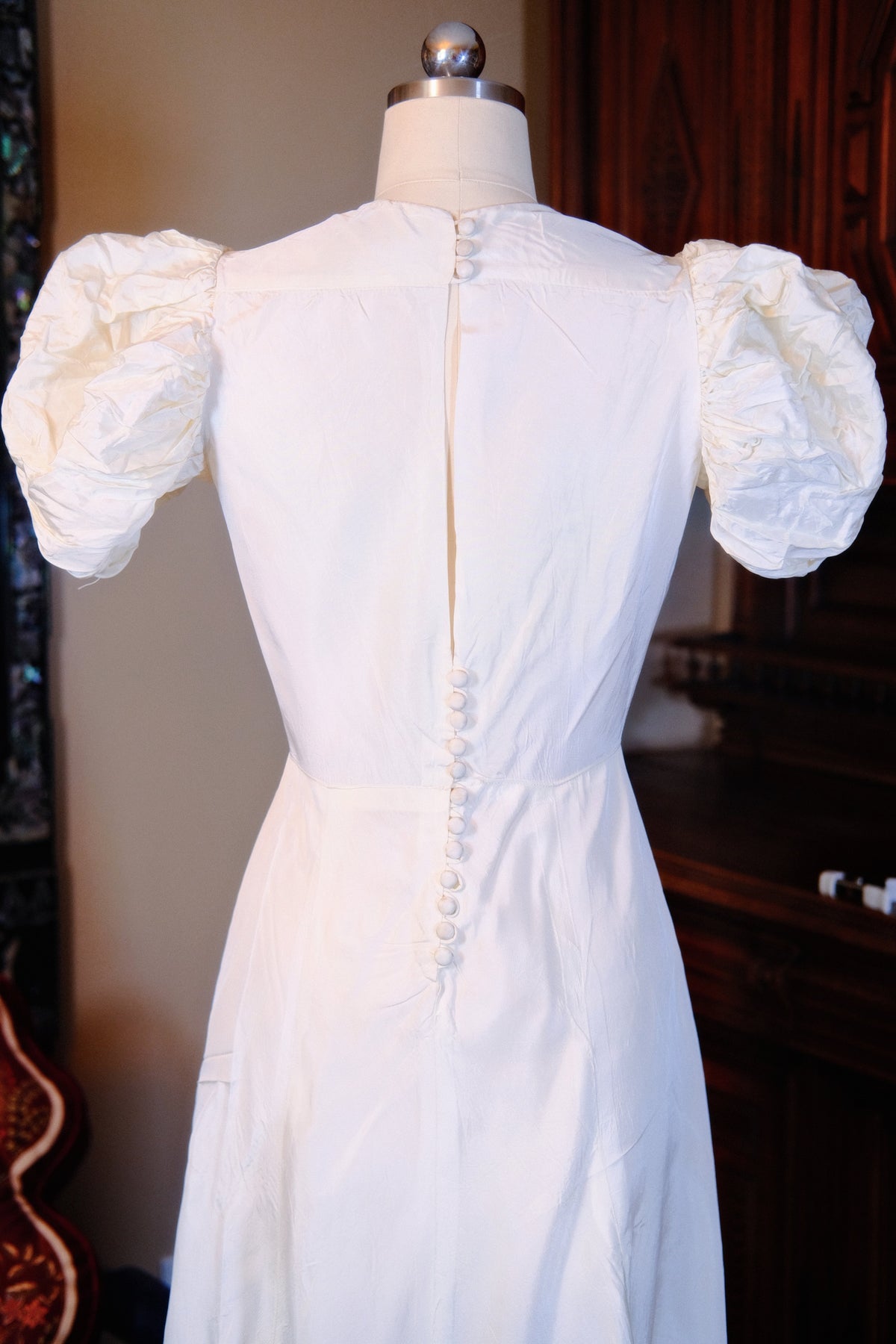
最为夺目的设计在于其夸张而饱满的泡泡袖。在西方服装史中,泡泡袖象征着宫廷的华丽与女性的柔美。而在30年代的中国,这种设计被称为“云肩式”廓形的变体。工匠巧妙地利用面料的挺括性,通过多层褶皱与衬里,将肩膀处的空间感推向极致,不仅衬托出穿着者面如桃花的娇小,更在视觉上营造出一种“弱肩丰衣”的戏剧张力。
* 胸部与腰线的剪裁(Draping & Fit):
与清代的宽大袍服截然不同,此裙采用了西方立体制版(Three-dimensional Draping)。领口呈优雅的V字形,从肩部到胸下围采用了繁复的抽褶(Gather/Ruching)工艺,这种处理方式不仅增加了面料的层次感,更精准地勾勒出女性的胸腰曲线,暗合了当时提倡的“健康美”与自然体态的解放。
* 背部美学(Back Detail):
翻看裙装背面,一道修长的垂直开衩贯穿脊柱,其间以数十粒同色包布纽扣(Cloth Buttons)细细密密地扣合。这种设计在民国时期极尽奢华与考究,体现了江南裁缝(俗称“红帮裁缝”)鬼斧神工的手工技艺。它不仅确保了背部的贴合度,更在穿着者转身回眸时,留下了一道令人遐想的优雅背影。
【文学阐释与时代侧影】
若说旗袍是民国女性的“战袍”,那么这件洋装则是她们在十里洋场中,与西方现代性对话的“情书”。
张爱玲曾言:“衣服是一种语言,随身带着一种袖珍戏剧。”这件裙子,便是一出无声的戏剧。它不再强调“三从四德”的束缚,而是大胆地拥抱了Art Deco(装饰艺术)的流线美。象牙白的色泽,宛如老上海公寓里透出的那抹月光,温润、克制,却暗流涌动。
照片中的佳人,端坐于棕榈叶影斑驳的画室之中,头戴白花,颈间佩珠,笑容温婉。这件裙子穿在她身上,不仅是一件蔽体之物,更是一种身份的重塑——她是受过新式教育、出入于大华舞厅与百乐门、既有东方婉约又有西式洒脱的“新女性”。
【结语】
岁月失语,惟物能言。
这件历经近百年沧桑的时装,虽布料已略显泛黄,却依旧挺括如初。它见证了那个时代,在战火与繁华交织的岁月里,中国女性对美、对自由、对现代化生活的极致追求。
它不是一具静止的标本,它是那个流金岁月里,一声温婉而坚定的叹息。
Name: Ivory White Puff-Sleeve Draped V-Neck Maxi Dress (Evening Gown / Tea Dance Dress)
Dating: Late 1920s to mid-1930s, Republican Era (c. 1930–1935)
Craftsmanship: Three-Dimensional Draping, Rear Covered-Button Placket, Ruching/Gathering Details, Sculpted Puff Sleeves
Within the evolving history of Republican-era fashion, the 1930s represented a decade of supreme aesthetic tension. During this period, the golden age of Hollywood’s cinematic industry intersected with the height of Shanghai's Haipai culture, birthing a visual landscape defined by East-West harmonization, classical dignity, and modern flair.
This archival piece stands as a masterwork born of that exact historical moment. Its pattern bears the dual influence of residual Edwardian aesthetics and 1930s Hollywood silver-screen glamour—recalling the costume styles of screen sirens Joan Crawford and Joan Fontaine.
The Shoulder Silhouette:
The most striking design element resides in its dramatic, voluminous puff sleeves. In Western fashion history, the puff sleeve symbolized courtly opulence and feminine gentleness; in 1930s China, it was interpreted as a modernist variant of the traditional "cloud-shoulder" (Yunjian) contour. Capitalizing on the fabric's crisp body, master tailors deployed layered gathers and structural linings to maximize volume at the shoulder—not only accentuating the wearer's delicate facial features, but creating a dramatic tension of soft shoulders paired with structural volume.
Draping & Bodice Construction:
Shedding the voluminous robes of the Qing Dynasty, this dress embraces Western three-dimensional draping. The neckline forms an elegant V-shape, anchored by intricate ruching (Ruching) and gathering from the shoulders down to the underbust. This technique adds multi-dimensional texture while precisely contouring the bust and waist—aligning with the era's advocacy for "natural athletic grace" and bodily liberation.
Back Detailing:
Examining the rear bodice, a long vertical opening runs down the spine, secured by dozens of meticulously crafted matching fabric-covered buttons (Cloth Buttons). Highly luxurious and demanding during the Republican era, this detail showcases the extraordinary handcraftsmanship of Shanghai tailors (famously known as Hongbang tailors). Beyond ensuring a glove-like fit across the back, it leaves behind a striking, elegant portrait as the wearer turns.
If the Qipao was the armor of the 1930s Republican woman, this Western-style gown served as her love letter to modern identity amidst the cosmopolitan metropolis of Shanghai.
Eileen Chang once observed: "Clothing is a silent language, a pocket drama carried upon the self." This dress is precisely such a silent play. Rejecting archaic constraints of traditional decorum, it boldly embraces the sweeping, fluid lines of Art Deco. Its ivory hue recalls soft moonlight filtering through the windows of a vintage Shanghai apartment—warm, restrained, yet humming with undercurrents of emotion.
The lady in the photograph, seated poised amidst the dappled shadows of palm leaves, wears a white blossom in her hair and pearls around her neck, her smile gentle. Worn upon her frame, the dress functions as more than coverage—it serves as a reinvention of identity. She is the "New Woman" (Xin Nüxing): educated, navigating the grand ballrooms of The Majestic and Paramount, blending Eastern gentleness with Western ease.
As the saying goes, "time remains silent, while objects speak."
Weathering nearly a century of history, this gown—though its textile bears the subtle patina of age—retains its pristine structural body. It stands as physical witness to an era when Chinese women pursued beauty, freedom, and modern living amidst the interwoven backdrop of turmoil and prosperity.
It is no static museum specimen; it remains a gentle, steadfast breath echoing from that golden age.