深圳溯源
无法加载取货服务可用情况
衣服尺寸:
胸围/腰围/臀围/衣长:90/76/96/109 厘米
细节描述:
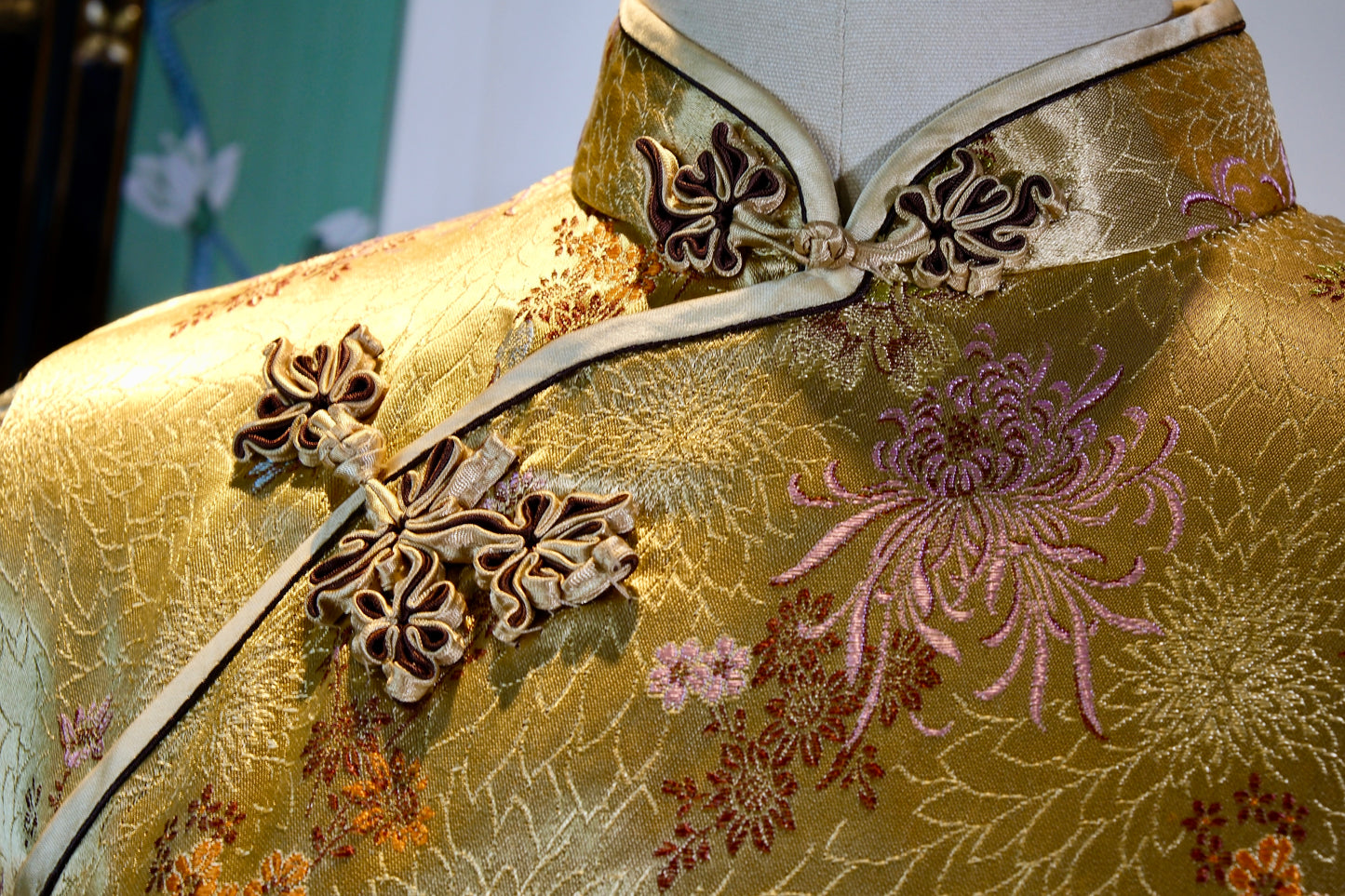
一、 织金为底,繁花入梦:图案与工艺的微观解读
这件旗袍最引人入胜之处,在于其面料本身所承载的精湛工艺。它采用了极具时代特征的提花织锦缎。这种面料并非简单的印染,而是通过复杂的经纬交织,将花纹直接“织”入布料之中。
- 底色之美: 衣身呈现出一种温润而富丽的香槟金色。在自然光下,丝绸的光泽如流水般淌过,既有金属的质感,又不失织物的柔美。这种色调在五十年代被称为“富贵色”,象征着战后香港经济的复苏与人们对美好生活的向往。
- 纹样之雅: 细观其上的纹样,是以菊花为主体,辅以细碎的小花与枝叶。
- 古人云:“采菊东篱下,悠然见南山。”菊花在中国传统文化中象征着高洁、隐逸与长寿。
- 但这件旗袍上的菊花并非孤傲冷僻,而是采用了散点式构图,花朵姿态各异,有的含苞待放,有的盛开吐蕊,色彩上运用了淡紫、藕粉、湖蓝与赭石色的丝线交织,打破了金色的单调,营造出一种“满园春色关不住”的繁华感,却又因菊花的雅致而不显俗艳。
- 这种纹样设计体现了五十年代海派与港式旗袍审美的融合——既保留了传统文人的清雅,又迎合了都市女性的摩登需求。
二、 匠心独运,盘扣点睛:细节中的艺术风格
请注意领口至大襟的花扣(盘扣)设计,这是整件旗袍的灵魂所在。
- 工艺考究: 这并非普通的直扣或简单的琵琶扣,而是采用了更为繁复的立体花扣工艺。扣头由深色丝线缠绕编织而成,形似盛开的兰花或如意云纹,与衣身的浅色滚边形成强烈的视觉对比。
- 结构美学: 这种花扣的制作需要极高的手工技艺,每一圈缠绕都需力度均匀,方能挺括有型。它不仅起到了固定的实用功能,更是一种装饰性的雕塑,展现了那个时代裁缝“慢工出细活”的匠人精神。这种重工花扣在现代成衣中已近乎绝迹,是鉴别古董旗袍年份与档次的重要标尺。
三、 香江旧梦,岁月留痕:古董衣背后的历史叙事
这件旗袍诞生于上世纪五十年代的香港,那是一个特殊的时空节点。
- 时代的缩影: 彼时,大量上海裁缝南下香江,将海派旗袍的精髓与岭南的务实风气相结合,造就了独特的“港式旗袍”风格。这件旗袍的剪裁——收腰适度,袖口圆润,长度过膝——正是那个时代女性追求端庄与曲线美并重的写照。
- 稀缺的价值: 织锦缎面料虽然华丽,但因其质地较硬且脆,极难保存。历经七十余载岁月,大多数同类衣物早已出现断裂、褪色或虫蛀。而这件旗袍保存如此完好,光泽依旧,实属凤毛麟角。它不仅是一件衣服,更是一段关于家族记忆、关于女性成长的实物见证。或许在某次重要的婚宴,或许在某个中秋佳节,曾有一位风华绝代的女子穿着它,留下了泛黄照片中最动人的身影。
四、 结语:穿在身上的博物馆
张爱玲曾言:“对于不会说话的人,衣服是一种语言,随身带着的是袖珍戏剧。”
这件五十年代的提花织锦缎旗袍,就是一出无声的戏剧。它以金线为墨,以丝绸为纸,书写了东方女性独有的韵味。收藏它,不仅是收藏一件稀缺的古董,更是珍藏那份“锦衣夜行”的低调奢华,和那段回不去的流金岁月。
Measurements / Size Guide:
Bust / Waist / Hips / Total Length: 90/76/96/109 cm
Detailed Description:
The most captivating quality of this qipao lies in the exquisite craftsmanship embedded directly into the fabric itself: a characteristic mid-century jacquard brocade (zhijindan). Departing from simple printed textiles, this fabric introduces patterns directly into the structure through complex warp and weft interlacing.
Luster of the Base: The body of the garment presents a warm, opulent champagne gold. Under natural light, the silk’s sheen flows across the surface like liquid, balancing metallic weight with textile softness. In the 1950s, this palette was celebrated as a "color of prestige" (fugui se), reflecting post-war economic revitalization and the quiet optimism of Hong Kong society.
Elegance of the Motif: Inspecting the surface reveals chrysanthemums as the primary subject, supported by delicate wildflowers, leaves, and sprigs.
Classical tradition holds that "Plucking chrysanthemums by the eastern fence, leisurely gazing upon the southern hills." Chrysanthemums in Chinese culture traditionally embody nobility, solitude, and longevity.
Here, however, the blossoms avoid cold isolation. Rendered in a scattered (sanjian) composition, the flowers display diverse postures—some in bud, others in full bloom—interwoven with silk threads in pale lavender, lotus-pink, lake blue, and ochre. This palette breaks any potential visual monotony, generating a sense of prosperous abundance while preserving the chrysanthemum's quiet restraint.
This motif exemplifies the mid-century fusion of Shanghai-style (Haipai) and Hong Kong qipao aesthetics—preserving classical literary refinement while answering the needs of modern urban women.
The bespoke hand-fashioned frog closures (pankou) along the collar and overlapping front flap (dajin) serve as the soul of the garment:
Refined Craftsmanship: Departing from standard straight frogs or basic lute closures, these utilize complex three-dimensional floral frog work. Wrapped in deep-toned silk cord, the closures take shapes echoing orchids or ruyi cloud motifs, creating a strong visual contrast against the lighter bias piping of the dress.
Structural Aesthetics: Fashioning such dimensional closures demands master-level handcraft; every wrapped coil requires uniform tension to remain firm and structured. Serving both a functional closure purpose and a sculptural decorative role, they demonstrate the deliberate "slow craftsmanship" of mid-century tailors. Such heavy-work frog closures have become nearly extinct in modern apparel, standing as a key indicator of an antique qipao's provenance and quality.
Born in 1950s Hong Kong, this qipao occupies a distinct historical intersection:
A Microcosm of the Era: During this decade, a large wave of Shanghai tailors migrated south to Hong Kong, fusing Shanghai-style tailoring with Lingnan practicality to give rise to the signature "Hong Kong-style qipao." The garment's cut—moderate waist suppression, rounded armholes, and a below-the-knee hemline—captures the period's preference for dignity paired with subtle curvature.
Archival Scarcity: While luxurious, brocade textiles are naturally structured and crisp, making them vulnerable to creasing or degradation over time. Survived across more than seven decades, most comparable garments have suffered silk breakdown, fading, or wear. That this qipao remains in such extraordinary preservation with its luster intact makes it a rare physical specimen—a tangible witness to family memory and personal history.
Eileen Chang famously observed in Reflections on Clothing (更衣记): "For those who cannot speak, clothes are a language, a pocket theater carried upon the body."
This 1950s jacquard brocade qipao is precisely that silent theater. Written with golden thread upon a canvas of silk, it records the singular poise of Eastern women. To appreciate such a piece is to honor both an irreplaceable antique and the enduring elegance of a golden era.