溯源
无法加载取货服务可用情况
【引言:爵士余韵与女神降临】
如果说20年代是属于直筒与流苏的爵士叛逆,那么30年代则是“女神”(Goddess)的回归。在大萧条的阴霾下,人们渴望从银幕与艺术中寻找慰藉。这件粉色印花绸连衣裙,便诞生于那个将“新古典主义”与“机械美学”完美融合的黄金年代。它不仅是一件衣物,更是一段被封存的、关于优雅与摩登的时光切片。
【艺术风格:Art Deco的几何韵律】
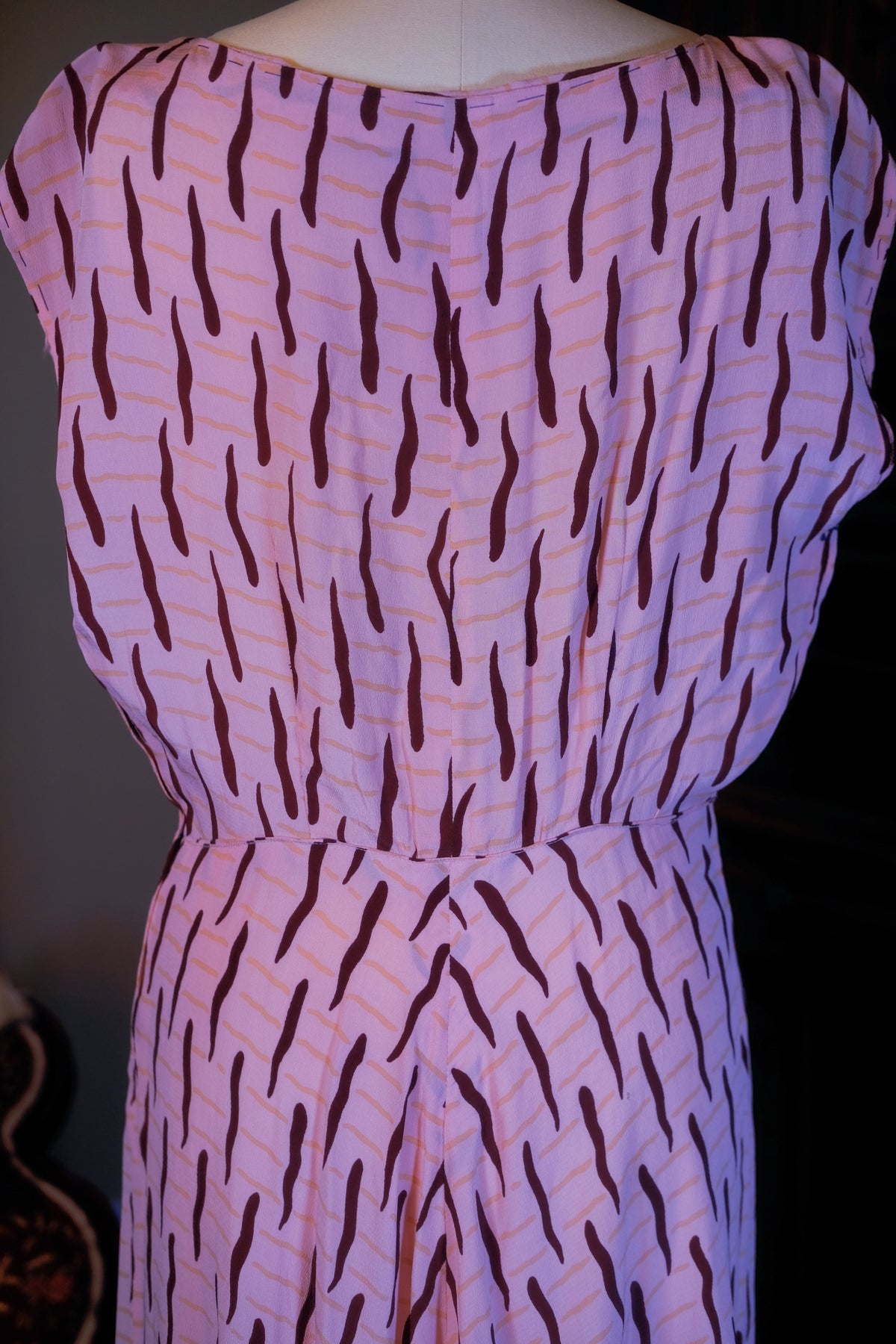
这件服装的灵魂在于其Art Deco(装饰艺术风格)的印花。
不同于19世纪末Art Nouveau那种繁复柔媚的有机曲线,30年代中期的Art Deco深受工业文明、包豪斯几何美学以及异域文化(如古埃及、远东图腾)的影响。裙身上的图案并非随意的植物写生,而是一种高度抽象化、秩序化的几何线条。
那些深褐色的、如同“柳叶”或“雨痕”般的垂直线条,带有强烈的速度感与流线型(Streamlined)特征——这与30年代流行的流线型火车、汽车设计遥相呼应。这种“垂直条纹”的视觉错觉(Optical Illusion)设计,在当时被誉为“显瘦神技”,它利用Art Deco的秩序感,在视觉上极力拉长穿着者的身形比例。
【剪裁工艺:Vionnet式的斜裁遗风】
仔细观察领口与袖子的结构,这件裙子展现了30年代标志性的斜裁(Bias Cut)美学。
虽然这件裙子采用了合身剪裁,但其袖山处的微耸、胸口的褶皱处理以及背部自然的垂坠感,都留有著名设计师Madeleine Vionnet(玛德琳·维奥内)的深刻烙印。
● 领型:采用了略带方形的U型领,这种设计既展示了女性锁骨的柔美,又比20年代的直筒低胸多了一份庄重与端庄。
● 收腰:30年代彻底告别了H型直筒轮廓,腰线回归并提高至自然腰线位置,通过省道(Darts)和分割线精准地贴合女性躯干的起伏,裙摆自然散开,形成优雅的A字型或轻微的鱼尾感,完美诠释了“女性曲线美”。
【面料与图案:东方韵味与工业印花】
面料上,光泽流转的真丝(Silk)是30年代奢华的象征。
其上的粉色底色带有明显的日本浮世绘(Japonisme)影响——Art Deco非常喜欢汲取东方元素。粉色的底色如同“樱花”或“晚霞”,而上面的深褐色条纹,既像是现代工业的机械线条,又隐约透着东方水墨中“枯笔飞白”的禅意。这种中西合璧的视觉张力,正是上海滩(当时的东方巴黎)或好莱坞黄金时代名媛们的最爱。
【搭配解析:珍珠的点睛之笔】
模特脖子上搭配的单串珍珠项链,是30年代最为经典的标配。如果说Art Deco印花代表着现代与张扬,那么温润的珍珠则带来了古典与温润,二者一刚一柔,中和了机械线条的冷硬,让整套造型显得富丽而不张扬,摩登而不失体面。
If the 1920s belonged to the jazz rebellion of straight silhouettes and fringe, the 1930s marked the triumphant return of the "goddess" (Goddess). Beneath the shadows of the Great Depression, people yearned to find solace within the silver screen and the arts. This pink printed silk dress was born into that golden age, which seamlessly fused Neoclassicism with mechanical aesthetics. Far more than a mere garment, it stands as a sealed slice of time dedicated to elegance and modernity.
The soul of this attire resides in its Art Deco (Art Deco) print.
Departing from the elaborate, tenderly sinuous organic curves of late-19th-century Art Nouveau, mid-1930s Art Deco was profoundly shaped by industrial civilization, Bauhaus geometric aesthetics, and exotic cultures, such as ancient Egyptian and Far Eastern totems. The patterns blanketing the dress avoid casual botanical sketching, favoring highly abstracted, disciplined geometric lines.
Those deep-brown vertical lines—resembling willow leaves or falling rain—exude a powerful sense of speed and streamlined design (Streamlined), echoing the streamlined locomotives and automobiles that defined the 1930s. This optical illusion (Optical Illusion) of vertical striping was celebrated at the time as a masterstroke of slimming geometry, harnessing Art Deco order to visually elongate the wearer's proportions.
A careful observation of the neckline and sleeve construction reveals the definitive bias cut (Bias Cut) aesthetics of the 1930s.
Although fitted in construction, the garment retains the deep imprint of legendary designer Madeleine Vionnet (Madeleine Vionnet) through the subtle lift at the sleeve crown, the bodice gathering, and the natural draping along the back.
Neckline: The dress features a gently squared U-neck (U-Neckline). This design gracefully highlights the soft contours of the collarbones while introducing a greater sense of decorum and poise compared to the drop-waist tubular styles of the 1920s.
Waist Definition: The 1930s completely bade farewell to the H-line tubular silhouette. The waistline returned and was elevated to its natural position, hugging the undulations of the female torso with precision through expert darting (Darts) and seam placement. The skirt flares outward naturally into an exquisite A-line or subtle mermaid flare, perfectly reinterpreting feminine curves.
In textile composition, lustrous silk (Silk) served as the ultimate symbol of 1930s luxury.
The pink background color bears the distinct influence of Japonisme (Japonisme), as Art Deco heavily drew inspiration from Eastern motifs. The pink ground evokes cherry blossoms or a twilight sky, while the deep-brown stripes simultaneously resemble modern industrial machine lines and hint at the Zen aesthetic of dry-brush calligraphy (Feibai) found in Eastern ink-wash painting. This East-West visual tension was the absolute favorite of high-society ladies across the Bund in Shanghai—the "Paris of the East"—and Hollywood’s golden age.
The single strand of pearls adorning the model's neck represents the quintessential staple of 1930s accessorizing. If the Art Deco print symbolized modernity and bold self-expression, the mellow pearls supplied classical warmth. Soft and rigid forces neutralized one another, tempering the mechanical coldness of the lines to ensure the entire ensemble looked opulent without arrogance, and modern without sacrificing grace.