深圳溯源
无法加载取货服务可用情况
衣服尺寸:
胸围/腰围/臀围:76/64/84 厘米
衣长:89 厘米
细节描述:
【引言】
张爱玲曾言:“对于不会说话的人,衣服是一种语言,随身带着的是袖珍戏剧。”当我们凝视这件诞生于上世纪五十年代的香港产古董旗袍时,仿佛能听到那段流金岁月的低语。它不仅是一件衣物,更是一段凝固的历史,一种在动荡与繁华交织中绽放的东方美学。
一、 图案赏析:暗夜繁花,低调奢华
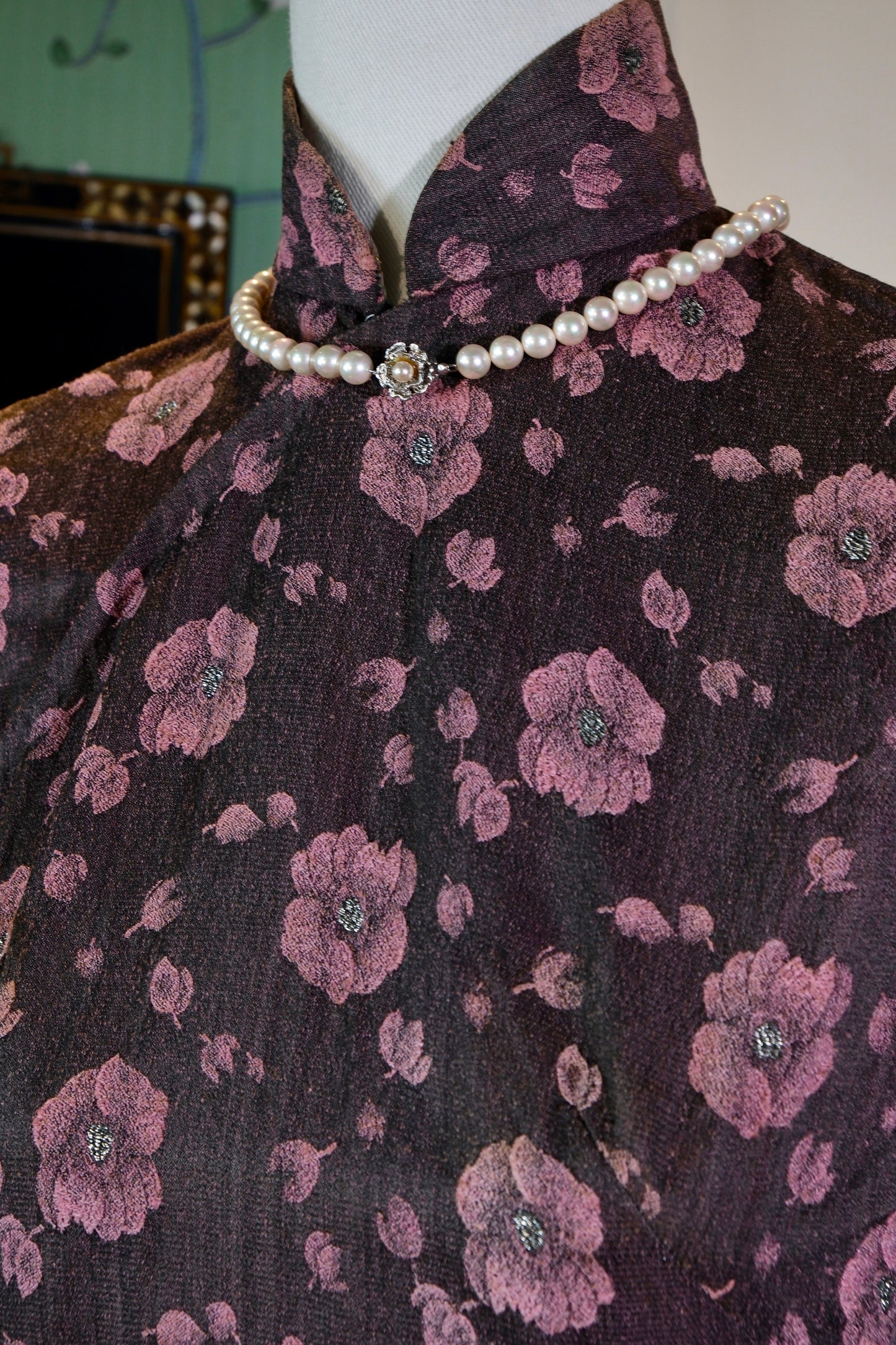
这件旗袍的面料工艺极为考究,采用了经典的“织金提花”技法。不同于普通的印染,提花是将花纹直接织入面料肌理之中,使得图案具有浮雕般的立体感与光泽度。
- 底色与光影: 面料底色呈现出一种深沉的炭灰色或暗紫色调,宛如夜幕低垂时的维多利亚港。这种深色调不仅衬托出穿着者肤色的白皙,更赋予了整件衣服一种沉稳、内敛的气质。
- 花卉纹样: 遍布衣身的粉色花朵,形态饱满,错落有致。它们并非艳俗的盛开,而是带有一种含蓄的朦胧美,仿佛晨雾中的蔷薇。花瓣边缘因织金工艺而泛着微光,随着光线角度的变化,花朵仿佛在呼吸。
- 细节点缀: 尤为珍贵的是,每一朵花的中心都镶嵌有细小的金属线(从细节图可见),这在五十年代的成衣中属于极高规格的装饰手法。这些微小的闪光点打破了深色底料的沉闷,如同夜空中闪烁的星辰,既俏皮又贵气。
二、 剪裁与形制:海派风韵与西式立体剪裁的完美融合
作为五十年代香港旗袍的代表作,它在形制上完美诠释了“中西合璧”的时代特征。
- 立领与襟型: 经典的元宝领设计,高度适中,既修饰颈部线条,又保留了传统韵味。
- 收腰与廓形: 这一时期的旗袍深受西方Dior“New Look”风格影响,极度强调女性的曲线美。这件旗袍采用了极其贴合的立体剪裁,胸省、腰省的运用使得衣身如第二层肌肤般包裹身体,勾勒出丰满的胸部、纤细的腰肢和圆润的臀部线条。这种“S”型轮廓,是五十年代女性自信与解放的象征。
- 短袖设计: 短袖的长度恰到好处,露出了女性纤细的手臂,增添了几分夏日的清凉与灵动。
三、 历史回响:香江旧梦与稀缺价值
上世纪五十年代的香港,正处于战后重建与经济腾飞的前夜。大量上海裁缝南下,将精湛的苏绣技艺与海派旗袍文化带入香港,并与当地的西洋风尚碰撞,诞生了独一无二的“港式旗袍”。
这件旗袍便是那个黄金时代的见证物。
- 工艺的绝唱: 如今,这种全幅织金提花的面料已极难寻觅。当年的纺织厂为了追求极致的华丽,不惜工本,这种面料在当时便属奢侈品,多为名媛闺秀定制。
- 保存的奇迹: 丝绸与织金面料极难保存,易氧化、易脆裂。但这件旗袍历经七十余载岁月,依然色泽如初,结构完整,实属凤毛麟角。它不仅仅是一件收藏品,更是研究五十年代服装史、纺织史的珍贵实物标本。
四、 结语
《诗经》云:“青青子衿,悠悠我心。”衣裳之美,在于悦己,亦在于传世。这件五十年代的香港织金提花旗袍,以其独特的暗黑浪漫风格和精湛绝伦的工艺,诉说着那个时代女性的优雅与坚韧。它是一件可以穿在身上的艺术品,等待着懂它的主人,续写这段未了的香江情缘。
Measurements / Size Guide:
Bust / Waist / Hips: 76/64/84 cm
Total Length: 89 cm
Detailed Description:
Eileen Chang famously observed in The Record of Changing Clothes: "To those who cannot speak, clothes are a language; what one carries with them is a pocket drama." Gazing upon this authenticated antique qipao birthed in 1950s Hong Kong, one can almost discern the low, interiorized whisper of a historic timeline. This artifact transcends its utility as a luxury garment to function as a fragment of frozen history—a magnificent materialization of Eastern aesthetics blossoming within the complex intersection of geopolitical displacement and metropolitan opulence.
The structural execution of this garment's textile matrix is exceptionally rigorous, utilizing a classical "Woven-Gold Jacquard" methodology (Zhijin Tihua). Shifting decisively away from flat surface printing or topical dye applications, the jacquard engineering weaves the ornamentation directly into the tactile structural grain, endowing the motifs with a high-relief, three-dimensional topography and variable reflectivity.
Grounding Chassis and Kinetic Light: The primary textile background presents as a deep, solemn charcoal gray or a low-visibility dark violet hue, visually mimicking the dense, atmospheric ink of Victoria Harbour at twilight. This desaturated, deep value baseline serves a dual aesthetic purpose: it exponentially accentuates the luminous clarity of the wearer's skin while anchor-weighting the entire silhouette with a poised, interiorized gravity.
Botanical Morphologies: The roseate blossoms distributed across the garment chassis display full-bodied, organic dimensions arranged in a highly calculated cadence. They strictly avoid any vulgar, aggressive display of full bloom, preserving instead an understated, hazy ambiance reminiscent of wild briar roses emerging through morning mist. Under shifting illumination angles, the gold-threaded boundaries defining the petal contours capture and refract light, causing the flora to visually expand and contract as if breathing.
Micro-Structural Finery: Of supreme consequence for chronological authentication is the integration of microscopic metallic threads (Jinshuxian) embedded directly within the biological core of each individual floret (visible via high-magnification close-up analysis). In the context of 1950s apparel fabrication, this intervention represents an elite, high-specification decorative execution. These minute structural glints punctuate the dense, dark chassis, operating like distant stellar constellations across a midnight sky to inject a sophisticated balance of spirited charm and sovereign nobility.
As a definitive archetype of the mid-century Hong Kong tailoring guild, this qipao serves as an irreproducible textbook demonstration of cross-cultural pattern-drafting, dissolving heritage Chinese boundaries into Western structural form.
Collar Architecture and Bodice Interface: The garment implements a classic Yuanbao high collar assembly (Yuanbaoling). The vertical rise is engineered with immense calculation to gracefully elongate the cervical lines while strictly honoring the structural decorum of heritage dress.
Waist Contouring and Volume Reductions: The tailoring configuration of this specific decade was profoundly conditioned by the architectural revolution of Christian Dior’s Western "New Look" silhouette, which aggressively prioritized the hyper-articulation of the female anatomical curve. This chassis executes that principle via high-precision three-dimensional darting; the rigorous calculation of the bust darts (胸省) and waist contour darts (腰省) forces the textile plane to operate as a flawless secondary epidermis. It sculpts a commanding "S-curve" silhouette characterized by an elevated bust line, an extremely reduced waist parameter, and rounded hip geometry—the ultimate material signifier of mid-century cosmopolitan female confidence and physical autonomy.
Sleeve Geometry: The execution of the abbreviated cap sleeves is calibrated with exceptional spatial awareness, exposing the linear mechanics of the arm to introduce a vital dimension of vernal lightness and kinetic fluidity to the overall structure.
During the 1950s, Hong Kong occupied a highly dynamic historical window characterized by post-war reconstruction and the dawn of an industrial economic miracle. Concurrently, an exodus of master tailors migrated south from Shanghai, transplanting the absolute peak of elite Suzhou embroidery discipline (Suxiang) and refined Shanghai-style qipao culture directly into the British colony. Their intersection with local Western metropolitan luxury markets generated the completely unique, hyper-sophisticated archetype known as the "Hong Kong-Style Qipao" (Gangshi Qipao).
This specific artifact stands as a monument to that unrepeatable crucible of craft.
The Decommissioned Peak of Texturing: In the contemporary global textile trade, a full-幅 (all-over) woven-gold jacquard yardage of this material composition has entered absolute depletion. The mid-century weaving mills engineered these textiles with absolute indifference to raw material costs to achieve an uncompromising tier of opulence. Consequently, these yardages operated as sovereign luxury items even in their own era, curated almost exclusively for bespoke commissions destined for elite socialites and aristocratic matrons.
A Miracle of Conservation: High-purity silk matrices interwoven with delicate metallic filaments are notoriously vulnerable to atmospheric oxidation, chemical embrittlement, and localized fiber fracturing over long timelines. For this specimen to navigate more than seven decades of environmental duress while preserving its original chromatographic saturation and pristine architectural structural integrity is an extreme statistical anomaly. It transcends its status as an antique asset to serve as an irreplaceable primary physical document for the cross-disciplinary research of twentieth-century costume history and textile engineering.
The ancient Classic of Poetry (Shijing) records: "Deep is the color of the scholar's collar; profoundly does it echo within my heart." The ultimate beauty of premium apparel rests in its dual capacity to honor the individual spirit and to archive history across generations. This 1950s woven-gold jacquard qipao, defined by its highly intellectual, dark romantic aesthetic and peerless structural craft, permanently charts the sovereign elegance and unyielding resilience of the mid-century woman. It stands as a wearable masterpiece of fine art, waiting for its next rightful custodian—one who possesses the archival literacy to decode its structural language—to step into its architecture and continue its cross-temporal narrative of old Victoria Harbour elegance.