深圳溯源
《港式摩登的绝唱:1960s立体剪裁蓝绿织锦旗袍赏析》| "The Last Cadence of Hong Kong Modernism: A Curatorial Analysis of a 1960s Sculpted Geometric Peacock-Blue Brocade Qipao"
《港式摩登的绝唱:1960s立体剪裁蓝绿织锦旗袍赏析》| "The Last Cadence of Hong Kong Modernism: A Curatorial Analysis of a 1960s Sculpted Geometric Peacock-Blue Brocade Qipao"
无法加载取货服务可用情况
《港式摩登的绝唱:1960s立体剪裁蓝绿织锦旗袍赏析》
衣服尺寸:
胸围/腰围/臀围/衣长:92/78/104/98 厘米
细节描述:
这件上世纪六十年代的香港产织锦旗袍,不仅是一件衣物,更是一段凝固的时光。它见证了那个时代独特的审美与工艺,其艺术价值与稀缺性,值得我们细细品读。
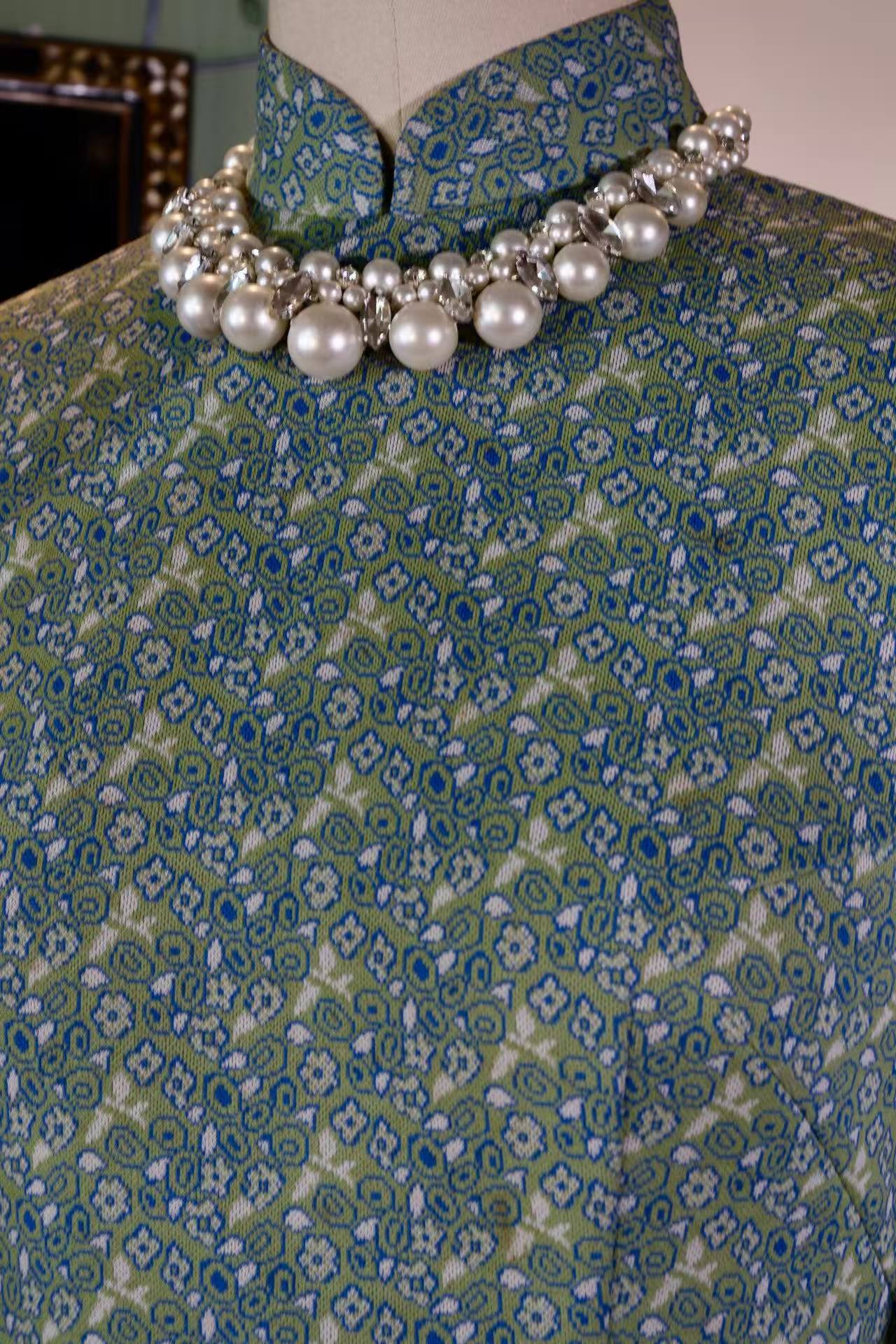
图案描述:几何秩序中的东方韵律
这件旗袍的面料并非传统的写实花卉,而是一种极具现代构成感的几何纹样织锦。
- 色彩美学: 整体色调呈现出一种清冷而高雅的孔雀蓝与豆绿交织的基调。这种配色在六十年代的香港非常流行,既保留了东方的含蓄,又融入了当时西方波普艺术对高饱和度与对比色的追求。
- 纹样结构: 仔细观察面料,你会发现它是由无数个细小的菱形格作为骨架排列而成。在每个菱形格内部,填充着类似传统团花或铜钱纹的抽象变体。这种设计巧妙地结合了“方”的秩序感与“圆”的柔和感。
- 视觉效果: 密集的重复纹样在视觉上产生了一种律动感,仿佛江南园林中的花窗棂格被无限延伸。这种细密的纹理在光线下会有微妙的折射,体现了织锦特有的华丽质感,却又因为图案的规律性而不显俗艳,反而透着一种理性的知性美。
古董衣的故事:香江岁月的摩登回响
这件旗袍诞生于20世纪60年代的香港,那是旗袍发展的最后一个黄金时代,也是“海派”与“港式”风格融合最完美的时期。
- 时代的剪裁: 请注意它的领口与袖长。不同于清末民初的宽大,这件旗袍采用了极高且紧致的元宝领,紧紧包裹颈部,展现出一种禁欲般的优雅。袖子则是标准的七分袖或九分袖,露出了纤细的手腕,这是为了适应当时女性开始参与社会工作、需要更利落行动的现实需求。
- 立体剪裁的巅峰: 这一时期的香港裁缝深受西式立体剪裁的影响。你可以看到腰部的收省非常精准,胸省与腰省的结合使得衣服如同第二层皮肤般贴合身体曲线,完美勾勒出女性的S型身段。这不仅仅是做衣服,更是在雕刻人体。
- 穿着者的想象: 想象一下,在那个霓虹灯初上的年代,一位受过良好教育的女性,或许是在中环写字楼里的白领,或许是在电台工作的播音员,她穿着这件旗袍,搭配着图中的复古珍珠项链,手里拿着一份《明报》,穿梭在繁忙的街道上。这件衣服,就是她独立、自信身份的宣言。
引经据典与艺术风格分析
张爱玲曾在《更衣记》中写道:“对于不会说话的人,衣服是一种语言,随身带着的是袖珍戏剧。”这件旗袍,便是一出无声的精致戏剧。
- 艺术风格——装饰艺术运动的余晖: 从艺术史的角度看,这种几何化的纹样深受Art Deco(装饰艺术)风格的影响。20世纪中叶的香港,作为东西方文化的交汇点,其纺织品设计往往将中国传统的吉祥寓意(如连绵不断的几何纹象征生生不息)与西方的现代主义几何构图相结合。这种风格在当时被称为“摩登”,它打破了传统旗袍必须龙凤呈祥或牡丹富贵的刻板印象,展现了一种工业时代的秩序美。
- 稀缺性与工艺价值:
- 织锦的没落: 真正的老织锦制作工艺繁复,需要提花机织造。随着70年代后成衣工业的兴起和化纤面料的普及,这种耗时耗力的真丝或人造丝织锦逐渐退出日常穿着,转而成为舞台装或极高端的定制。因此,保存完好、色泽如新的60年代织锦旗袍在市场上已属凤毛麟角。
- 不可复制的版型: 现在的机器量产旗袍往往只有其形而无其神。这件古董衣背后的手工归拔工艺(通过熨斗的热度改变布料经纬密度以塑造立体感),是老一辈红帮裁缝的绝活。正如沈从文先生在《中国古代服饰研究》中所强调的,服饰的演变不仅是审美的变化,更是工艺流程与社会生活方式的直接投射。这件衣服,就是那个精湛工艺时代的实物标本。
总结:
这不仅是一件用来穿着的衣服,更是一件可以收藏的艺术品。它以几何为骨,以织锦为肉,以岁月为魂。穿上它,你穿上的不是复古,而是那个风华绝代、中西合璧的黄金年代。
"The Last Cadence of Hong Kong Modernism: A Curatorial Analysis of a 1960s Sculpted Geometric Peacock-Blue Brocade Qipao"
Measurements / Size Guide:
Bust / Waist / Hips / Total Length: 92/78/104/98 cm
Detailed Description:
I. Iconographic Typography: Eastern Rhythms Inside Geometric Order
The distinguishing visual signature of this specimen is its absolute rejection of literal, organic floral illustration in favor of a highly structured, modern textile arrangement built through clean graphic composition.
-
Chromatic Articulation: The overarching palette presents a cool, aristocratic interplay of saturated peacock blue and soft sage green threads. This specific color story enjoyed immense cultural currency across 1960s Hong Kong, skillfully bridging traditional Eastern restraint with the high-contrast, high-chroma visual provocations of Western Pop Art.
-
Structural Matrix: Close analysis of the brocade reveals a foundation composed of a repeating micro-rhomboid lattice. Nested inside each individual diamond cell is an abstract geometric variant of the traditional medallion (tuanhua) or copper coin motif (tongqianwen). This technical layout resolves the tension between the strict order of linear quadrilaterals ("the square") and the fluid grace of curvilinear forms ("the circle").
-
Optical Kineticism: The high-density repetition of the pattern creates an almost kinetic rhythm across the fabric plane, mirroring the rhythmic lattice structure seen in classical Chinese garden screen-windows. Under shifting light conditions, this complex weave produces a highly controlled, sophisticated refraction. The strict graphic regulation prevents the heavy brocade from appearing ostentatious, delivering instead a refined, cerebral intellectualism.
II. Historical Narrative: The Modern Resonance of Postwar Hong Kong
This artifact was engineered during the twilight golden age of the qipao, marking the definitive, historical peak where traditional Shanghai construction principles synthesized perfectly with an urbanized Hong Kong lifestyle.
-
Chronological Engineering: The structural choices of the collar and sleeve lengths are deeply revealing. Moving far away from the expansive, relaxed cuts of earlier decades, this garment features an exceptionally tall, close-fitting Mandarin collar (yuanbaoling) that completely wraps the neck to achieve a severe, sculptural elegance. The sleeves are drafted to a precise three-quarter length, leaving the wrists bare—a conscious accommodation for the emerging class of professional women who required physical mobility in an expanding workforce.
-
The Zenith of Three-Dimensional Drafting: During this decade, Hong Kong ateliers thoroughly internalized Western haute-couture pattern drafting. The garment exhibits an impeccable deployment of engineered waist and bust darts. The tailored intersection of these lines allows the textile to fit like a secondary skin, flawlessly tracing the biological S-curve of the figure. This is pattern drafting elevated to the status of anatomical sculpture.
-
The Wearer's Life-World: To reconstruct the historical milieu: this specimen represents the precise uniform of the educated, independent mid-century woman—perhaps a corporate professional in Central or a radio broadcaster in Wan Chai. Styled with the period-authentic pearl strand shown in the archive, and navigating the neon-lit urban core, this garment served as an explicit material declaration of confidence, autonomy, and modern class status.
III. Art-Historical Taxonomy and Mechanical Rarity
As Eileen Chang famously stated in Reflections on Clothing: "For those who cannot speak, clothes are a language, a pocket theater carried upon the body." This geometric qipao functions as a silent, impeccably staged mid-century drama.
-
The Aesthetic Paradigm — Echoes of Art Deco: From the perspective of design history, this stylized layout channels the late industrial elegance of the Art Deco movement. Mid-century Hong Kong, operating as a strategic geopolitical crossroads, produced textiles that seamlessly merged classical Chinese auspicious symbols (where continuous interlocking lines signify unbroken lineage) with Western modernist geometry. This stylistic dialect, colloquially termed "Modern" (Modeng), shattered the archaic requirement that high-end silk must feature literal dragons, phoenixes, or peonies, celebrating instead the clean order of the machine age.
-
Material and Technical Scarcity:
-
The Decline of Complex Brocade: True mid-century brocade required complex mechanical jacquard looms and intense setup labor. With the meteoric rise of ready-to-wear apparel and low-cost synthetic fibers in the 1970s, these time-intensive silk and rayon blends vanished from everyday dress, relegated to theatrical costume or elite custom orders. Consequently, a 1960s brocade specimen in this pristine state of preservation is a absolute rarity in the global market.
-
Irreproducible Fabric Manipulation: Contemporary mass-produced qipaos consistently mimic the outward form of the garment while entirely lacking its internal structural soul. The antique specimen relies heavily on iron-work shaping (hongbang guiba工艺)—the rigorous artisan method of using targeted heat, moisture, and pressure to alter the warp-and-weft density of raw fabric to permanently sculpt a three-dimensional contour. As the legendary scholar Shen Congwen emphasized in Researches on Ancient Chinese Costumes, the evolution of dress is never merely a shift in taste; it is a direct material projection of technical processes and societal transformation. This garment stands as a rare, physical archive of that elite tailoring lineage.
-
Conclusion
This artifact transcends the category of apparel; it is a museum-grade archival specimen. It possesses geometric order as its bone, masterfully woven brocade as its flesh, and historical time as its soul. To engage with it is not to indulge in superficial retro-revivalism, but to step directly into the poise, sophistication, and cross-cultural brilliance of a true golden age.
分享