深圳溯源
无法加载取货服务可用情况
衣服尺寸:
胸围/腰围/臀围/衣长:86/70/90/90 厘米
细节描述:
这是一件承载着六十年代海派风韵与台湾裁缝精湛技艺的古董旗袍,其背后所蕴含的文化价值与稀缺性,远非普通衣物可比。它不仅是服饰,更是一段被针线封存的时光史诗。
一、图案与形制:素雅之极,方见真章
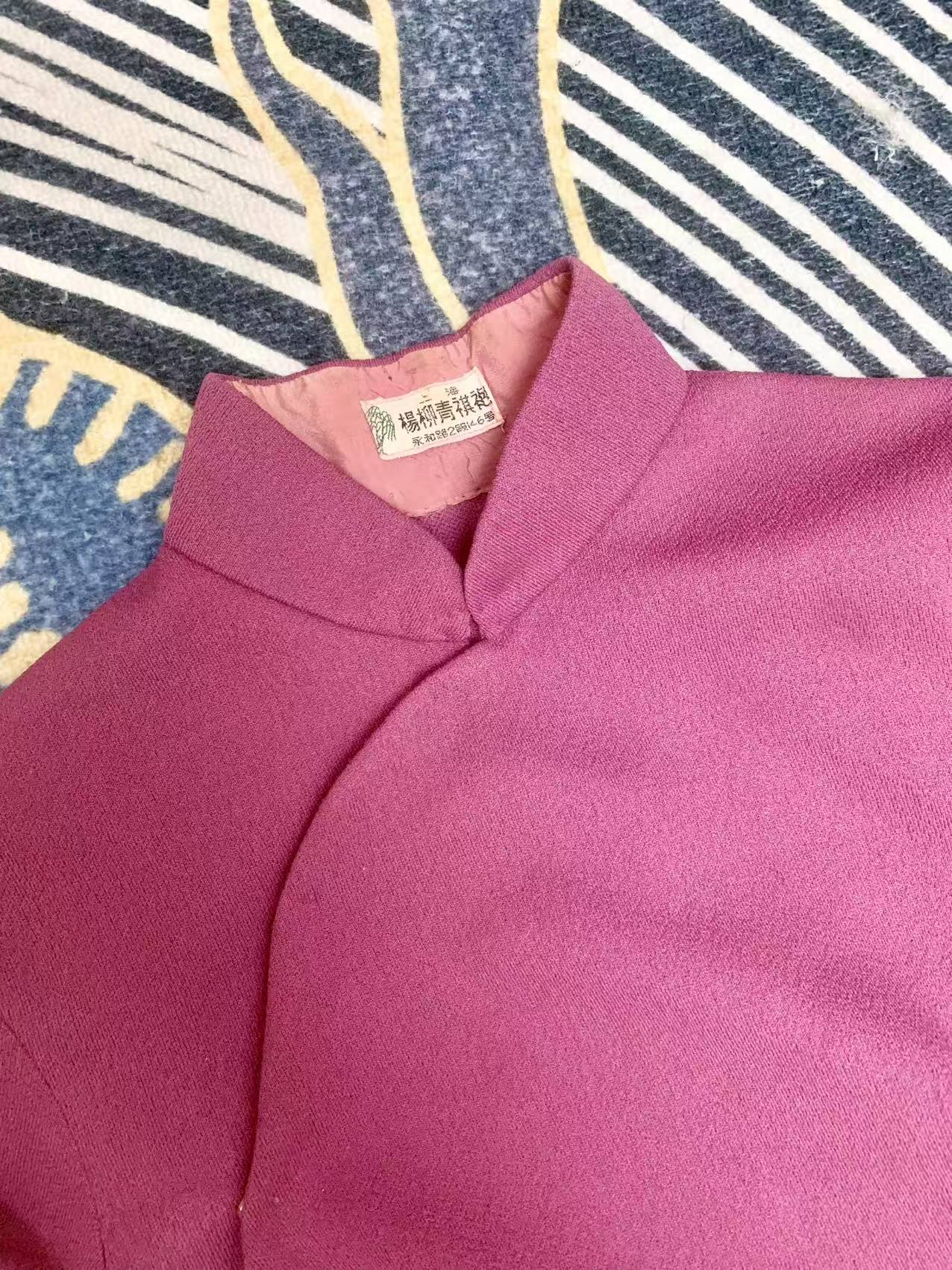
这件旗袍最引人注目的,恰恰是它的“无图案”。通体采用意大利进口时装呢面料,呈现出一种深邃而温润的紫红色调——这并非寻常的艳紫,而是带有灰度的“烟霞紫”,如暮色初临天际,含蓄内敛,却自带贵气。这种色彩在六十年代的上海与台湾上流社会中极为流行,象征着成熟女性的稳重与优雅。
从剪裁上看,它完美复刻了六十年代“海派旗袍”的黄金比例:立领高耸而不僵,贴合颈部曲线;肩部线条圆润自然,短袖设计既保留了传统韵味,又适应了现代生活的便利;腰身收束得恰到好处,通过省道工艺勾勒出女性曼妙的S型曲线,下摆则微微外扩,行走时如风拂柳,摇曳生姿。这种“以形写神”的设计哲学,正是中国传统美学中“大音希声,大象无形”的体现——无需繁复纹样,仅凭轮廓与质感便足以摄人心魄。
二、品牌故事:杨柳青旗袍店——一个时代的针脚记忆
这件旗袍出自“杨柳青旗袍店”,由江贤梅师傅于1957年在新北市永和区创立。彼时正值台湾经济起飞前夕,社会风气尚保守,旗袍作为女性正式场合的礼服,仍具重要地位。江师傅初开业时生意清淡,幸得画家叶若舟先生题字助阵,才逐渐打开局面。这段往事不仅是一段商业传奇,更是艺术与手工艺结合的典范——书法家的笔墨为裁缝铺注入文化灵魂,使“杨柳青”超越了单纯的服装店,成为一处承载文人雅士情怀的空间。
至1974年迁址中正路后,“杨柳青”进入鼎盛期,直至1995年江师傅退休歇业。如今市面上能见到的“杨柳青”原作已凤毛麟角,每一件都是不可再生的文化遗产。
三、材质与工艺:意式面料 × 台式匠心 = 绝版珍品
选用意大利进口时装呢,说明当时店主对品质的极致追求。这种面料质地紧密、垂坠感佳、抗皱性强,且色泽持久不褪,非常适合制作高级定制旗袍。而台湾裁缝师以其细腻的手工著称,尤其擅长处理复杂结构与精细滚边。此件旗袍虽无明显刺绣或印花,但其缝线平整度、省道过渡的自然流畅,无不彰显出“慢工出细活”的匠人精神。
值得注意的是,旗袍内衬标签清晰可见“杨柳青旗袍”字样及地址信息,这是鉴定真伪与年代的重要依据。在古董衣收藏界,拥有完整原始标签的作品往往更具学术价值与市场溢价能力。
四、艺术风格与稀缺性:穿越时空的东方美学符号
从艺术史角度看,这件旗袍代表了“新中式极简主义”的早期实践。它摒弃了民国旗袍的繁缛装饰,而是在保留民族基因的基础上,融入现代人体工学与审美趋势,形成了一种“低调奢华”的独特语汇。正如《礼记·深衣》所言:“古者深衣,盖有制度,以应规、矩、绳、权、衡。”这件旗袍虽无明文规制,却处处暗合传统礼仪之序,体现了“衣以载道”的深层文化内涵。
在全球范围内,保存完好、来源明确、工艺精湛的六十年代台湾古董旗袍极为罕见。它们大多已被博物馆收藏或私人藏家珍藏,流通市场几乎绝迹。因此,这件“杨柳青”出品之作,不仅是一件可穿戴的艺术品,更是一份值得传世的文化遗产。
Measurements / Size Guide:
Bust / Waist / Hips / Total Length: 86/70/90/90 cm
Detailed Description:
The most arresting visual dimension of this specimen is, paradoxically, its complete lack of surface iconography. The entire garment is built from a mid-century Italian import fashion wool, rendering a deep, warm, purplish-red hue—not a standard, high-chroma violet, but rather a low-saturation, grey-infused "Amethyst Mist" (Yanxia Zi). Evocative of the sky at early dusk, this color is deeply restrained yet inherently regal. This specific chromatic value enjoyed immense canonization among the upper-echelons of both Shanghai and Taiwan high society during the 1960s, serving as a visual signifier of mature, aristocratic composure.
From a structural perspective, the pattern drafting perfectly replicates the golden ratios of the mature 1960s Haipai (Shanghai-style) qipao. The high Mandarin collar stands erect without rigidity, adapting cleanly to the cervical spine anatomy. The shoulder transitions are rounded and natural, while the short-sleeve construction bridges traditional modesty with the practical demands of modern civic life. The waist is precisely sculpted via engineered darts (shengdao) to contour the biological S-curve, while the hemline features a subtle, controlled flare. This movement dynamic creates a fluid, swaying cadence during locomotion—a physical manifestation of the classical philosophy of "The greatest sound is left unspoken; the grandest form remains formless." It foregoes superficial decoration, relying purely on silhouette, structural contour, and tactile weight to achieve absolute aesthetic authority.
This artifact bears the clear provenance of the "Yangliuqing Qipao Atelier," established in 1957 in the Yonghe District of New Taipei City by Master Artisan Jiang Xianmei. This period immediately preceded Taiwan’s postwar economic transformation, a time when social mores remained conservative and the qipao retained its status as the mandatory formal attire for civic and ceremonial functions. The boutique’s early commercial isolation was broke through an artistic collaboration with the renowned calligrapher and painter Ye Ruozhou, who brushed the shop’s formal signage. This historical intersection represents more than a successful marketing narrative; it is an exemplary synthesis of fine art and high craftsmanship, wherein calligraphic ink infused a tailoring space with literati sentiment, elevating "Yangliuqing" from a mere retail workshop into a cultural salon.
Following its relocation to Zhongzheng Road in 1974, the atelier entered its historical zenith, operating continuously until Master Jiang’s retirement and the workshop's closure in 1995. Today, surviving original specimens from "Yangliuqing" are exceedingly rare within the global market, with each remaining piece functioning as a non-renewable unit of material culture.
The deployment of imported Italian fashion wool demonstrates a radical commitment to material premiumization. This textile matrix is characterized by a high-density weave, exceptional fluid drape, superior wrinkle recovery, and excellent colorfastness, making it an elite substrate for high-order bespoke tailoring. The Taiwanese tailoring lineages of this era were celebrated for their meticulous hand-work, particularly in the execution of complex structural seams and razor-thin bias piping (gumbian). Although this specimen features no embroidery or surface prints, the absolute linear precision of its structural rows and the seamless, organic transitions of its waist and bust darts reveal a rigorous devotion to slow-engineered, bespoke excellence.
Crucially, the interior lining retains its original woven silk label, clearly displaying the "Yangliuqing Qipao" logotype and its historical geographic address. Within the taxonomy of antique dress collection, a pristine, intact origin label serves as primary diagnostic evidence for authentication, driving both its academic research value and its market valuation premium.
From the perspective of material culture and dress history, this qipao represents an early, highly successful realization of "Neo-Chinese Minimalism." It completely strips away the dense, over-embellished surface decorations common in the early Republican era. Instead, it preserves fundamental ethnic design markers while seamlessly integrating modern ergonomic principles and mid-century global style trajectories to articulate a dialect of "quiet luxury." This structural discipline mirrors the ancient mandate of the Book of Rites (Liji) regarding the construction of formal robes: "Cutting and measuring must correspond exactly to the square, the compass, the plumb line, and the balance." Though built without written decrees, this garment conforms implicitly to traditional rules of structural order and propriety, embodying the deep-seated cultural maxim that "The vestment must carry the weight of the Tao."
On a global scale, well-preserved, fully provenanced 1960s Taiwanese bespoke qipaos of this caliber are vanishingly scarce. The vast majority of surviving elite specimens have already been absorbed into institutional museum collections or locked permanently into private family archives. Consequently, this original production from the Yangliuqing Atelier stands not merely as a wearable work of art, but as a critical heirloom of mid-century fashion history.