深圳溯源
无法加载取货服务可用情况
衣服尺寸:
胸围/腰围/臀围/衣长:92/84/100/110 厘米
细节描述:
一、 视觉解码:繁花似锦的立体诗篇
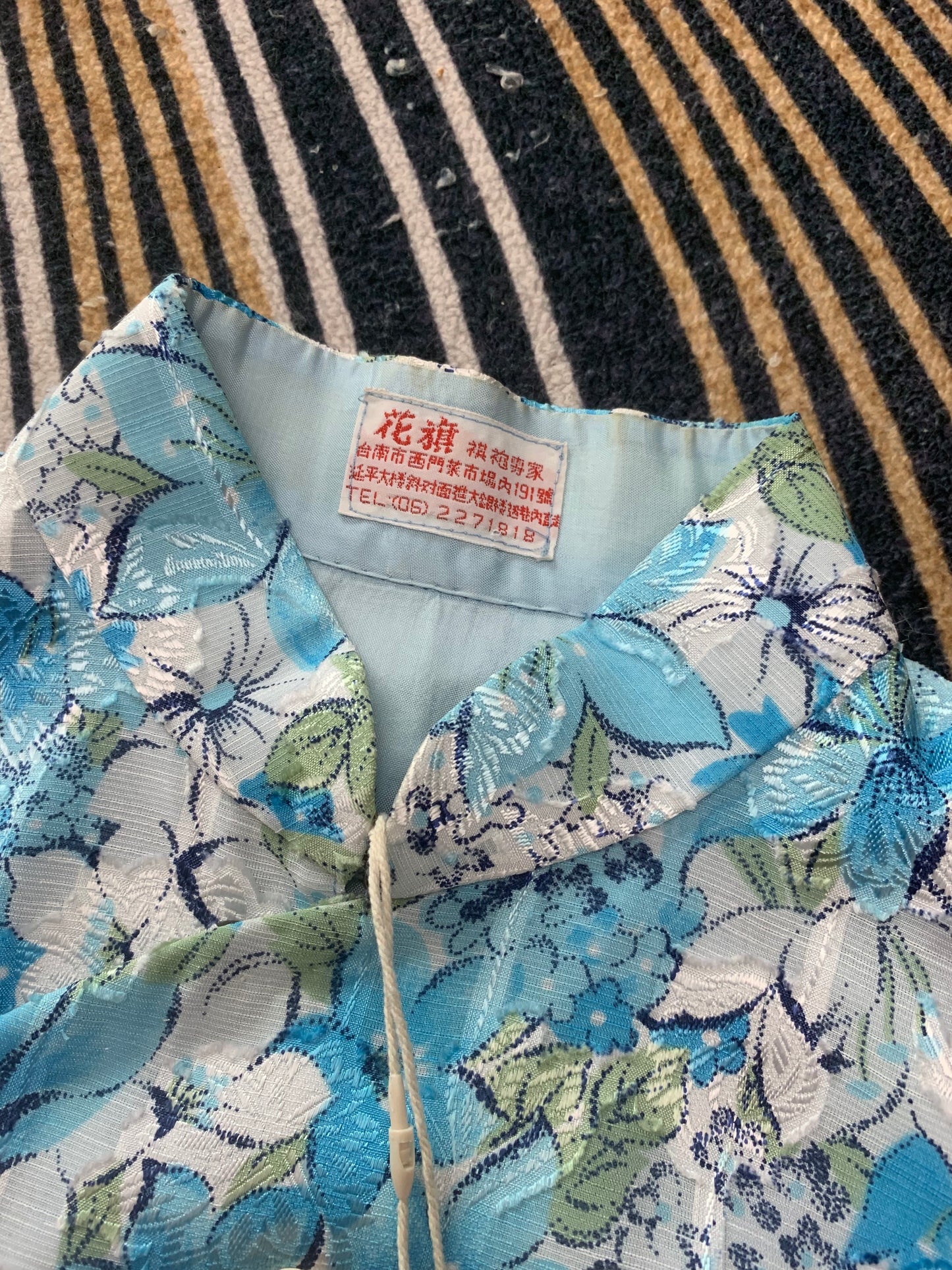
这件旗袍最引人入胜之处,在于其面料工艺的精湛与图案设计的巧思。它并非普通的平面印染,而是采用了高难度的暗纹提花工艺。
- 色彩美学: 通体以清雅的湖蓝与纯净的月白为主调,间以淡绿枝叶点缀。这种配色在五色斑斓的民国及战后旗袍中显得尤为脱俗,宛如雨后初晴的天空,透着一股“雨过天青云破处”的宋瓷般的高级质感。
- 图案意象: 衣身遍布盛放的百合花簇。在中国传统文化语境中,百合寓意“百年好合”、“纯洁庄严”。设计师并未采用传统的折枝画法,而是采用了满铺式的构图,花朵形态饱满,花瓣层叠,通过丝线的经纬交织,在光线下呈现出若隐若现的浮雕感。这种繁复而不杂乱的设计,正是五十年代纺织工业追求华丽与秩序并重的体现。
二、 历史溯源:台南西门市场的裁缝传奇
衣领内侧那枚泛黄的标签,是解开这件衣物身世之谜的钥匙——“花旗 旗袍专家”。
- 地理坐标的历史厚度: 上世纪五十年代的台南西门市场(今国华街一带),是当时台湾最繁华的商业中心,也是时尚的最前沿。那里汇聚了来自上海、宁波的顶尖裁缝师傅,他们随国民政府迁台,将海派旗袍的精髓带到了宝岛。
- “花旗”的品牌印记: 在那个年代,敢以“专家”自居并拥有独立门牌的店铺,绝非等闲之辈。“花旗”二字,或许暗示了其面料来源或设计理念受到当时西方流行文化的影响,亦或是寄托了对大洋彼岸某种繁荣的向往。这件旗袍,正是那个大时代下,南北文化交融、中西审美碰撞的实物见证。
三、 形制考证:黄金时代的最后余晖
从剪裁上看,这件旗袍完美继承了海派旗袍“省道”技术的成熟运用。
- 立体剪裁: 注意看腰部的收省与胸部的隆起,完全符合人体工学,勾勒出女性曼妙的S型曲线。这与张爱玲笔下那种“紧俏”、“贴身”的描写不谋而合。
- 细节考究: 立领高度适中,既保留了东方的含蓄,又露出了修长的颈部线条;袖口呈微喇状,这是五十年代末期为了行动方便而做的改良。配合那一串圆润的珍珠项链(虽为配饰,但与原衣气质浑然天成),再现了当年名媛闺秀出席晚宴或重要场合时的端庄风华。
四、 文化互文:衣香鬓影中的文学隐喻
若要为这件衣裳寻找文学注脚,非白先勇先生的《台北人》莫属。
“尹雪艳总也不老……她穿一身蝉翼纱的素白旗袍……” ——白先勇《台北人·永远的尹雪艳》
虽然这件旗袍并非素白,但其那份历经岁月而不败的贵气,与尹雪艳那般“总也不老”的意象有着精神上的契合。它是流落在民间的“台北人”记忆,承载着那一代人在异乡重建生活、延续精致的倔强与优雅。
又如苏青在《结婚十年》中所言:“衣服是女人的第二层皮肤。”这件提花百合旗袍,不仅是御寒遮体之物,更是五十年代台湾女性自我意识觉醒、追求极致美感的宣言。它在光影流转间,诉说着一个关于时间、关于美、关于传承的永恒故事。
【结语】
这不仅仅是一件衣服,这是一段被封存在丝线里的历史。在快时尚泛滥的今天,这样一件出自五十年代台南名师之手、保存完好、工艺繁复的古董旗袍,已是凤毛麟角。它值得被珍藏,更值得被穿着,让那份跨越半个多世纪的东方雅致,再次惊艳时光。
Measurements / Size Guide:
Bust / Waist / Hips / Total Length: 92/84/100/110 cm
Detailed Description:
The absolute allure of this qipao lies in the exquisite craftsmanship of its fabric and the ingenuity of its pattern design. Rather than a standard flat print, it utilizes a highly challenging hidden jacquard weaving technique (暗纹提花).
Color Aesthetics: The entire garment is dominated by an elegant lake blue and pure moon white, punctuated by accents of pale green stems and leaves. This palette appears exceptionally refined among the multicolored qipaos of the Republican and postwar eras, resembling the sky just as it clears after rain—projecting a premium, porcelain-like quality reminiscent of classic Song Dynasty wares (雨过天青云破处).
Pattern Imagery: The body of the dress is covered with full-blooming clusters of lilies. In traditional Chinese cultural contexts, the lily symbolizes "a harmonious union lasting a hundred years" (百年好合) and "purity and dignity." Instead of using traditional broken-branch arrangements, the designer opted for an all-over composition. The blossoms are full and the petals are beautifully layered; through the interlacing of warp and weft threads, they present a subtle, embossed relief effect under the light. This rich yet un-cluttered design perfectly reflects the 1950s textile industry's pursuit of simultaneous luxury and structural order.
The yellowed label inside the collar serves as the key to unlocking the mystery of this garment's history: "Huaqi: Qipao Expert" (花旗 旗袍专家).
The Historical Weight of Geographic Coordinates: In the 1950s, the West Market of Tainan (now around Guohua Street) was the most prosperous commercial hub in Taiwan and the absolute forefront of fashion. It gathered top master tailors from Shanghai and Ningbo who had relocated to Taiwan with the Nationalist government, transplanting the absolute core of Shanghai-style (Haipai) qipao craftsmanship onto the island.
The Brand Imprint of "Huaqi": In that era, any shop that dared to style itself as an "expert" and possessed an independent storefront was by no means ordinary. The name "Huaqi" (which translates literally to "American Flag" or "Stars and Stripes" in historical Chinese context, often associated with premium foreign imports) may suggest that its fabric sources or design concepts were influenced by contemporary Western popular culture, or it expressed a yearning for prosperity across the ocean. This qipao stands as a physical witness to the fusion of northern and southern cultures and the collision of Eastern and Western aesthetics during a monumental era.
In terms of cut and construction, this qipao perfectly inherits the mature application of Western darting techniques characteristic of refined Shanghai-style tailoring.
Three-Dimensional Tailoring: Looking closely at the taking-in of the waist and the contouring of the bust, the pattern conforms entirely to ergonomics, sculpting a woman's graceful S-curve silhouette. This aligns flawlessly with the "fitted" and "close-fitting" descriptions found throughout the literary works of Eileen Chang.
Exquisite Details: The standing mandarin collar is moderate in height, preserving Eastern modesty while revealing a elongated neck line. The cuffs feature a subtle flare, a distinct modification of the late 1950s designed to allow greater ease of movement. Paired with a strand of round pearls, it faithfully resurrects the dignified elegance of mid-century socialites attending grand dinners or critical functions.
If one were to seek a literary footnote for this garment, it would undoubtedly be found in Kenneth Pai's (白先勇) masterpiece, Taipei People (台北人).
"Yin Hsueh-yen seemed never to grow old... She always wore a plain white qipao of cicada-wing gauze..." — Kenneth Pai, Taipei People: The Eternal Yin Hsueh-yen
Although this specific qipao is not plain white, its noble air—undiminished by the passage of decades—shares a deep spiritual connection with the imagery of an "eternally timeless" grace. It represents a living fragment of "Taipei People" memory preserved outside museums, carrying the defiance, stubborn elegance, and refined lifestyle of a generation rebuilding their world in a displaced land.
Furthermore, as Su Qing noted in Ten Years of Marriage (结婚十年): "Clothing is a woman's second skin." This jacquard lily qipao is far more than a mere shield against the elements; it stands as a bold mid-century declaration of aesthetic pursuit and self-awareness among Taiwanese women. Shifting gracefully through light and shadow, it narrates a timeless story of time, beauty, and heritage.
This is not merely a piece of apparel; it is a profound fragment of history sealed within threads. In today's landscape of fast fashion, an immaculate, highly intricate antique qipao crafted by a 1950s Tainan master tailor is an absolute rarity. It deserves to be deeply treasured and gracefully worn, allowing this mid-century Eastern elegance to captivate the modern world once more.