深圳溯源
无法加载取货服务可用情况
衣服尺寸:
胸围/腰围/臀围/衣长:98/94/106/102 厘米
细节描述:
一、 纹样解构:从“具象”到“心象”的视觉突围
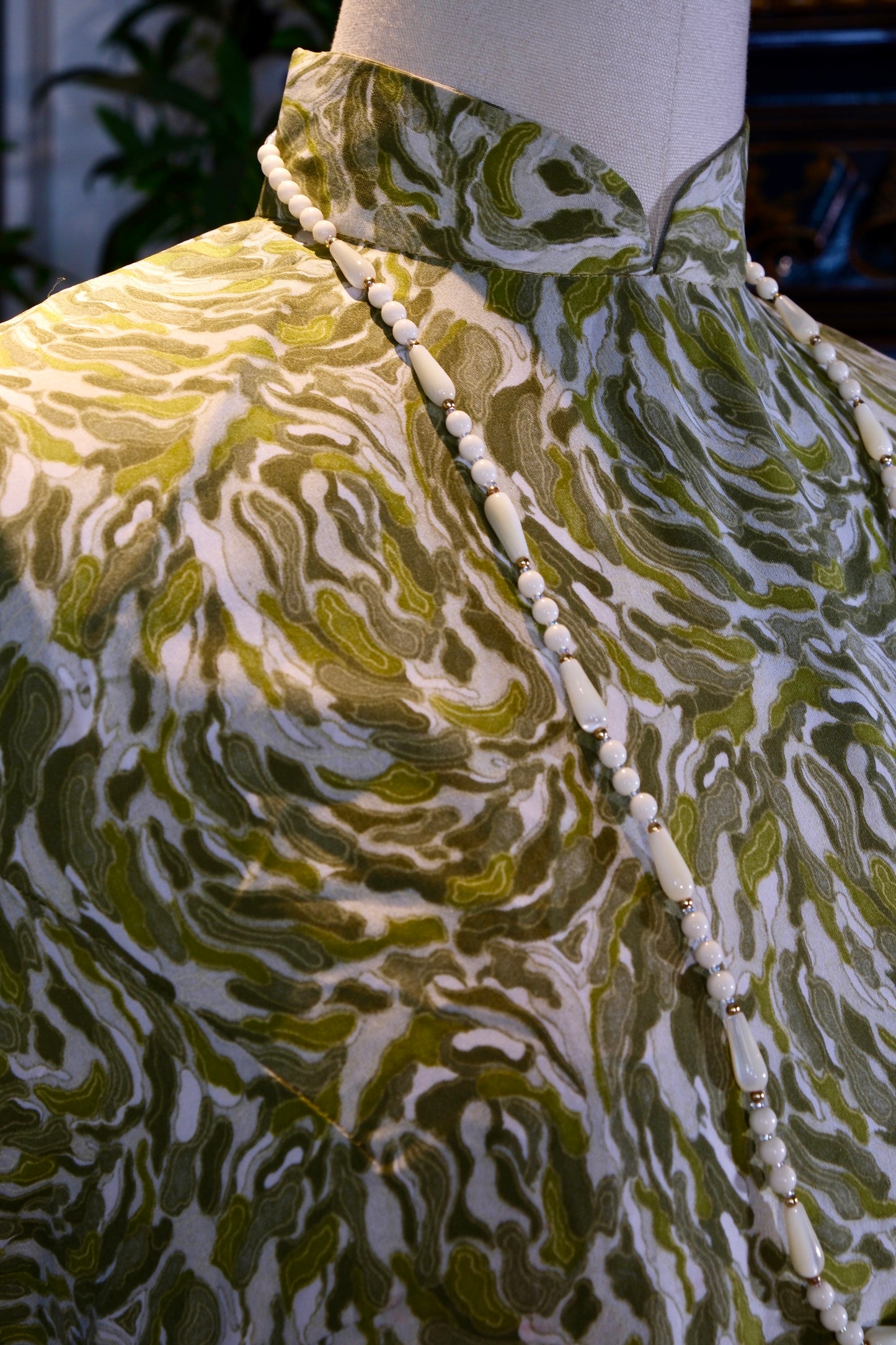
这件旗袍最引人入胜之处,在于其面料纹样的大胆与前卫。不同于传统旗袍惯用的牡丹、凤凰或梅兰竹菊等具象吉祥寓意,此衣采用了一种极为罕见的抽象表现主义风格印花。
* 色彩美学:主色调选取了极具生命力的苔藓绿(Moss Green)与橄榄黄交织,底色留白如宣纸般透气。这种配色方案在五行中属木,象征着生生不息的自然之力,既保留了东方文人画中对“青绿山水”的隐喻,又带有西方现代艺术对自然光影的解构。
* 线条韵律:图案并非静止的花卉,而是如同流动的液态金属,又似被风吹皱的一池春水,亦或像是显微镜下细胞分裂的瞬间。这种涡旋状、流体状的线条,打破了传统服饰图案的对称性,呈现出一种动态的平衡感。它不描绘具体的物象,而是捕捉一种“气韵”,正如宗白华先生在《美学散步》中所言:“中国画所表现的境界特征,可以说是根基于中国民族的基本哲学……即‘气韵生动’。”这件衣服的纹样,正是将“气韵”通过现代印染技术具象化的典范。
二、 历史语境:香江旧梦与“上海裁缝”的黄金时代
要读懂这件衣服,必须回到上世纪五十年代的香港。那是旗袍发展的一个特殊转折期——“海派东渐,西风南被”。
1. 工艺的传承与改良:五十年代的香港汇聚了大量从上海南下的顶尖裁缝(俗称“红帮裁缝”)。他们带来了精湛的归拔工艺(通过熨烫使平面布料呈现立体曲线),同时为了适应香港亚热带的气候和快节奏的都市生活,开始大量尝试轻薄、透气的棉麻或人造丝面料,并引入西式立体剪裁。
2. 审美的西化:此时的香港深受好莱坞电影及欧美时尚杂志的影响。张爱玲曾写道:“各人住在各人的衣服里。”五十年代的香港女性,渴望通过衣着表达独立与现代。这种抽象印花,极有可能是当时受西方抽象表现主义艺术(如杰克逊·波洛克的作品)或欧普艺术萌芽的影响,结合本土印染工业的一次大胆实验。它代表了那个时代女性不再满足于做传统的“闺秀”,而是渴望成为拥有独立人格的“都会女郎”。
三、 稀缺性与艺术价值:不可复制的孤品
在古董衣收藏界,素色易得,小花常见,而大格局的抽象印花存世量极低。
* 面料的绝唱:这种高饱和度的抽象印花面料,对印染技术要求极高,且当时的流行周期极短,往往昙花一现。随着六十年代迷你裙和成衣工业的兴起,这种讲究面料肌理与剪裁配合的高级定制旗袍逐渐式微。
* 版型的考究:观察其领口,是典型的五十年代“低领元宝领”,既修饰颈部线条又不显拘谨;袖口微微外撇,能极好地衬托手臂纤细;腰身的收省(Darts)位置精准,完美贴合人体工学,展现了极高的制版水平。
四、 结语
这件旗袍,不仅是一件遮体的衣物,更是一幅穿在身上的抽象画,一段被针线缝合的历史。它静默地诉说着那个年代,东方韵味与西方现代主义在香江之畔的一场华丽邂逅。
正如木心先生所言:“从前慢,车,马,邮件都慢,一生只够爱一个人。”而这件衣裳,历经七十余载岁月流转,依然色泽如初,仿佛在等待一位懂它的女子,续写那段关于美与自由的未完篇章。
Measurements / Size Guide:
Bust / Waist / Hips / Total Length: 98/94/106/102 cm
Detailed Description:
The most captivating aspect of this qipao lies in the bold and avant-garde nature of its fabric pattern. Completely breaking away from the representational, auspicious motifs traditionally favored in qipaos—such as peonies, phoenixes, or the "Four Gentlemen" (plum, orchid, bamboo, and chrysanthemum)—this garment adopts a highly rare Abstract Expressionist style print.
Chromatic Aesthetics: The primary color palette intertwines a highly vital moss green with an olive yellow, while the background space leaves breathable gaps resembling the negative space (liubai) on Xuan paper. This color scheme, belonging to the wood element within the Five Elements framework, symbolizes the unceasing force of nature. It simultaneously preserves the metaphor of "blue-green landscapes" (qinglv shanshui) found in traditional Eastern literati paintings while integrating the Western modern art deconstruction of natural light and shadow.
Linear Rhythm: The motifs are not static flora; instead, they move like flowing liquid metal, a pool of spring water wrinkled by the wind, or even the precise moment of cellular division under a microscope. These swirling, fluid lines disrupt the rigid symmetry of traditional textile patterns, presenting a sense of dynamic equilibrium. Rather than depicting a concrete object, the layout captures a sense of "spirit resonance" (qiyun). As the philosopher Zong Baihua noted in Aesthetics Promenade: "The characteristic of the realm expressed in Chinese painting can be said to be rooted in the fundamental philosophy of the Chinese nation... namely, 'spirit resonance and life-movement' (qiyun shengdong)." The patterning on this garment is a textbook exemplar of reifying that spiritual resonance through the medium of mid-century printing technology.
To fully comprehend this garment, one must return to Hong Kong in the 1950s—a unique transitional period for the evolution of the qipao defined by the southward migration of Shanghai style (Haipai) and the intense absorption of Western trends.
Transmission and Modification of Craft: The 1950s saw a massive influx of elite, southward-migrating tailors from Shanghai to Hong Kong (historically categorized as the Hongbang tailors). They brought along master-level iron-molding techniques (guiba—using heat and steam to manipulate flat yardage into three-dimensional anatomical curves). Concurrently, to accommodate Hong Kong’s sub-tropical climate and fast-paced urban lifestyle, they began experimenting with lightweight, breathable cotton, linen, or rayon substrates while integrating Western-style three-dimensional pattern drafting.
Sartorial Westernization: During this window, Hong Kong was heavily influenced by Hollywood cinema and European fashion journals. Eileen Chang famously observed in Reflections on Clothing (Geng Yi Ji) that "each of us lives within our own clothing." The Hong Kong women of the 1950s yearned to articulate their independence and modernity through dress. This abstract print represents a daring experiment by the local printing and dyeing industry, highly likely inspired by Western Abstract Expressionism (reminiscent of Jackson Pollock's action paintings) or the early roots of Op Art. It stands as a physical declaration that the modern woman was no longer content to remain a traditional household maiden (guixiu), but fiercely aspired to become an independent "metropolitan lady."
Within the realm of antique apparel curation, solid colors are accessible and small floral patterns are commonplace, but large-scale, sweeping abstract prints suffer from an exceptionally low survival rate.
The Extinction of the Substrate: Producing this level of high-saturation abstract printing demanded rigorous industrial mastery, and because the mid-century trend cycle moved rapidly, these exact designs were often short-lived. With the rise of the mini-skirt and industrialized mass-produced ready-to-wear in the 1960s, these bespoke haute couture qipaos requiring complex alignment between fabric texture and custom tailoring gradually entered obsoletion.
The Discipline of the Pattern: Observing its construction reveals a classic 1950s low-profile "Yuanbao collar," which elegantly elongates the neckline without imposing a rigid stiffness. The cuffs flare slightly outward, beautifully complementing the slender contours of the arms. Furthermore, the positioning of the waist-reduction darts (shengdao) is executed with flawless ergonomic precision, showcasing the absolute pinnacle of mid-century technical pattern drafting.
This qipao transcends the functional utility of apparel to exist as a wearable abstract painting—a physical archive stitched together by thread. It silently chronicles a magnificent historical encounter where Eastern spiritual grace and Western modernism collided along the shores of the Fragrant Harbor.
As the writer Mu Xin beautifully reflected: "In the past, things moved slowly: the carriages, horses, and mail were all slow; a lifetime was only enough to love one person." Having journeyed across more than seventy years of time, this garment retains its original chromatic brilliance, waiting like a silent monument for a connoisseur to step forward and continue its unfinished narrative of beauty and structural freedom.