深圳溯源
无法加载取货服务可用情况
衣服尺寸:
胸围/腰围/臀围/衣长:92/80/104/122 厘米
细节描述:
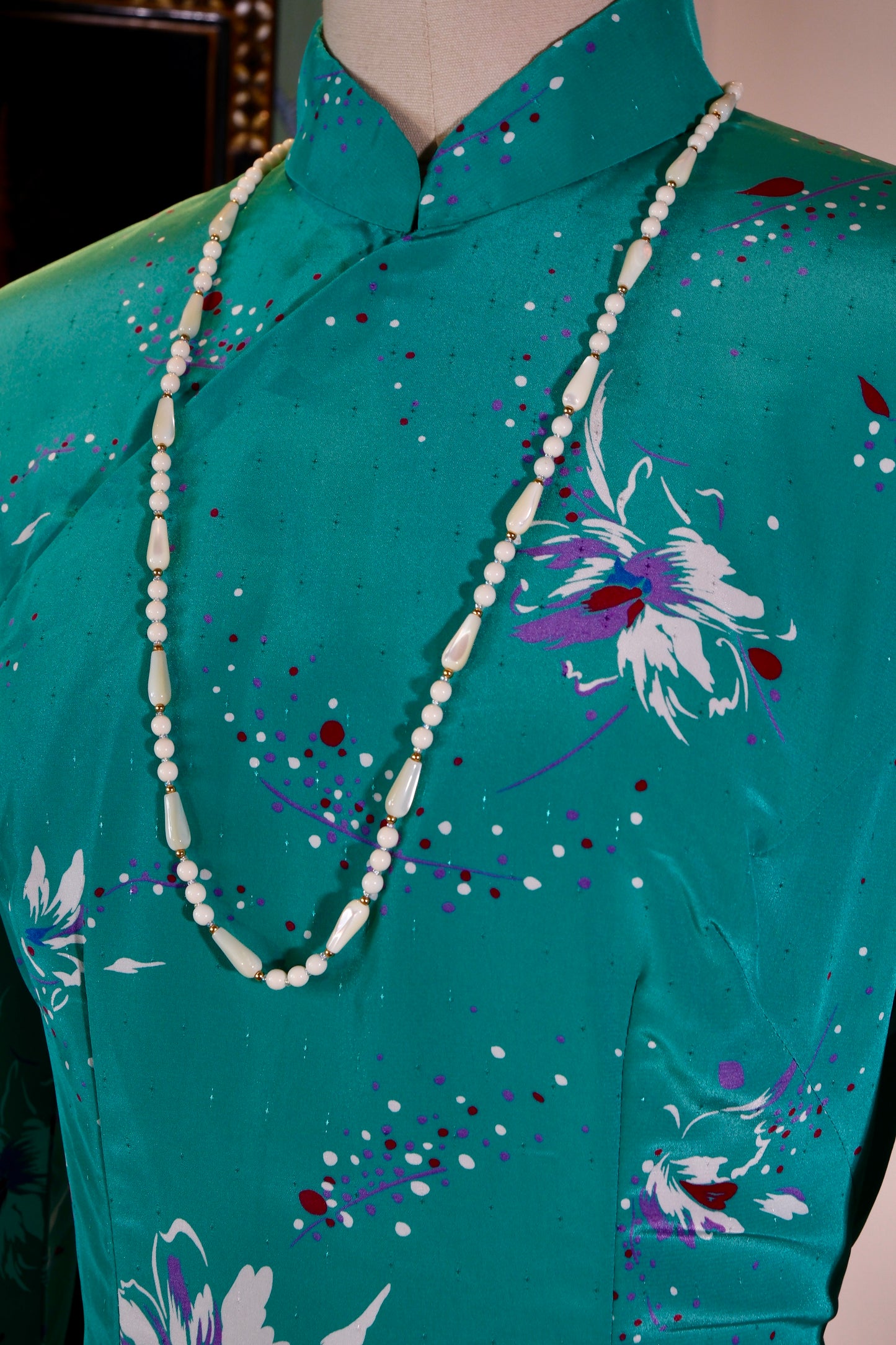
【器物描述:翠微深处的写意繁花】
这件旗袍,首先映入眼帘的是那一抹极具时代张力的“孔雀绿”或曰“翡翠绿”。这种色调在六十年代的时尚语境中,既保留了东方玉石文化的温润底蕴,又呼应了当时西方波普艺术对高饱和度色彩的偏爱。
面料之上,并非传统中式旗袍那般工笔细描的牡丹或龙凤,而是一幅充满现代主义气息的“写意花卉图”。
- 花型解构: 图案主体为抽象化的百合或兰花形态,花瓣以大面积的留白与淡紫晕染而成,花蕊处点缀着深邃的靛蓝与朱红。这种处理方式明显受到了二十世纪中期西方抽象表现主义绘画的影响,打破了传统纹样的对称与拘谨,呈现出一种随风摇曳的动态美。
- 点线韵律: 在花丛之间,散落着无数细小的白色、紫色与红色圆点,如同夜空中的星尘,又似春雨后的落英。这些跳跃的色点打破了绿色底色的沉静,赋予了整件衣物一种轻盈的节奏感,仿佛能听到那个年代爵士乐的低回婉转。
- 剪裁语言: 典型的六十年代“海派”改良剪裁。立领低而贴合,修饰颈部线条;袖长至肘下,袖口微敞,既端庄又不失利落;腰身收束极高且紧致,完美勾勒出女性自然的S型曲线,这是战后女性自信与身体意识觉醒的体现。
【历史溯源:跨越重洋的丝路新语】
要读懂这件旗袍,必须将其置于上世纪六十年代特殊的时空坐标中。那是一个全球化浪潮初兴、东西方文化剧烈碰撞与融合的“黄金时代”。
1. 意大利面料的远渡重洋
标签上注明的“意大利进口”,是这件衣服最珍贵的身份注脚。六十年代的意大利正处于纺织工业的巅峰期,科莫湖畔的印染工厂掌握着世界上最先进的丝绸处理技术。彼时,台湾作为亚洲四小龙之一,其高端定制旗袍店(如著名的“荣昌祥”等流派)往往不惜成本,通过贸易商从欧洲引进顶级面料。
这块面料漂洋过海来到台北,本身就是一段关于贸易与审美的传奇。它证明了当时的穿着者拥有极高的社会地位与国际视野——她穿在身上的,不仅仅是布料,而是来自米兰或佛罗伦萨的时尚呼吸。
2. 台湾制造的匠心独运
虽然面料源自欧洲,但灵魂却是纯正的中式。台湾的裁缝师傅们继承了上海老裁缝的精湛技艺,又在海岛的相对封闭环境中沉淀出更为细腻的风格。他们懂得如何用西方的立体剪裁(如装袖、省道)来重塑东方的平面布料,使这件意产印花布在保持原有垂坠感的同时,紧紧包裹住东方的身躯。这是一种“西料中做”的完美典范。
【文化互文:引经据典下的艺术风格】
张爱玲在《更衣记》中曾言:“对于不会说话的人,衣服是一种语言,随身带着一种袖珍戏剧。”这件旗袍,便是一出无声的折子戏。
- “参差对照”的美学: 张爱玲亦云:“我不喜欢壮烈。我是喜欢悲壮,更喜欢苍凉……壮烈只有力,没有美,似乎缺少人性。悲剧则如大红大绿的配角,是一种强烈的对照。”这件旗袍的配色正是如此。翠绿底色上的紫红碎花,不追求和谐统一,而是在冲突中寻求平衡,这种“参差对照”恰恰是六十年代摩登女性的审美自觉——不再满足于传统的温婉,开始追求个性的张扬与视觉的冲击。
- 从“束缚”到“解放”: 此时的旗袍,已褪去了清代旗装的宽大与民国初期的繁复。正如林语堂所言,中国女性的服装演变史,实则是一部身体的解放史。这件衣服的收腰设计与适中的开衩,既遵循了礼教的含蓄,又大胆地展示了女性的自然体态。它是那个时代女性走向职场、走向社交舞台的战袍。
【稀缺性综述:不可复制的时光标本】
在古董衣收藏界,六十年代的“洋料旗袍”属于金字塔尖的品类。
- 文化孤本: 它是冷战时期特殊地缘政治下的产物。随着产业链的转移和时尚潮流的更迭,这种“意大利面料+台湾手工”的特定组合模式已成绝响。
这件旗袍,不仅是一件御寒遮体的衣物,更是一枚被封存的时光胶囊。它记录了那个年代一位优雅女性对美的极致追求,也见证了东西方文明在针线与织物间的一次深情拥抱。
Measurements / Size Guide:
Bust / Waist / Hips / Total Length: 92/80/104/122 cm
Detailed Description:
Upon initial visual confrontation, this garment commands attention through a specific hue of profound chronological tension—a striking peacock green or emerald green. Within the sartorial vernacular of the 1960s, this color value structuralizes a dual identity: it simultaneously safeguards the unctuous, restrained legacy of traditional Eastern jade culture while reciprocating the high-saturation color theory popularized by contemporary Western Pop Art.
Upon the structural epidermis of the silk matrix, the layout deliberately rejects the meticulous, fine-line literalism (Gongbi) of traditional peonies or imperial dragons; it manifests instead a modernist, highly atmospheric expressionist botanical panorama.
Morphological Motif Deconstruction: The dominant graphic vectors outline highly abstracted lily or orchid silhouettes. The petals are executed through expansive fields of negative space paired with delicate mauve or light-purple gradient washes, while the stamen centers are punctuated by deep indigo blues and cinnabar reds. This material execution borrows directly from mid-twentieth-century Western Abstract Expressionism, shattering the rigid symmetry and compositional timidity of traditional ornamentation to achieve a kinetic, wind-swept fluidity.
Pointillist and Linear Cadence: Scattered organically across the botanical clusters are infinite, minute pointillist dots of white, violet, and crimson. They simulate stellar dust across a nocturnal sky or fallen petals following a vernal rain. These hyper-kinetic chromatic points disrupt the static composure of the emerald ground, injecting the structural textile plane with a weightless, rhythmic syncopation—evoking the low, undulating cadence of mid-century jazz.
The Vernacular of Pattern-Drafting: The silhouette represents the absolute zenith of the 1960s modified Hong Kong-Shanghai tailoring lineage. The Mandarin collar is drafted low and structurally flush against the throat to elongate the cervical line. The sleeves terminate just below the elbow joint with a subtle, structural flare—balancing formal dignity with high-mobility utility. The waist axis is plotted exceptionally high and contoured with aggressive precision, mapping out the biological S-curve of the female anatomy, a material reflection of post-war female self-determination and heightened corporeal consciousness.
To accurately decode this qipao, it must be mapped onto the precise spatio-temporal coordinates of the 1960s—a golden historical window defined by the early cresting of globalized commercial routes and the violent, generative collision of Eastern and Western design systems.
The archival salvage of the "Imported from Italy" provenance marker constitutes the most critical diagnostic proof of this garment’s historical status. During the 1960s, the Italian textile sector occupied the absolute pinnacle of global industrial manufacturing; the high-capacity printing and dyeing mills operating along the shores of Lake Como preserved the most advanced chemical processing technologies for silk filaments in the world. Concurrently, as Taiwan established its economic footprint within the post-war East Asian trade network, elite haute couture qipao ateliers (including legendary houses descended from the Rong Chang Xiang lineage) completely bypassed domestic cost boundaries to procure premium European yardage via international brokers.
The maritime transit of this specific silk matrix from European ports to the cutting tables of Taipei is itself a profound epic of mid-century trade and aesthetic circulation. It archives undeniable material proof that the original patron commanded elite socio-economic status and a highly sophisticated cosmopolitan worldview. She did not merely drape her body in silk; she inhabited the living, contemporary fashion respiration of Milan and Florence.
Though the textile matrix claims a strictly European industrial birth, its sovereign soul remains purely Chinese. The artisanal tailors operating in Taiwan had inherited the supreme technical lineages of the pre-war Shanghai masters, refining those practices within the island's mid-century landscape into an even more meticulous, micro-engineered style. They demonstrated an absolute mastery over the synthesis of Western three-dimensional pattern-drafting (utilizing set-in sleeves and calculated anatomical darting) and the structural parameters of traditional Eastern flat-plane textiles. The result forced a highly fluid, European printed silk to retain its natural, liquid drape while remaining seamlessly engineered to the contours of the Eastern body. It stands as a flawless holotype of the "Western Material, Eastern Architecture" (Xiliao Zhongzuo) methodology.
As Eileen Chang famously remarked in her seminal sartorial essay Chronicle of Changing Clothes: "To those who are systematically denied a voice, clothes function as a sovereign vernacular; they carry a pocket drama wherever they go." This specific qipao operates as a silent, yet theatrical masterpiece.
The Aesthetic Law of "Contrast and Compensation": Chang further posited: "I do not care for the purely heroic. I prefer tragic grandeur, and even more, the quality of desolation... The purely heroic possesses velocity but lacks beauty, appearing fundamentally detached from human nuance. True tragedy operates like the stark juxtaposition of primary reds and greens—it relies on violent contrast." The chromatic engineering of this qipao honors this exact law. The scattering of purple-crimson floral clusters against the deep emerald baseline seeks no passive, harmonious synthesis; instead, it synthesizes an equilibrium directly out of visual conflict. This manifestation of "contrast and compensation" (Canci Duizhao) denotes the precise aesthetic self-awareness of the 1960s modern woman—one who explicitly renounced traditional pastel docility in pursuit of radical individualism and high-impact visual sovereignty.
From Bodily Confinement to Liberation: By this historical juncture, the qipao had completely shed the vast, structural weight of the Qing Dynasty Manchu robes and the hyper-ornamental complications of the early Republican era. Lin Yutang once conceptualized the evolution of Chinese women's dress as an explicit history of corporeal emancipation. The radical high-waist darting and the calculated geometry of the side vents on this garment strictly observe traditional modesty while daringly articulating the natural architecture of the female form. It functioned as the literal armor for the mid-century woman stepping out of domestic isolation and onto the global corporate and social stage.
Within the specialized taxonomy of antique garment preservation and high-tier collection, mid-century "Western-fabric qipaos" (Yangliao Qipao) occupy the absolute apex of the archival pyramid.
The Cultural Monad: This artifact represents a highly specific material byproduct of the complex geopolitical and trade realities of the Cold War era. Following the eventual migration of global textile supply chains and the rapid obsolescence of traditional tailoring systems, this highly localized intersection of "Premium Italian Industrial Silk + Traditional Taiwanese Artisan Tailoring" has closed permanently.
Consequently, this qipao ceases to function merely as a textile protective layer for the human body; it operates as a pristine, vacuum-sealed temporal capsule. It archives the absolute limits of aesthetic refinement pursued by an elite mid-century woman, while standing as a material monument to the moment Eastern and Western civilizations enacted a profound, permanent embrace through the trajectory of a needle and thread.