深圳溯源
无法加载取货服务可用情况
衣服尺寸:
胸围/腰围/臀围:106/92/108 厘米
衣长:100 厘米
细节描述:
【纹样考释:经纬间的几何诗意】
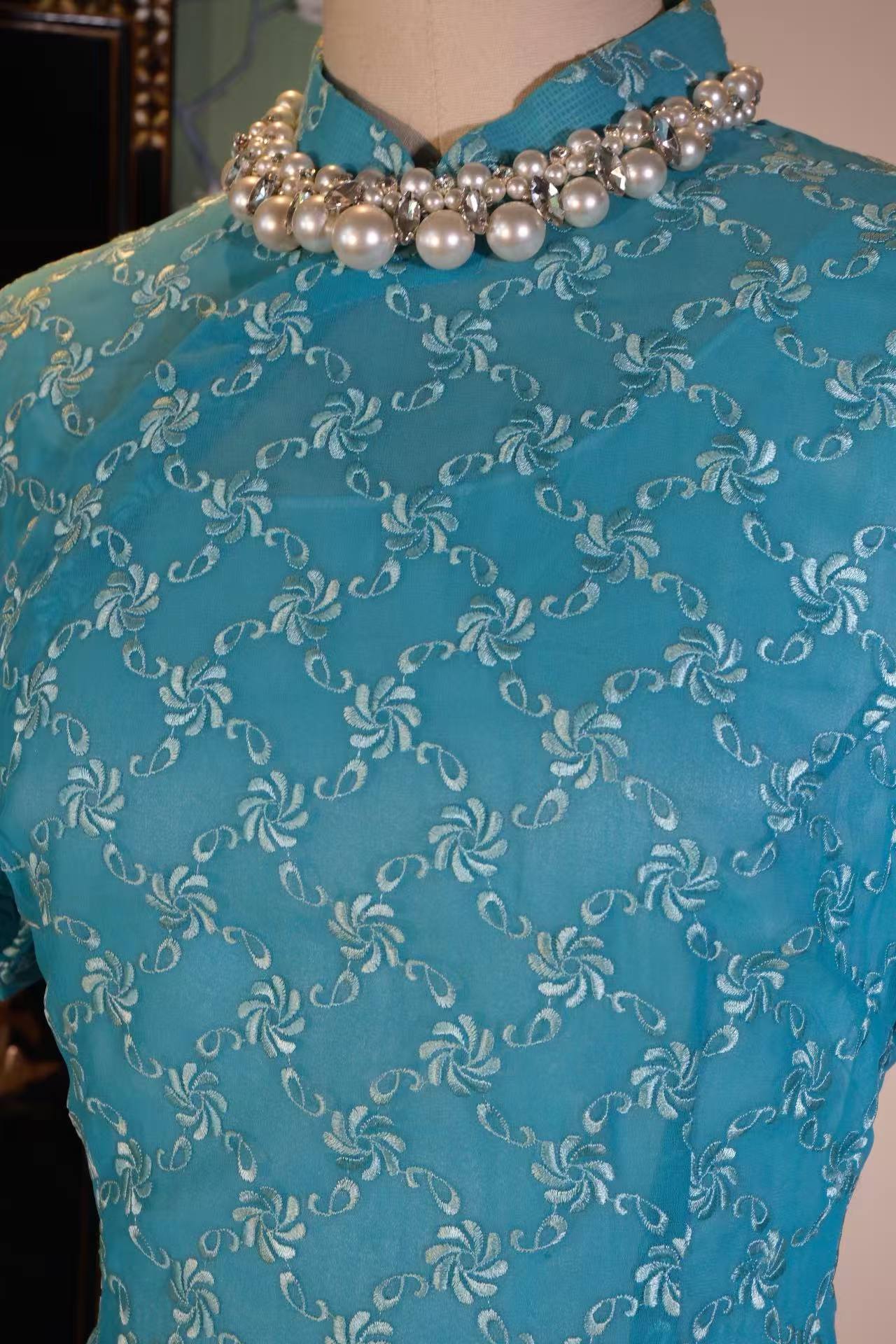
这件旗袍的纹样,并非传统意义上的具象花鸟,而是一种极具现代主义色彩的“几何缠枝”。
细观其面料,这是一种轻盈通透的欧根纱。在淡若天青的底色之上,银白色的丝线通过精密的机器刺绣,构建出一种菱形网格状的骨架。每一个菱形的节点处,都绽放着一朵抽象化的、呈螺旋状的风车花(或称团花)。这种纹样既保留了中国传统“缠枝莲”连绵不断的吉祥寓意,又深受20世纪60年代西方波普艺术与装饰艺术运动的影响,呈现出一种秩序感与流动感并存的视觉张力。
正如《考工记》所云:“天有时,地有气,材有美,工有巧。”这种机器绣花工艺,在那个年代代表了香港纺织工业的黄金水准,针脚细密均匀,光泽流转间,宛如碧波之上泛起的层层涟漪。
【衣史钩沉:香江摩登的黄金时代】
若要为这件衣裳寻一个注脚,那必然是20世纪60年代的香港。
那是张爱玲笔下“倾城之恋”余韵尚存,却又迎来新一轮西化浪潮的时代。彼时的香港,是东西方文化剧烈碰撞与融合的熔炉。旗袍,这一原本属于满族女性的服饰,在此时完成了它最后的、也是最华丽的蜕变。
不同于30年代海派旗袍的繁复与奢华,60年代的港式旗袍开始追求“轻便”与“日常”。这件旗袍正是这一历史转折的见证者:
- 剪裁之变: 它的剪裁更加立体,强调女性的自然曲线,但袖口略微放宽,长度及膝,这是为了适应当时女性日益繁忙的社交生活与职场需求,不再像旧式长袍那般束缚肢体。
- 面料之新: 欧根纱的使用,是那个时代的时尚宣言。它比丝绸更挺括,比棉麻更梦幻,自带一种朦胧的“空气感”。这种面料在当时多用于制作晚装或高级成衣,象征着穿着者不俗的品味与家境。
想象一下,半个多世纪前,或许有一位身处湾仔或中环的时髦女士,身着此衣,颈间佩戴着温润的珍珠项链(如图中搭配),穿梭于半岛酒店的下午茶会或是邵氏片场的首映礼上。她步履轻盈,裙摆随风微动,那是独属于那个年代的“东方赫本”风姿。
【艺术风格与稀缺性:不可复制的时光标本】
从学术角度审视,这件旗袍具有极高的物质文化研究价值。
首先,它是“中西合璧”审美范式的典型样本。它将西方的几何构成法则与东方的材质工艺完美嫁接。这种风格在服装史上被称为“Mid-Century Modern Orientalism”(世纪中叶现代东方主义)。
其次,其稀缺性不言而喻。
- 工艺的断层: 这种特定配方的欧根纱面料,以及当年香港制衣厂特有的高密度机器锁边与刺绣工艺,随着产业的转移与升级,大多已失传或发生了质变。现在的仿制品,往往只有其形,而无那种经过岁月沉淀后的柔和光泽与挺括手感。
- 保存的难度: 欧根纱虽美,却极难保存。六十年的光阴,足以让脆弱的化纤或真丝混纺脆化、断裂。而这件旗袍品相如此完好,色泽依旧鲜亮如初,实乃凤毛麟角。
古人云:“锦衣雪华玉颜色,回眸一笑百媚生。”这件旗袍不仅是一件衣物,更是一首凝固的诗,一段被封存的香江往事。它静静地立在那里,便是在诉说着那个风华绝代、不可复刻的流金岁月。
收藏建议:
此件藏品适合对20世纪中叶亚洲时尚史、纺织工艺演变感兴趣的藏家。它不仅可作为博物馆级的陈列品,亦可在特定的复古主题展览中,作为展示60年代香港都市女性风貌的核心展品。
注释:瑕疵特价
Measurements / Size Guide:
Bust / Waist / Hips: 106/92/108 cm
Total Length: 100 cm
Detailed Description:
The motifs on this qipao reject the conventional, representational rendering of birds and blossoms, delivering instead a highly modernist take on "geometric continuous vines."
Gazing closely at the textile chassis, one finds a lightweight, translucent organza fabric. Upon a ground matrix as faint as a cloud-clearing celadon blue, silver-white filaments are woven through precision machine embroidery to construct a diamond-lattice structural framework. At each intersection of the diamond grid, an abstract, spiral-shaped pinwheel blossom (or medallion flower) bursts into bloom. This pattern layout beautifully preserves the continuous, auspicious metaphor of traditional Chinese "intertwined lotus vines," while drawing heavily from the structural influences of 19x0s Western Pop Art and the Art Deco movement—presenting a visual tension where order and fluidity coexist seamlessly.
As the ancient text Artificers' Record (Kao Gong Ji) records: "Heaven has its seasons, Earth has its vital energy, materials have their beauty, and craftsmen have their skill." This machine-embroidery technique represented the golden benchmark of Hong Kong’s textile industry during that decade; the needlework is exceptionally dense and uniform, causing the shifting luster to resemble layers of ripples rising across green waves.
If one must find a historical footnote for this garment, it resides non-negotiably within the Hong Kong of the 1960s.
It was an era where the lingering resonance of Eileen Chang's "Love in a Fallen City" still breathed, yet seamlessly intersected with a massive new wave of Westernization. Hong Kong during this timeline functioned as a hyper-dynamic melting pot where Eastern and Western cultures collided and fused with absolute intensity. The qipao—an attire that originally belonged to Manchu women—executed its definitive and most magnificent evolution during this specific window.
Distinct from the intricate complexity and heavy luxury of 1930s Shanghai-style qipaos, 1960s Hong Kong-style tailoring began aggressively pursuing "lightness" and "everyday wearability." This qipao stands as a direct physical witness to this historic turning point:
The Evolution of the Pattern Draft: Its cut is significantly more three-dimensional, emphasizing the natural curves of the female form. However, the cuffs are slightly relaxed and the hem terminates at knee-length; these adjustments were made to adapt to the increasingly busy social schedules and professional workplace demands of contemporary women, throwing off the physical constraints characteristic of old-school full-length robes.
The Innovation of the Textile Matrix: The implementation of organza stands as a definitive fashion statement of that decade. It offers a crisper structure than silk and a more dreamy, ethereal quality than cotton or linen, carrying an intrinsic, misty "airiness." This specific fabric was heavily reserved in that era for evening wear or luxury haute couture, symbolizing the impeccable taste and affluent family background of its custodian.
Imagine a stylish lady navigating the bustling streets of Wan Chai or Central more than half a century ago, stepping into this garment, her neck adorned with a warm, muted strand of pearls (as styled in the accompanying visual). She moves gracefully through an afternoon high tea gathering at The Peninsula Hotel or a cinematic premiere at the Shaw Brothers studio. Her steps are light, her hemline shifts softly with the breeze—embodying the definitive poise of an "Eastern Audrey Hepburn" unique to that generation.
Appraised under academic metrics, this qipao holds immense material culture research value.
First, it operates as a textbook specimen of the "East-West synthesis" aesthetic paradigm. It flawlessly grafts Western geometric composition rules directly onto Eastern material craftsmanship. Within costume history, this design movement is formally classified as "Mid-Century Modern Orientalism."
Second, its absolute physical scarcity is beyond question:
The Discontinuity of Technical Lineage: This specific formula of organza fabric, paired with the hyper-dense machine overlocking and embroidery techniques unique to Hong Kong garment factories of that era, has largely been lost or fundamentally altered due to industrial relocation and technological upgrades. Contemporary replicas consistently capture only the superficial shape, completely lacking the softened luster and crisp, structured hand-feel that has settled into this piece through decades of natural timeline.
The Defiance of Conservation: Though visually magnificent, organza is notoriously difficult to conserve. Sixty years of natural timeline are more than enough to cause fragile synthetic fibers or silk-blend matrices to embrittle and fracture. For this qipao to retain such an immaculate physical condition, with its coloration remaining as vibrant as day one, is exceptionally rare—a true phenomenon.
As the ancients wrote: "Clad in splendid brocade like pristine snow, with a countenance as radiant as jade; a single backward glance dissolves into a hundred captivating charms." This qipao transcends its utility as a basic garment to operate as a piece of frozen poetry, a sealed archive of old Hong Kong memories. Its silent presence alone serves to narrate a peerless, irreproducible era of golden years.
This specific acquisition is ideally destined for discerning collectors possessing a deep interest in mid-20th-century Asian fashion history and the structural evolution of textile manufacturing. It is fully qualified to serve as a museum-grade archival display object, or to function as the core, headlining artifact in specialized vintage exhibitions illustrating the lifestyle and societal landscapes of 1960s metropolitan Hong Kong women.
Note: As-Is Special Offer