深圳溯源
无法加载取货服务可用情况
衣服尺寸:
胸围/腰围/臀围/衣长:100/94/116/110 厘米
细节描述:
在服装史的浩瀚长河中,旗袍不仅是一种服饰形制,更是一段凝固的时光。当我们凝视这件上世纪六十年代产自台湾的古董旗袍时,仿佛推开了一扇通往那个“黄金时代”的窗棂。它不仅仅是一件衣物,更是一件融合了东方美学与时代精神的纺织艺术品。
一、 纹样考据:秋意浓处的繁花似锦
这件旗袍最引人入胜之处,在于其面料上繁复而雅致的印花图案。不同于清代旗装那种大面积留白或规整的团花,亦不同于三十年代上海旗袍常见的几何 Art Deco 风格,这件六十年代的台湾旗袍展现出一种“自然主义的浪漫”。
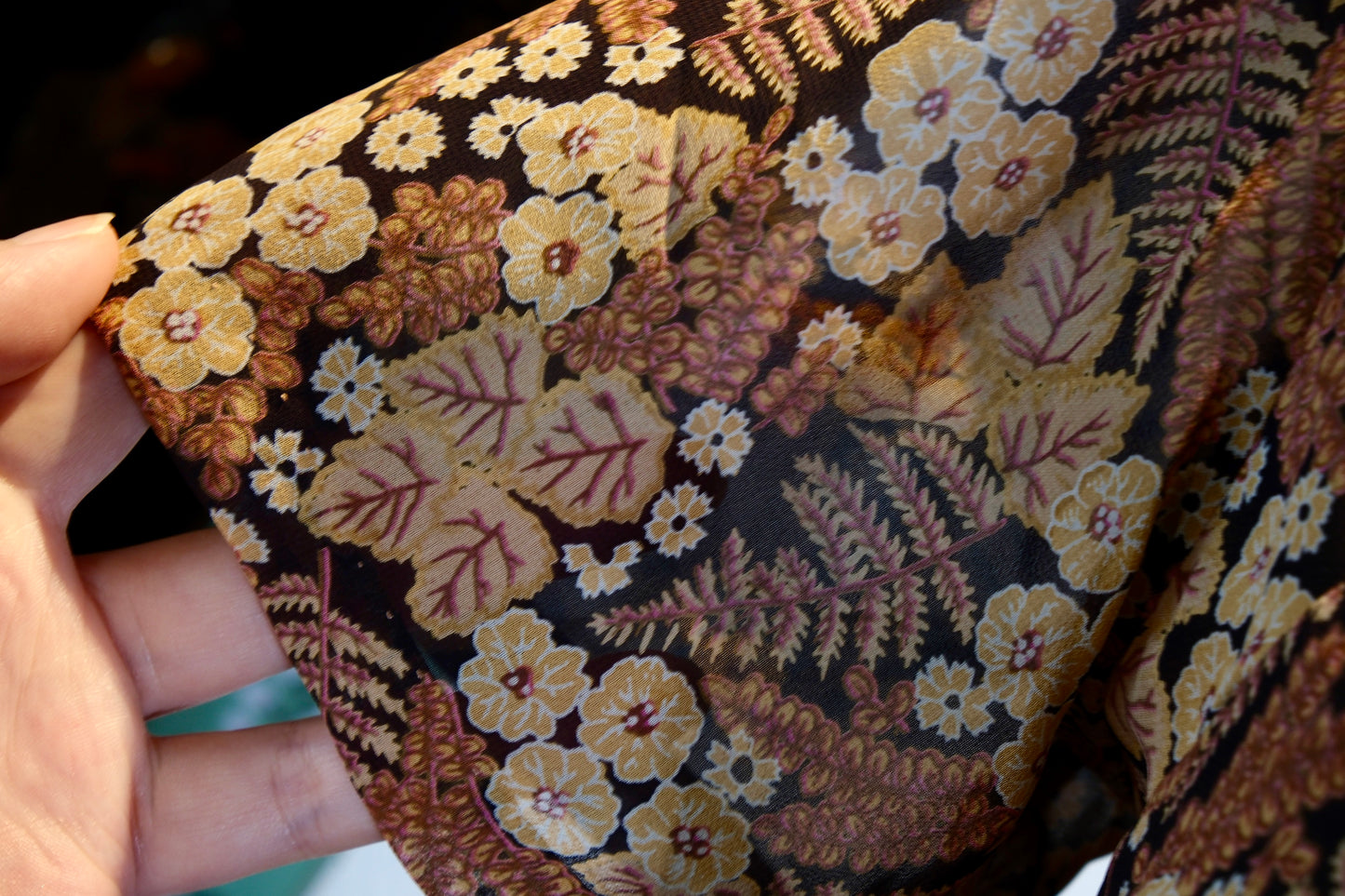
细观其纹样,底色深沉如夜,仿佛深秋的泥土或暮色。其上铺陈着密集的蕨类植物叶片与细碎野花。
- 叶之形态: 那些羽状复叶的蕨类,线条舒展,色泽呈现出赭石、枯黄与暗红的交织,精准地捕捉了“秋叶”将落未落时的斑斓质感。这种对植物形态的写实描绘,带有明显的战后现代纺织品设计特征,既保留了传统工笔的细腻,又融入了西式植物图谱的科学观察视角。
- 花之点缀: 在层层叠叠的秋叶之间,点缀着米黄与淡白的小花。它们不似牡丹般雍容,也不像玫瑰般热烈,而是如同山间野菊或桂花般,星星点点,错落有致。
这种“叶多花少,以叶衬花”的构图,在视觉上营造出一种深邃的景深感。正如宋代词人吴文英所言:“何处合成愁?离人心上秋。” 但这件旗袍并无愁苦之气,反而通过暖色调的运用(金黄、赭红),将“悲秋”转化为了一种成熟、丰盈的“颂秋”。它象征着生命的沉淀与收获,是六十年代台湾社会在动荡后寻求安定与繁荣的心理投射。
二、 剪裁与形制:海派遗韵与宝岛新风
从形制上看,这件旗袍完美继承了海派旗袍的精髓,并在六十年代的台湾得到了进一步的改良与固化。
- 立领与袖型: 经典的元宝领高度适中,既修饰颈部线条,又不失庄重。短袖的设计利落大方,袖口微微外撇,这是为了适应台湾亚热带气候而做的实用主义调整,同时也展现了当时女性日益独立、干练的社会形象。
- 归拔工艺: 仔细观察腰身与臀部的曲线,可以看出当年裁缝高超的“归拔”技艺。在没有弹性面料的年代,完全依靠熨斗的热度与手工的推拉,使平面的布料顺应女性身体的起伏,达到“天衣无缝”的贴合感。这种对曲线的极致追求,正是张爱玲笔下“紧俏的曲线,像一句未说完的情话”的最佳注脚。
三、 稀缺性与艺术价值:时光孤本
作为一件存世半个多世纪的古董衣,其稀缺性不言而喻。
1. 面料的不可再生性: 六十年代的印花棉布或人造丝,其染料多为植物提取或早期化学染料,随着时间推移,色彩会发生微妙的氧化,形成一种现代工业印染无法模仿的“包浆感”。这种温润的光泽,是岁月赋予的独家签名。
2. 工艺的断层: 当时的全手工制作——从滚边、嵌线到盘扣,每一道工序都凝聚着手艺人的体温。在现代快时尚席卷全球的今天,这种慢工出细活的匠心已成绝响。
3. 历史的见证: 六十年代的台湾,正处于传统文化与现代文明激烈碰撞又温柔融合的时期。这件旗袍既有中国传统服饰的含蓄内敛,又有西方时装的立体剪裁意识,它是那个特殊时空下文化交融的实物见证。
四、 结语:衣香鬓影后的文化乡愁
穿着这样一件旗袍的女子,或许曾漫步在台北的牯岭街,或许曾在某次文人雅集上低眉浅笑。她颈间佩戴的那串白色珠链(如图所示),更是点睛之笔,打破了深色面料的沉闷,增添了几分温婉与贵气。
这不仅仅是一件衣服,它是“穿在身上的文学”。它让我们得以触摸到那个时代的温度,感受到那份独属于东方的、含蓄而热烈的生命张力。收藏这样一件古董旗袍,便是收藏了一段回不去的旧时光,一份对极致美学的永恒致敬。
Measurements / Size Guide:
Bust / Waist / Hips / Total Length: 100/94/116/110 cm
Detailed Description:
In the vast river of apparel history, the qipao stands not merely as a silhouette, but as a moment frozen in time. Gazing upon this 1960s antique qipao from Taiwan feels like opening a window onto a lost golden era—an exquisite piece of textile art where Eastern aesthetics harmonize with the spirit of a mid-century generation.
The most arresting quality of this garment is its complex, refined print. Departing from the wide expanses of empty space (liubai) seen in Qing court attire, as well as the geometric Art Deco motifs popular in 1930s Shanghai, this 1960s Taiwanese design embraces a distinct "Naturalistic Romanticism."
The ground color is deep and dark, evoking autumnal earth or twilight, across which rests a dense layer of fern fronds and delicate wildflowers:
Leaf Forms: The pinnate fern fronds curve naturally, blending ochre, withered yellow, and muted reddish-brown tones to capture the vivid texture of late-autumn foliage. This naturalistic rendering reflects post-war modern textile developments, combining the precision of classical Gongbi brushwork with the observational clarity of Western botanical illustration.
Floral Accents: Scattered among the layered autumn leaves are tiny cream and off-white blossoms. Less ostentatious than peonies and softer than roses, they resemble wild chrysanthemums or sweet osmanthus, lightly rhythmically dispersed across the composition.
This composition—where foliage takes center stage to frame smaller blooms—creates a rich visual depth. Rather than projecting melancholy, the warm ochres and golds transform the quiet melancholy of autumn into a celebration of maturity, abundance, and harvest—a visual reflection of a society seeking stability and grace in mid-century Taiwan.
In terms of cut and construction, this qipao inherits the core principles of Shanghai-style (Haipai) tailoring, refined and adapted within Taiwan's mid-century aesthetic:
Standing Collar and Sleeve Line: The classic yuanbao standing collar is moderate in height, framing the neckline with dignified composure. The clean, short-sleeved cut flares slightly at the cuff—a practical adaptation to Taiwan's subtropical climate that simultaneously reflects the increasingly active, modern lifestyle of women during the era.
Iron-Shaping Mastery (Gui-Ba): The seamless contouring along the waist and hips demonstrates exceptional iron-shaping technique. Operating without elastic fibers, tailors relied entirely on heat, steam, and precise manual tensioning to mould two-dimensional fabric around three-dimensional curves, achieving an effortless fit. It honors Eileen Chang's famous sentiment: "A snug curve, like an unfinished phrase of love."
Having survived over half a century, the rarity of this vintage piece rests on three distinct pillars:
Irreplaceable Vintage Textiles: Printed cottons and early rayon fabrics from the 1960s utilized dyes that oxidized subtly across decades. This process yields a gentle patina and soft luster that modern industrial dyeing cannot replicate.
Handcrafted Artisanship: Every detail—from bias piping (gumbian) and embedded cords (qianxian) to hand-fashioned frog closures (pankou)—carries the warmth and dedication of traditional handcraft, a quality increasingly rare in an age of rapid mass production.
Historical Document: The 1960s in Taiwan marked an era where heritage techniques fused with Western three-dimensional tailoring. This garment stands as a physical witness to that cultural dialogue.
One can easily imagine the original wearer strolling through mid-century Taipei or attending an evening gathering, accented by a classic strand of white beads at her collar (as pictured) to break the dark tones with quiet elegance.
This garment is truly "literature worn upon the body." It allows us to touch the warmth of a bygone era and experience an Eastern aesthetic that remains both subtle and deeply expressive. To appreciate such an antique qipao is to preserve an unrepeatable fragment of history and a timeless tribute to textile art.