深圳溯源
无法加载取货服务可用情况
衣服尺寸:
胸围/腰围/臀围:106/100/108 厘米
衣长:110 厘米
细节描述:
一、 纹样解码:几何与自然的现代主义对话
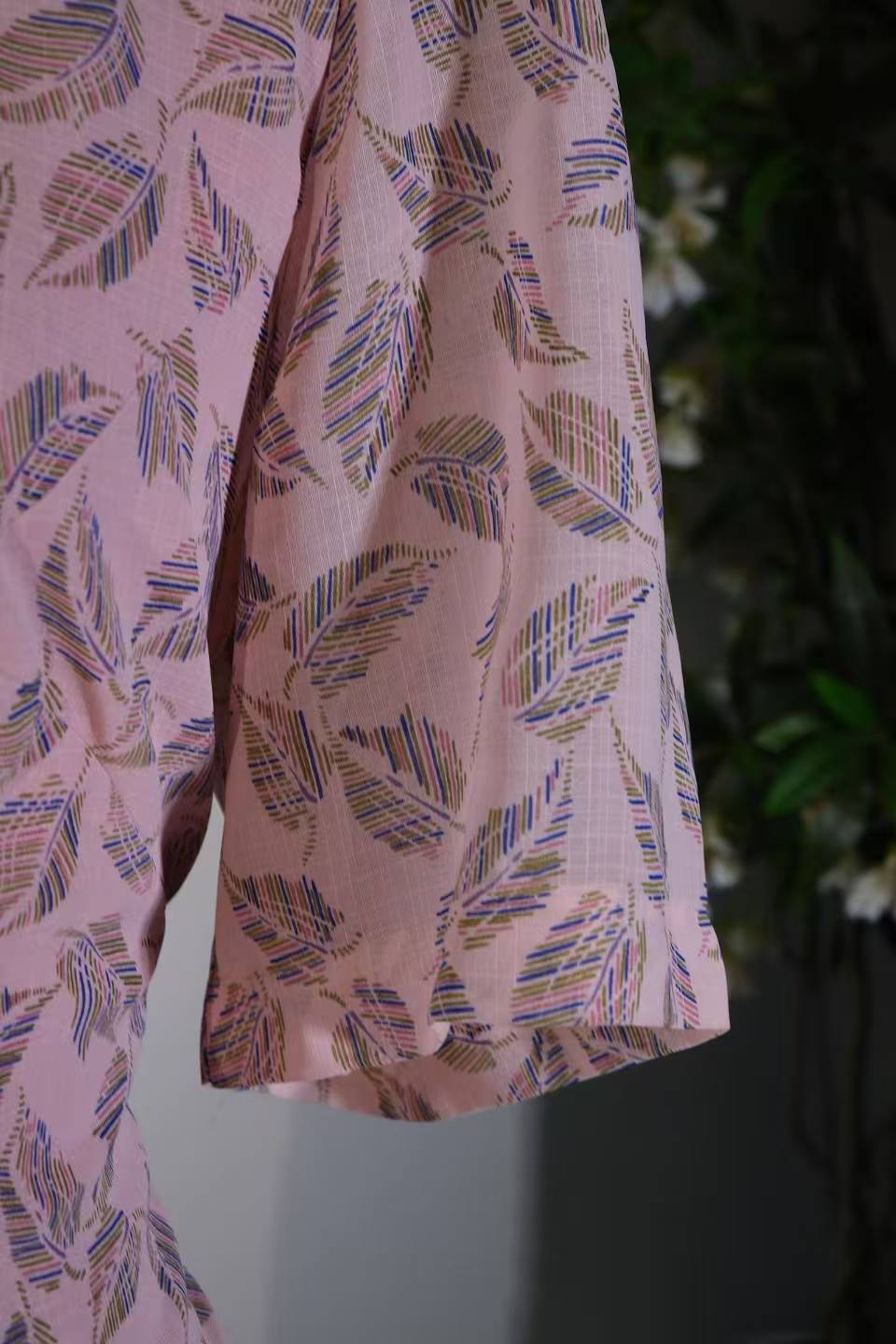
这件旗袍最引人入胜之处,在于其面料图案的独特性。它摒弃了传统旗袍中常见的牡丹、凤凰等具象吉祥纹样,转而采用了一种极具现代主义(Modernism)色彩的抽象叶纹设计。
仔细观察,这些叶片并非写实描绘,而是由无数细密的蓝、紫、褐三色线条交织而成,呈现出一种类似版画或织锦的“肌理感”。这种设计手法在60年代的纺织品设计中极为前卫,它打破了二维平面的沉闷,利用视错觉营造出丰富的层次感。底色选用的是温润的藕粉色(Dusty Pink),既中和了冷色调线条的锐利,又为整件衣服注入了女性特有的柔美与温婉。这种“乱中有序”的叶纹,仿佛微风拂过树梢留下的光影斑驳,既有东方的写意神韵,又兼具西方的构成主义美感。
二、 历史回响:香江裁缝的黄金时代
这件旗袍不仅是一件衣物,更是一段历史的切片。
20世纪60年代,是香港服装业的“黄金时代”。彼时,随着上海裁缝师傅的大规模南下,中西文化在香江交汇碰撞,催生了独一无二的“港式旗袍”风格。不同于老上海旗袍的繁复滚边与极度紧身,60年代的港产旗袍更注重实用性与日常化。
这件作品正是那个时代的缩影。它采用了当时流行的亚麻混纺面料。亚麻透气吸汗,极适应南方湿热的气候,而混纺工艺则增加了面料的挺括度,使其不易起皱,便于都市女性的日常通勤与社交。这种对材质的改良,体现了当时香港女性追求独立、干练的新形象——她们不再是深闺中的娇客,而是穿梭于写字楼与茶餐厅之间的职业女性。
三、 剪裁美学:含蓄中的身体解放
从形制上看,这件旗袍保留了经典的立领与右衽大襟,但在廓形上进行了微妙的改良。
- 袖型: 采用了略微宽松的连肩短袖,袖口微微外扩,这种设计不仅修饰了手臂线条,更增添了几分俏皮与灵动,符合60年代全球范围内女性着装趋向自由的审美潮流。
- 腰身: 收腰位置精准,下摆呈直筒微收状。它不刻意强调夸张的S型曲线,而是顺应人体自然的起伏,展现出一种“克制的性感”。正如张爱玲所言:“对于不会说话的人,衣服是一种语言。”这件旗袍的语言,是内敛而自信的。
四、 稀缺性与收藏价值
在古董衣市场上,保存完好的60年代港产旗袍已属凤毛麟角,而像这样面料特殊、花色现代且品相极佳的作品,更是可遇不可求的孤品。
大多数存世的旧旗袍多为丝绸质地,虽华丽却难打理,且容易脆化。而这件亚麻混纺旗袍,历经半个多世纪依然色泽如初,肌理清晰,足见当年用料之考究与保存之精心。它不仅具有极高的穿着价值——亚麻的质感随着岁月的洗礼会愈发柔软亲肤;更具有深厚的文献价值,是研究20世纪中叶东亚服饰变迁的实物佐证。
【结语】
《诗经》有云:“青青子衿,悠悠我心。”衣裳之于人,不仅是遮体之物,更是心境的投射。这件六十年代的粉黛旗袍,穿越了半个世纪的风尘,带着那个时代特有的摩登与雅致来到我们面前。它不仅仅是一件古董,更是一首穿在身上的散文诗,等待着懂它的人,续写新的故事。
Measurements / Size Guide:
Bust / Waist / Hips: 106/100/108 cm
Total Length: 110 cm
Detailed Description:
The most captivating attribute of this qipao resides in the pure singularity of its textile surface pattern. It completely relinquishes the representational auspicious iconography—such as peonies or phoenixes—common to conventional heritage qipaos, opting instead to implement an abstract foliage design heavily saturated with mid-century Modernism.
Close inspection reveals that these leaves reject realistic rendering; they are engineered from a dense interlacing of fine tri-color lines in navy, violet, and espresso, generating a highly palpable structural texture reminiscent of printmaking or classical jacquard weaves. This design methodology was profoundly avant-garde within the textile design circles of the 1960s, completely shattering the flatness of a two-dimensional surface by using optical illusion to build a rich, multi-layered depth. The grounding chassis selects a warm, disciplined lotus-root pink (dusty pink), which beautifully softens the sharpness of the cool-toned structural lines while injecting the silhouette with a distinctly feminine grace and gentleness. This "ordered chaos" within the leaf composition evokes the dappled plays of light and shadow left by a gentle breeze rustling through tree canopies—simultaneously capturing the expressive essence of Eastern ink washing (Xieyi) and the compositional beauty of Western Constructivism.
This qipao functions far beyond its definition as an article of clothing; it stands as a live physical slice of history.
The 1960s represented the undisputed "Golden Age" of the Hong Kong apparel apparatus. During this timeline, driven by the massive southward migration of Shanghainese master tailors, Eastern and Western cultural vectors intersected and collided along Victoria Harbour, giving rise to the singular "Hong Kong-Style Qipao" (Gangshi Qipao). Deviating from the multi-layered, heavy pipings (Piping) and extreme, body-shackling constrictions of the old Shanghai styles, 1960s Hong Kong-produced qipaos prioritized practical utility and daily versatility.
This specific masterpiece stands as the ultimate distillation of that epoch. It implements a linen-blend textile matrix that was highly favored during the period. Linen operates with exceptional breathability and moisture absorption, adapting perfectly to the humid, subtropical climate of the region, while the blending process enhances the structural uprightness of the textile, preventing excessive wrinkling to accommodate the daily commuting and socializing routines of metropolitan women. This targeted modification of material composition mirrors the emerging mid-century archetype of the independent, executive Hong Kong woman—they were no longer delicate ornaments confined to private chambers, but career professionals swiftly navigating the spaces between corporate high-rises and local diners.
Structurally, this qipao faithfully safeguards heritage anchors including the classical standing collar and the right-side asymmetrical closure (Youren Dajin), yet it introduces subtle, nuanced modernizations to the overarching silhouette profile.
Sleeve Architecture: The garment implements slightly relaxed, extended-shoulder short sleeves with a gentle outward flare at the cuffs. This design choice not only refines the anatomical lines of the arm but injects a touch of youthful vitality and movement, aligning seamlessly with the global mid-century fashion trend toward liberation and freedom in women's apparel.
The Waistline Matrix: The waist reduction is mapped with high-precision darting, flowing into a streamlined, straight-cut hem that tapers ever so slightly. Rather than force-generating an exaggerated, artificial S-curve, the pattern follows the organic, natural undulations of the human anatomy to project a sense of "disciplined sensuality." As Eileen Chang immortally observed: "To those who cannot speak, clothes are a language." The language articulated by this specific qipao is one of absolute self-containment and quiet confidence.
Within the contemporary global antique apparel market, 1960s Hong Kong-produced qipaos in pristine preservation are already exceedingly rare; encountering a specimen that balances such a singular textile matrix and modernized print layout with an immaculate state of conservation represents an irreproducible curatorial phenomenon.
The overwhelming majority of surviving period qipaos are engineered from pure silks—gorgeous to behold but highly volatile, fragile, and prone to chemical embrittlement over time. Conversely, this linen-blend piece has traversed more than half a century while maintaining its original color saturation and crisp textural definition, serving as primary material proof of the premium tier of its raw components and the meticulous care exercised by its historical keepers. It commands immense wearability value—the tactile handle of premium linen grows increasingly soft and skin-friendly through the natural passage of time—alongside profound documentarian value, operating as an indispensable physical reference for researching the mid-twentieth-century evolution of East Asian costume.
The ancient Classic of Poetry (Shijing) famously reads: "Green is the collar of your robe, and deep is the longing in my heart." Apparel, in relation to humanity, extends far beyond simple bodily shelter; it serves as the ultimate mirror of an internal state of mind. This 1960s rose-dust qipao has cut through fifty years of temporal dust, presenting itself to us with the definitive modernization and elegance of its era. It stands not merely as an antiquity, but as a wearable piece of prose poetry, waiting for those who truly decode its structural language to author its next live chapter.