深圳溯源
无法加载取货服务可用情况
衣服尺寸:
胸围/腰围/臀围:90/84/94 厘米
衣长:97 厘米
细节描述:
【器物综述】
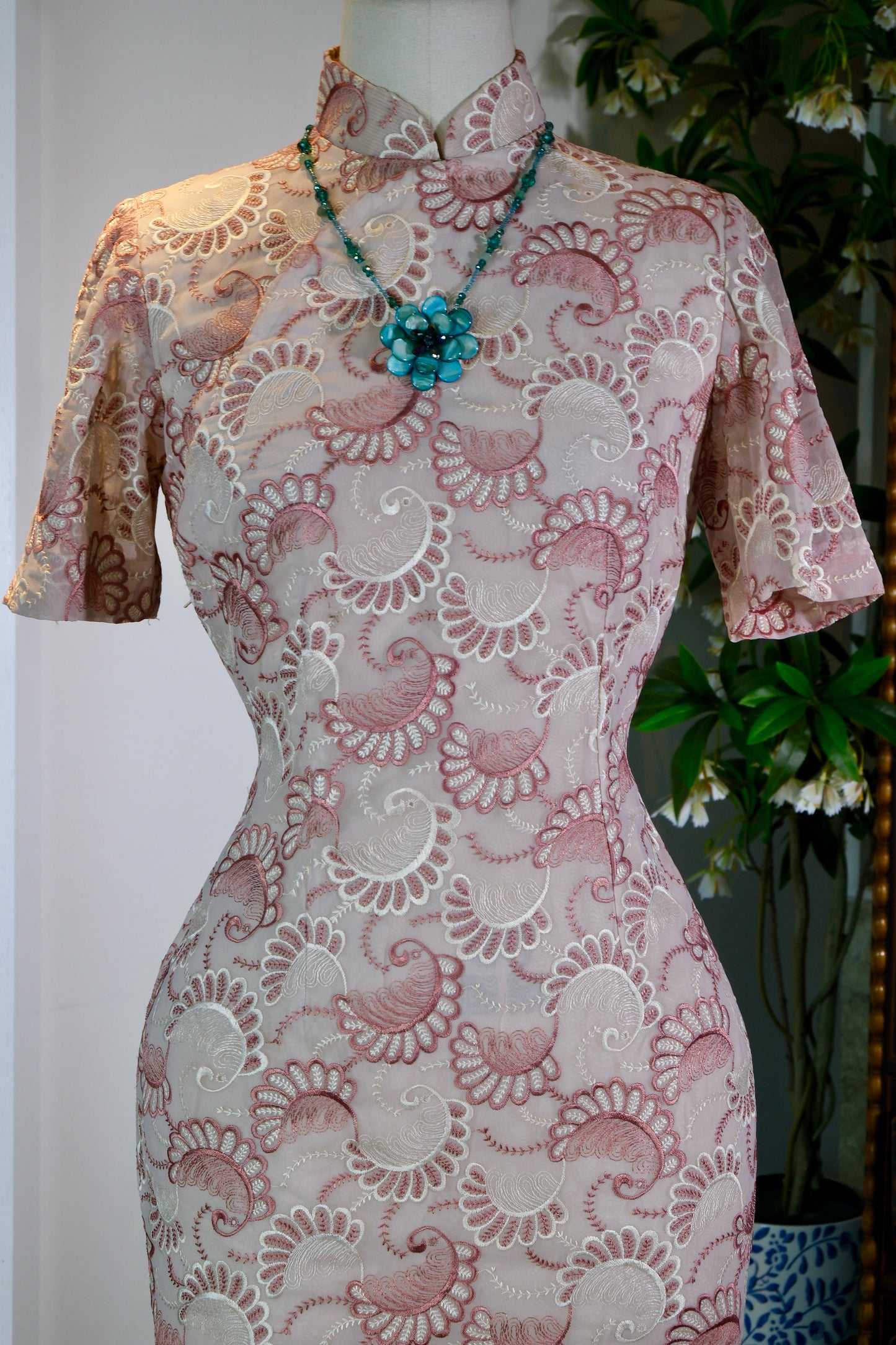
这是一件极具断代研究价值的上世纪五十年代香港产古董旗袍。其最显著的特征在于面料的运用——采用了当时从日本进口的机绣蕾丝(Machine-embroidered Lace)。在服装史的维度上,五十年代的香港正处于东西方文化剧烈碰撞与融合的“黄金时代”。彼时,西方的高级定制理念与东方的传统剪裁技艺在香江交汇,而来自日本的纺织工业技术则为这一时期的旗袍注入了前所未有的轻盈感与现代性。这件旗袍不仅是衣物,更是那个时代“中西合璧、洋为中用”的实物佐证。
【纹样解析:卷草与佩斯利的变奏】
细观衣身图案,这并非传统的中国缠枝莲或龙凤纹样,而是一种经过高度抽象化与几何化的植物卷草纹,兼具“佩斯利”(Paisley)涡纹的韵味。
* 构图逻辑: 图案以二方连续与四方连续的方式铺陈,形成一种流动的视觉韵律。每一个单元纹样都呈扇形或贝壳状展开,内部通过细腻的机绣针法勾勒出叶脉般的纹理。
* 色彩美学: 采用了经典的“粉白双色”搭配。底色为温润的藕粉色(Dusty Pink),象征着女性的柔美与温婉;刺绣线条则使用了纯白色,这种高明度的对比使得图案在视觉上具有浮雕般的立体感,既保留了东方的含蓄,又带有Art Deco(装饰艺术)时期的几何秩序感。
* 文化隐喻: 这种纹样虽源自西方或西亚的装饰母题,但在五十年代的香港,它被巧妙地转化为一种摩登的东方审美。它脱离了封建等级的象征,转而追求纯粹的装饰美感与女性曲线的展示。
【工艺与形制:海派剪裁的巅峰】
作为一件五十年代的港产旗袍,其形制完全遵循了当时最考究的“海派”标准:
1. 立领与归拔: 领口高耸且贴合颈部,这是典型的传统遗存。但请注意腰身的处理,工匠运用了极高超的“归拔”工艺(通过湿热定型改变织物形态),在不使用省道(Darts)或仅使用隐形省道的情况下,完美地塑造出符合人体工学的S型曲线。
2. 袖型设计: 采用了略带弧度的短袖,袖口微微外撇,这种设计能有效修饰大臂线条,露出手腕的纤细,是五十年代职业女性与名媛闺秀通用的经典款式。
3. 蕾丝拼接: 日本进口蕾丝面料质地轻薄通透,为了保持旗袍的挺括,内里必然衬有同色系的真丝或棉质里料。这种双层结构在光影下会产生微妙的朦胧感,正如张爱玲所言:“衣服是一种言语,随身带着的一种袖珍戏剧。”
【历史叙事:香江岁月的吉光片羽】
这件旗袍的故事,应当放置在二战后香港社会转型的宏大背景中去阅读。
五十年代的香港,大量上海裁缝南下,带来了精湛的制版技术;与此同时,国际贸易的复苏使得日本的高品质纺织品得以流入。这件旗袍正是这一历史进程的结晶。想象一下,在那个没有快时尚的年代,一位生活在湾仔或半山的优雅女士,或许是在某家位于中环的老字号洋服店,对着样本挑选了这款来自东瀛的蕾丝面料。她可能穿着它出席过一场在半岛酒店举办的下午茶,或是乘坐天星小轮渡过维多利亚港。
随着时间的推移,蕾丝虽然脆弱,但这件衣服却奇迹般地保存了下来。它见证了香江从转口贸易港向工业化城市的蜕变,也记录了那个时代女性对于美、对于独立、对于现代生活的向往。
【学术总结与稀缺性】
在目前的古董衣收藏市场中,五十年代的丝绒或织锦缎旗袍尚属常见,但保存完好、且采用特定时期日本进口机绣蕾丝面料的旗袍实属凤毛麟角。
原因在于:
1. 材质脆弱性: 人造丝或尼龙混纺的早期蕾丝极易老化脆裂,能历经七十年岁月而绣线不断、色泽不褪,堪称奇迹。
2. 时代特殊性: 这种特定的粉白配色与几何卷草纹样,是五十年代特有的审美符号,后世难以复刻那种神韵。
综上所述,这件旗袍不仅是一件可供穿着的艺术品,更是一份关于二十世纪中叶东亚服饰文化交流的珍贵档案。它以其独特的材质语言和精湛的剪裁工艺,向我们诉说着那个流金岁月的风华绝代。
Measurements / Size Guide:
Bust / Waist / Hips: 90/84/94 cm
Total Length: 97 cm
Detailed Description:
This exceptional artifact holds immense chronological and analytical value for the study of mid-century costume history, operating as a definitive material benchmark for 1950s Hong Kong garment production. Its most historically significant diagnostic attribute lies in its daring material taxonomy: the strategic employment of imported Japanese machine-embroidered lace.
In the broader trajectory of textile history, 1950s Hong Kong stood as an electrified, high-velocity crucible where Eastern heritage and Western modernist currents collided. During this post-war "Golden Age," Western haute couture drafting philosophies integrated seamlessly with traditional Chinese sartorial disciplines, while cutting-edge textile innovations from a recovering post-war Japanese industrial complex injected an unprecedented lightness, breathability, and structural fluidity into the classic qipao silhouette. This garment transcends its utilitarian purpose as apparel; it functions as a primary material testament to the historical ethos of “Zhongxi Hebi, Yangwei Zhongyong” (The Harmonious Synthesis of East and West; Adapting Foreign Innovations for Eastern Expression).
A close-range formal analysis of the surface ornamentation reveals a profound departure from the classical Chinese design vocabulary of stylized dragons, phoenixes, or traditional intertwined lotuses. Instead, the textile showcases a highly abstracted, geometrically stylized iteration of scrolling foliage (Juan Caowen) that consciously borrows the visual cadence and curvilinear tension of the Western Paisley motif.
Compositional Logic and Spatial Symphony: The decorative scheme utilizes rigorous two-way and four-way continuous pattern repeats (Erfang Lianxu / Sifang Lianxu) to map a liquid, rhythmic cadence across the anatomical planes. Each discrete design cell blossoms outward in an elegant fan or scallop shell configuration. Within these borders, miniature, hyper-fine machine embroidery stitches trace delicate organic veins, generating a complex, high-density surface micro-texture.
The Aesthetics of Palette and Contrast: The textile employs a masterful, highly restrained dual-tone chromatic strategy: Dusty Pink and Pure White. The base chassis is rendered in a warm, muted, almost jade-like dusty pink (lotus-root pink), a classic material signifier of Eastern feminine grace, internal cultivation, and serene modesty. This is juxtaposed against high-luminance, crisp white embroidery lines. This sharp tonal contrast creates a striking, low-profile dimensional relief across the fabric face. The resulting visual language balances the spatial depth of traditional relief carving with the crisp, geometric order characteristic of the late Art Deco movement.
Sociological and Cultural Metaphor: While these ornamental themes derive directly from Western and West Asian decorative lineages, 1950s Hong Kong design circles successfully translated them into a thoroughly modern, cosmopolitan Eastern aesthetic. By stripping these motifs of traditional feudal hierarchy and imperial symbolism, the garment reorients its focus entirely toward pure decorative beauty and the celebration of the organic female silhouette.
As a premier exemplar of 1950s Hong Kong craftsmanship, the structural architecture of this qipao strictly aligns with the highest, most uncompromising standards of the Shanghai-Style (Haipai) tailoring guilds.
The High Collar and the Physics of Gui-Ba Fabric Manipulation: The garment features a towering, strictly perpendicular stand-up collar that wraps seamlessly against the neck—a proud, monumental survival of traditional Chinese styling. However, the true marvel of its construction lies in the engineering of the torso. Rather than relying on conspicuous, disruptive Western-style darts, the master artisan deployed the ultimate tier of "Gui-Ba" processing (Gui-Ba Gongyi). Through a grueling sequence of high-temperature moisture iron-shaping, the tailor physically altered the molecular tension of the textile fibers, forcing a flat fabric plane to memorize the complex, three-dimensional curves of the female anatomy. The result is an flawless "S-curve" profile achieved via entirely hidden, invisible shaping mechanics.
Ergonomic Sleeve Engineering: The short sleeves are executed with a highly controlled, subtle geometric arc, flaring slightly outward at the cuff. This specific drafting intervention is highly strategic: it softens the muscular contour of the upper arm while visually accentuating the slenderness of the wearer’s wrist. This profile stood as the universal sartorial uniform for the era's sophisticated career women, socialites, and literary elite.
The Multi-Layered Dynamics of Lace Joining: Given the translucent, hyper-delicate, and ethereal quality of the imported Japanese lace, the structural integrity of the qipao is reinforced by a secondary, perfectly color-matched underlay of premium silk or fine-gauge cotton lining. This sophisticated double-layer architecture catches and refracts ambient light to generate a mysterious, painterly chiaroscuro effect across the skin—vividly capturing the sentiment of Eileen Chang's famous literary maxim: "Clothing is a pocket cinema that one carries on their person."
The historical biography of this garment must be read against the sweeping socioeconomic backdrop of post-World War II Hong Kong.
The 1950s witnessed a monumental southern migration of master tailors fleeing Shanghai, a movement that permanently relocated the elite technical secrets of Haipai pattern-making to the shores of the colony. Concurrently, the swift revitalization of maritime trade networks allowed ultra-premium textiles from Japan to flood the local market. This qipao represents the absolute intersection of these two historical forces.
One can readily envision the social life of this garment in an era entirely untouched by the homogenization of fast fashion: an elegant lady residing in Central, Mid-Levels, or Wan Chai, visiting an elite tailoring establishment in the heart of Central. There, she would meticulously select this avant-garde East Asian lace from imported sample books. She would have inhabited this textile architecture while attending afternoon tea at the Peninsula Hotel, or while leaning against the railings of a Star Ferry crossing Victoria Harbour amidst the evening mist. Though the lace itself is inherently fragile, the garment has survived the decades in miraculous, museum-quality preservation. It remains a silent, monumental archive of Hong Kong's economic evolution from an entrepôt trade port into a vibrant industrial powerhouse, tracking a historical generation of women who pursued individual beauty, autonomy, and a modern lifestyle.
Within the contemporary international market for antique clothing and museum-grade textile curation, while 1950s silk velvets and heavy brocade jacquards remain relatively accessible, a pristine, unaltered qipao utilizing verified 1950s imported Japanese machine-embroidered lace is an absolute anomaly of the highest rarity.
This extreme scarcity is governed by two critical archival factors:
The Material Vulnerability of Early Synthetics: Early iterations of post-war lace, often composed of delicate rayon or early nylon-blend matrices, are exceptionally prone to atmospheric oxidation, brittle cracking, and fiber decay. For a specimen to survive nearly seventy years of environmental timelines with its embroidery strands entirely unbroken and its delicate dusty-pink coloration completely unfaded is nothing short of an archival miracle.
The Temporal Specificity of the Visual Design: This precise dusty-pink and stark white color configuration, coupled with the hybridized geometric-foliage paisley layout, operates as an irreplaceable aesthetic signature unique to the 1950s. The specific artisanal aura and manufacturing patina of this era remain completely inimitable by modern textile reproduction methods.
In conclusion, this qipao is far more than a wearable object of fine art; it stands as a pristine, cross-cultural archive documenting the mid-century textile dialogue across East Asia. Through its sophisticated material language and uncompromising tailoring physics, it preserves the timeless, uncompromised glamour of a golden era.